Questions 4 to 7: the 3° glide path
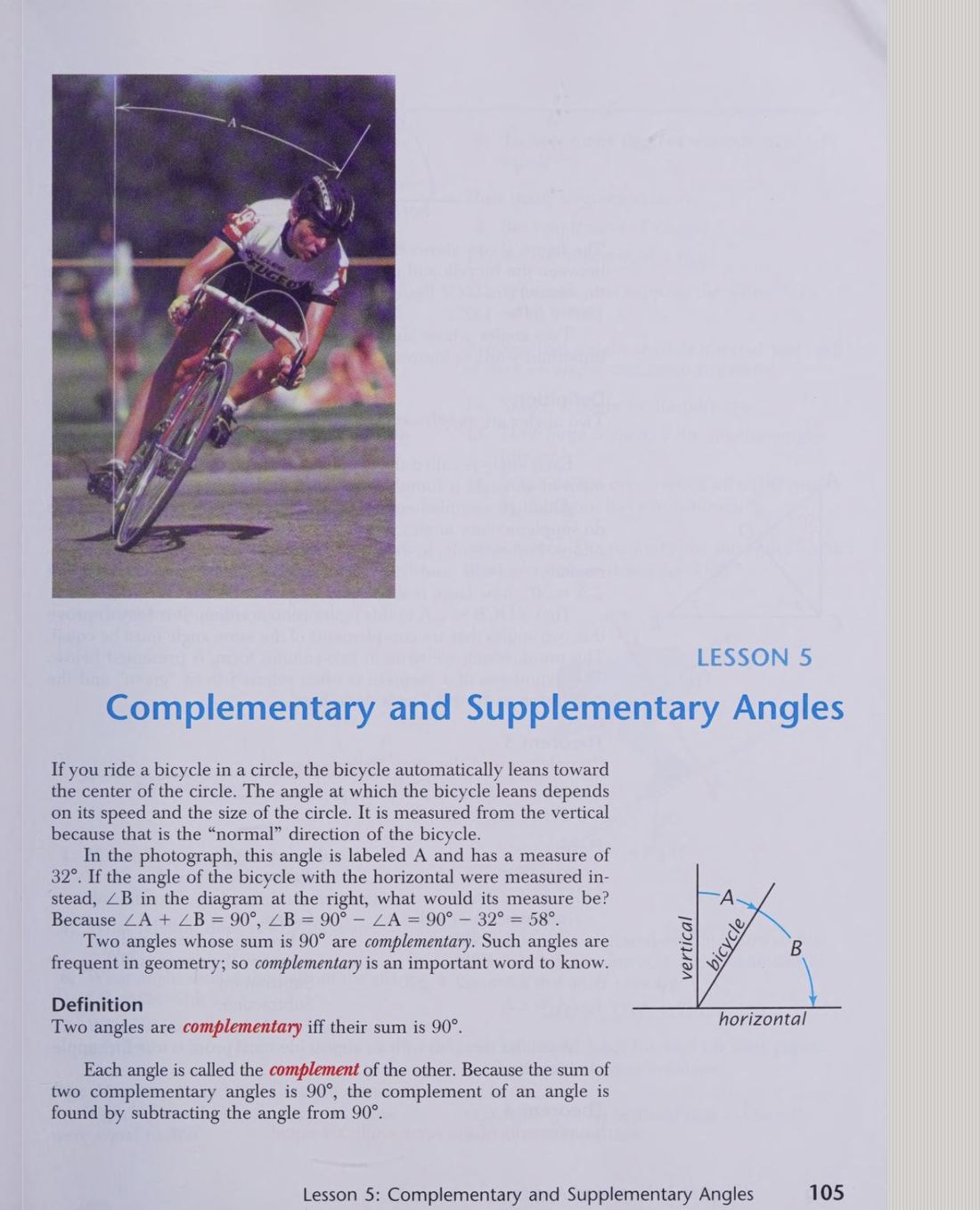
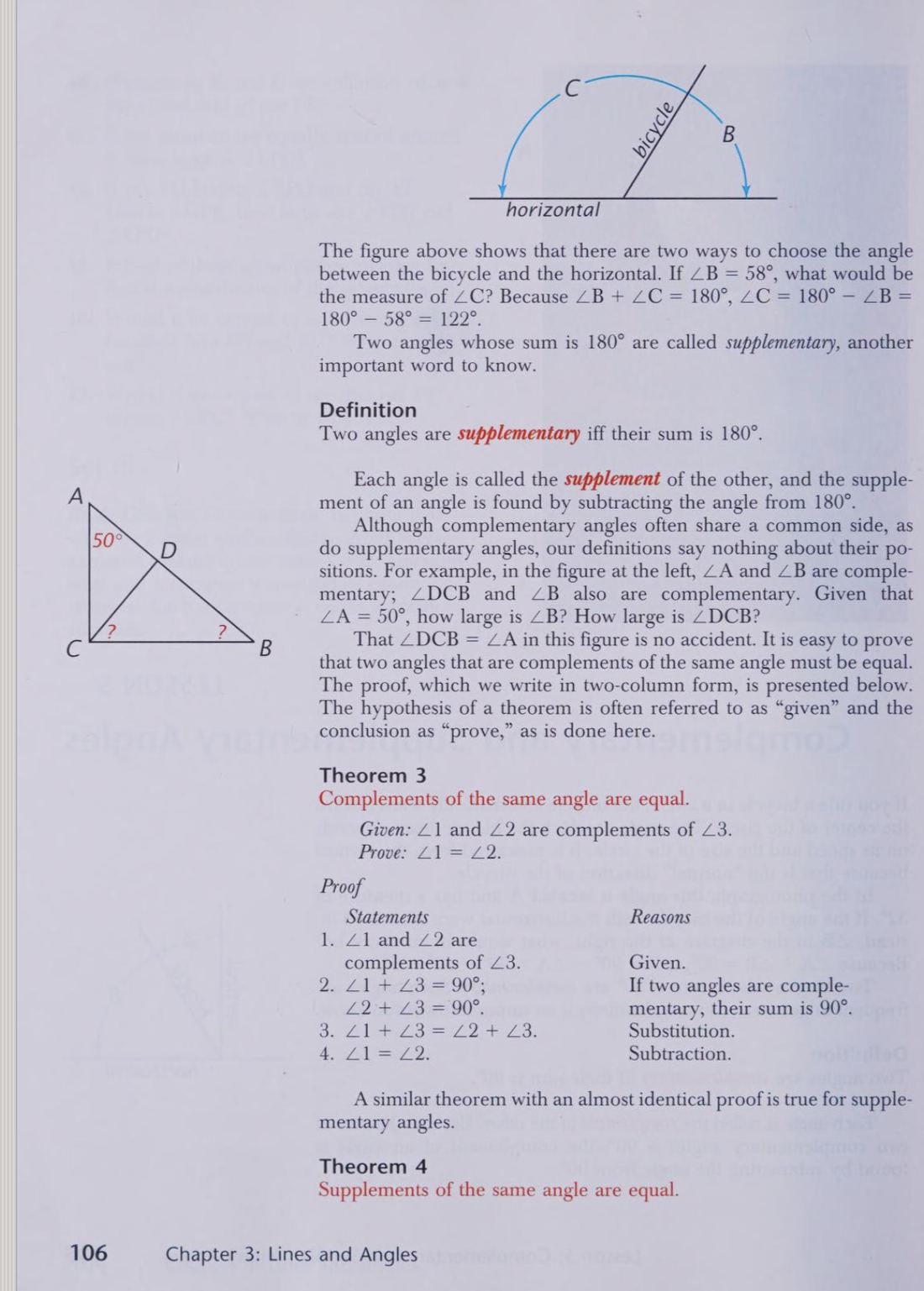
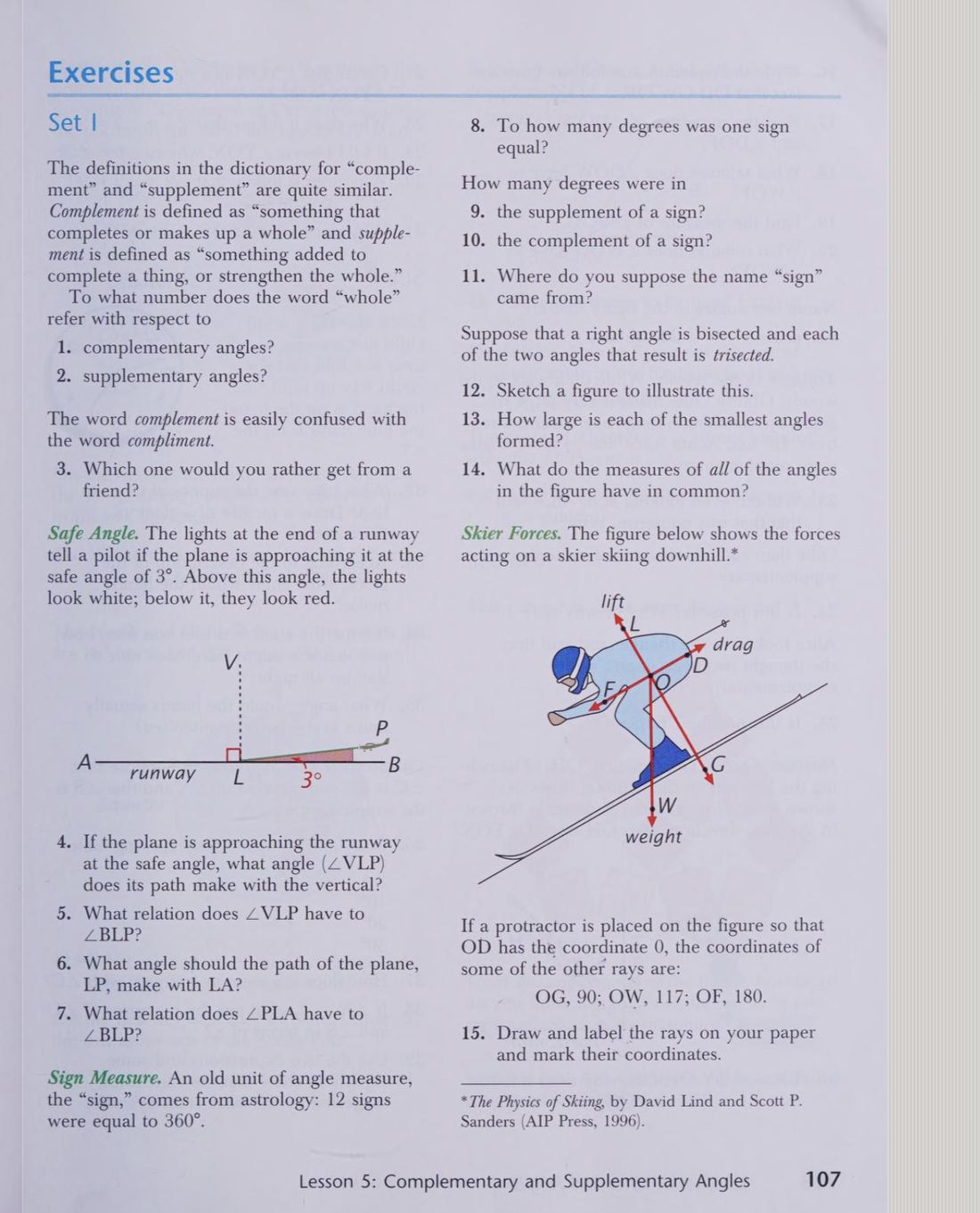
A plane approaches the runway at the safe angle of 3° above the horizontal (angle BLP). What angle does its path make with the vertical VL, what should ∠PLA be, and how do these angles relate to ∠BLP?
- Question 4: vertical and horizontal are 90° apart, so ∠VLP = 90 − 3 = 87°.
- Question 5: 87 + 3 = 90, so ∠VLP and ∠BLP are complementary, by the page 105 definition.
- Question 6: A lies along the runway on the other side of L, so ∠PLA stretches from the path to the opposite ray: 180 − 3 = 177°.
- Question 7: 177 + 3 = 180, so ∠PLA and ∠BLP are supplementary.
- Self-check the pattern: one 3° angle generated an 87 and a 177, complement and supplement, subtractions from 90 and from 180. The table on page 108 (questions 36 to 39) will show the supplement always beats the complement by exactly 90, and here it does: 177 − 87 = 90.
Questions 26 to 31: the ideal hammer throw
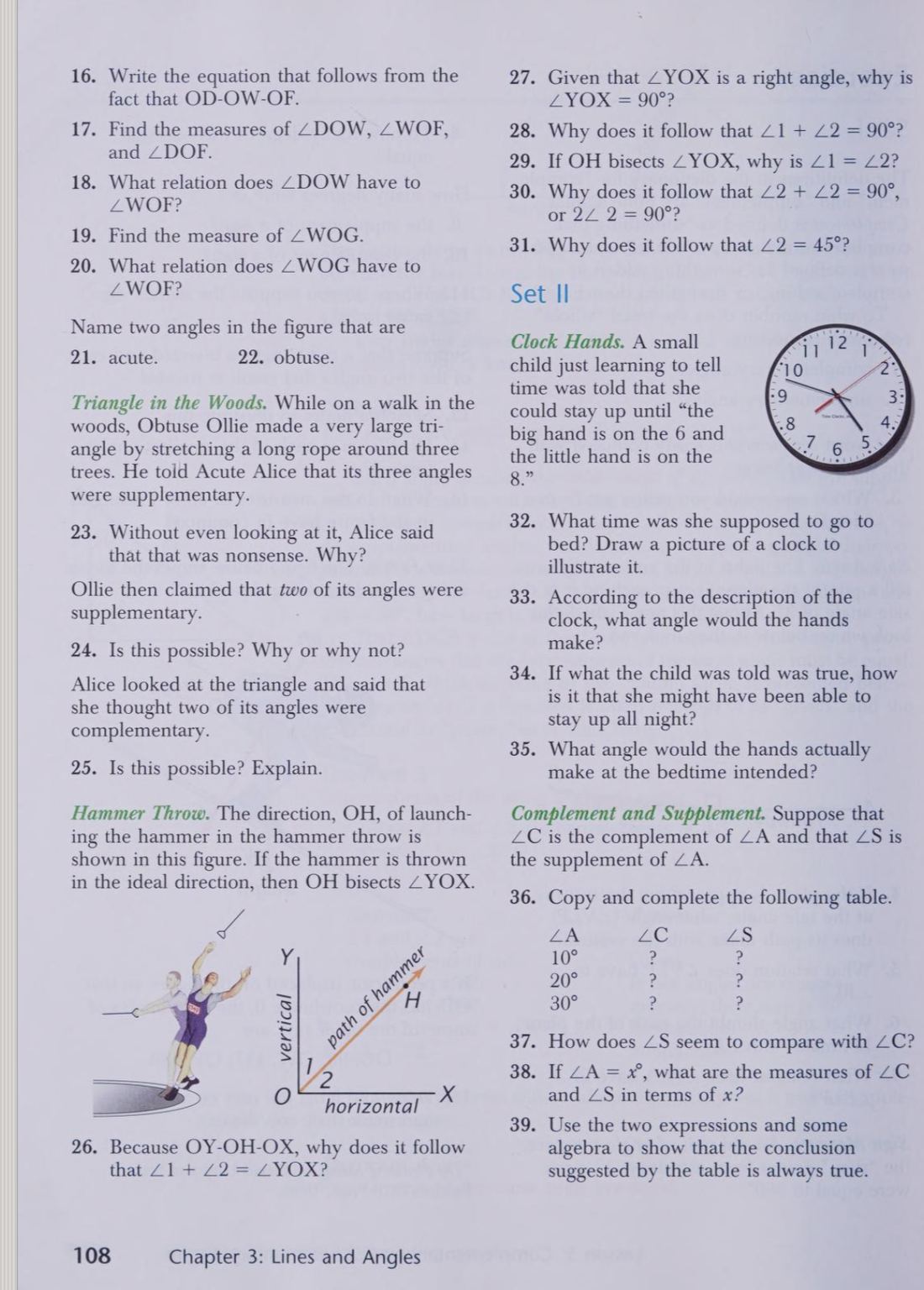
OH bisects the right angle YOX between vertical and horizontal. Supply the reason for each step proving ∠2 = 45°.
- Question 26: OY-OH-OX, so ∠1 + ∠2 = ∠YOX by the Betweenness of Rays Theorem.
- Questions 27 and 28: ∠YOX is a right angle, and a right angle is 90° by definition; substitute to get ∠1 + ∠2 = 90°. (In this lesson's language: the launch angles are complementary.)
- Question 29: OH bisects ∠YOX, and a bisecting line divides an angle into two equal angles, so ∠1 = ∠2.
- Question 30: substitute ∠2 for ∠1: ∠2 + ∠2 = 90°, so 2∠2 = 90°.
- Question 31: divide both sides by 2: ∠2 = 45°. The ideal throw leaves at 45° above the horizontal, and the proof is the miter joint of page 103 with a hammer in it. Physics agrees about maximum range, but notice geometry got there with no physics at all.
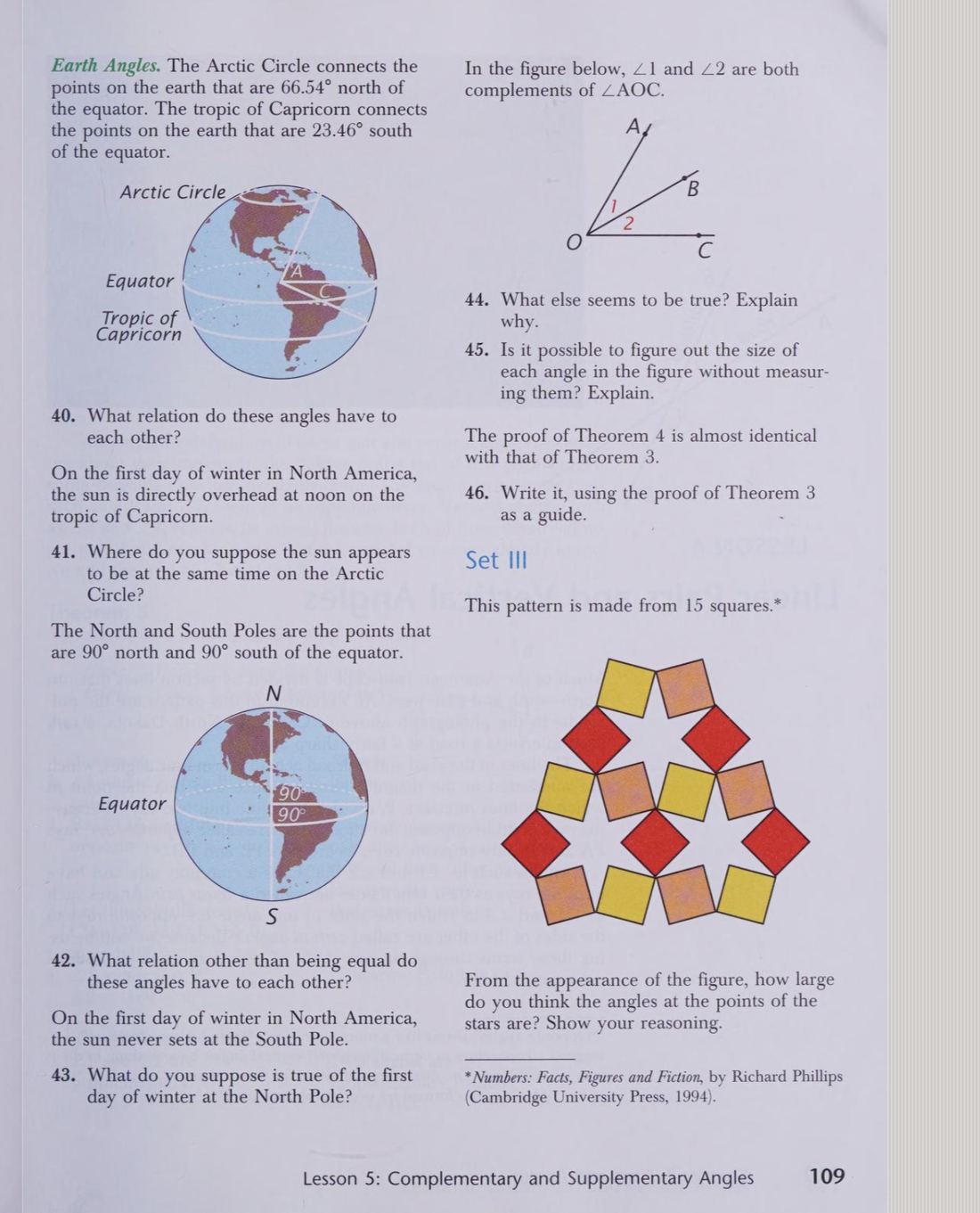
Question 46: proving Theorem 4
Supplements of the same angle are equal. Given: ∠1 and ∠2 are supplements of ∠3. Prove: ∠1 = ∠2. Write the two-column proof, using Theorem 3's proof as the guide.
- Statement 1: ∠1 and ∠2 are supplements of ∠3. Reason: Given.
- Statement 2: ∠1 + ∠3 = 180° and ∠2 + ∠3 = 180°. Reason: if two angles are supplementary, their sum is 180° (the definition).
- Statement 3: ∠1 + ∠3 = ∠2 + ∠3. Reason: substitution, since both sides equal 180°.
- Statement 4: ∠1 = ∠2. Reason: subtraction, taking ∠3 from both sides.
- Compare line by line with Theorem 3 on page 106: one number changed. That near-identity is worth noticing as a habit; when two theorems differ by a constant, one proof is both proofs, and page 112 is about to lean on this theorem to prove vertical angles equal.
Questions 1 and 2: the folding chair
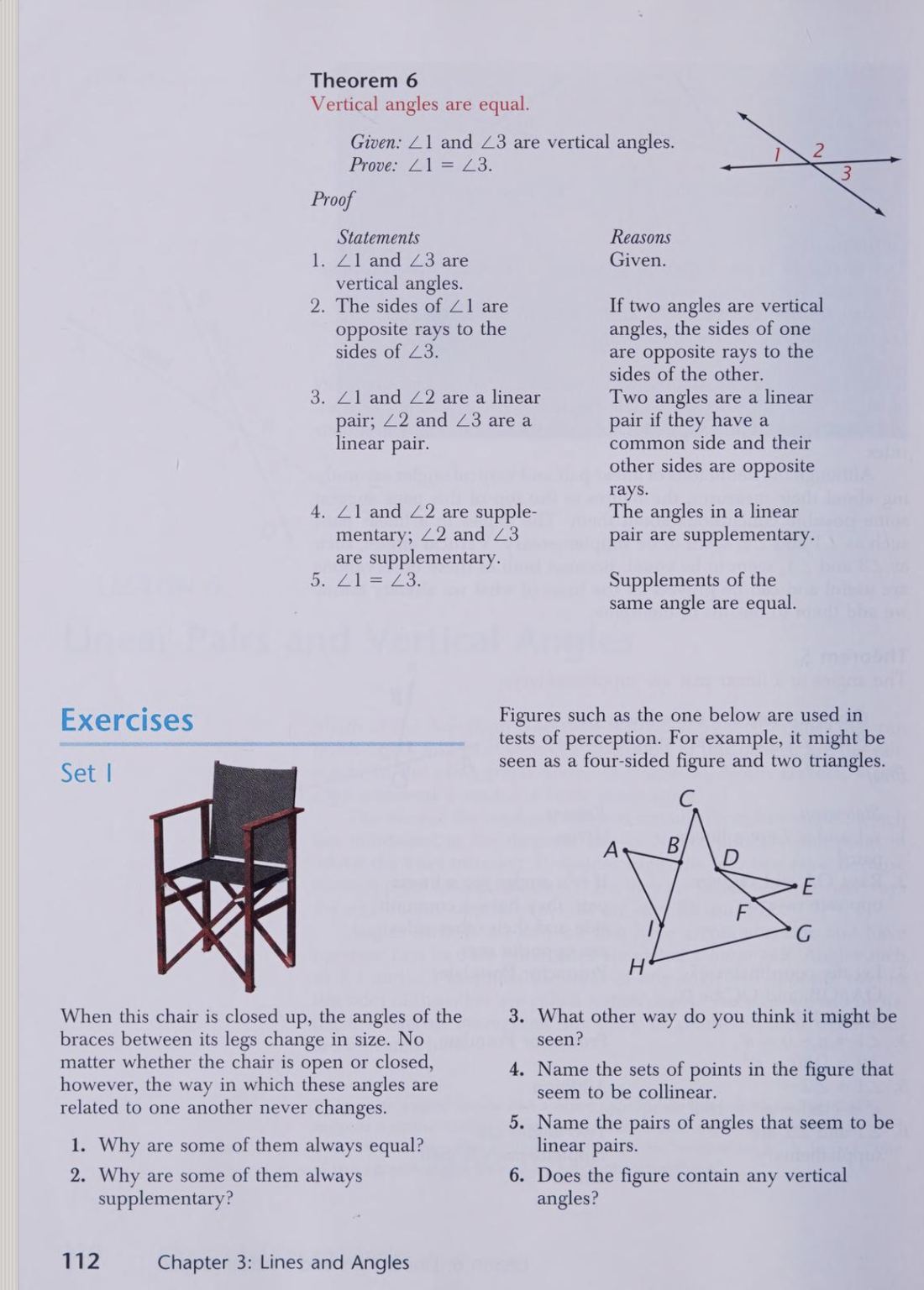
The chair's leg braces cross like scissors. As the chair opens and closes, why are some brace angles always equal, and some always supplementary?
- Model the braces: two straight braces crossing at a pivot are two intersecting lines, making four angles at every opening width.
- Question 1: the angles across the pivot from each other are vertical angles, and Theorem 6 says vertical angles are equal, at every position of the chair. Which numbers they equal changes as the chair folds; that they are equal never does.
- Question 2: adjacent angles at the pivot share a side, and their other sides run opposite ways along one brace: a linear pair. Theorem 5 makes each such pair supplementary, again at every position.
- The punchline to carry: the theorems are about the crossing, not the crossing angle. Open the chair 10 degrees or 80 and both facts hold, which is why the book keeps saying proofs buy every case at once. The hedge shears on page 115 run the same idea with a subtraction twist.
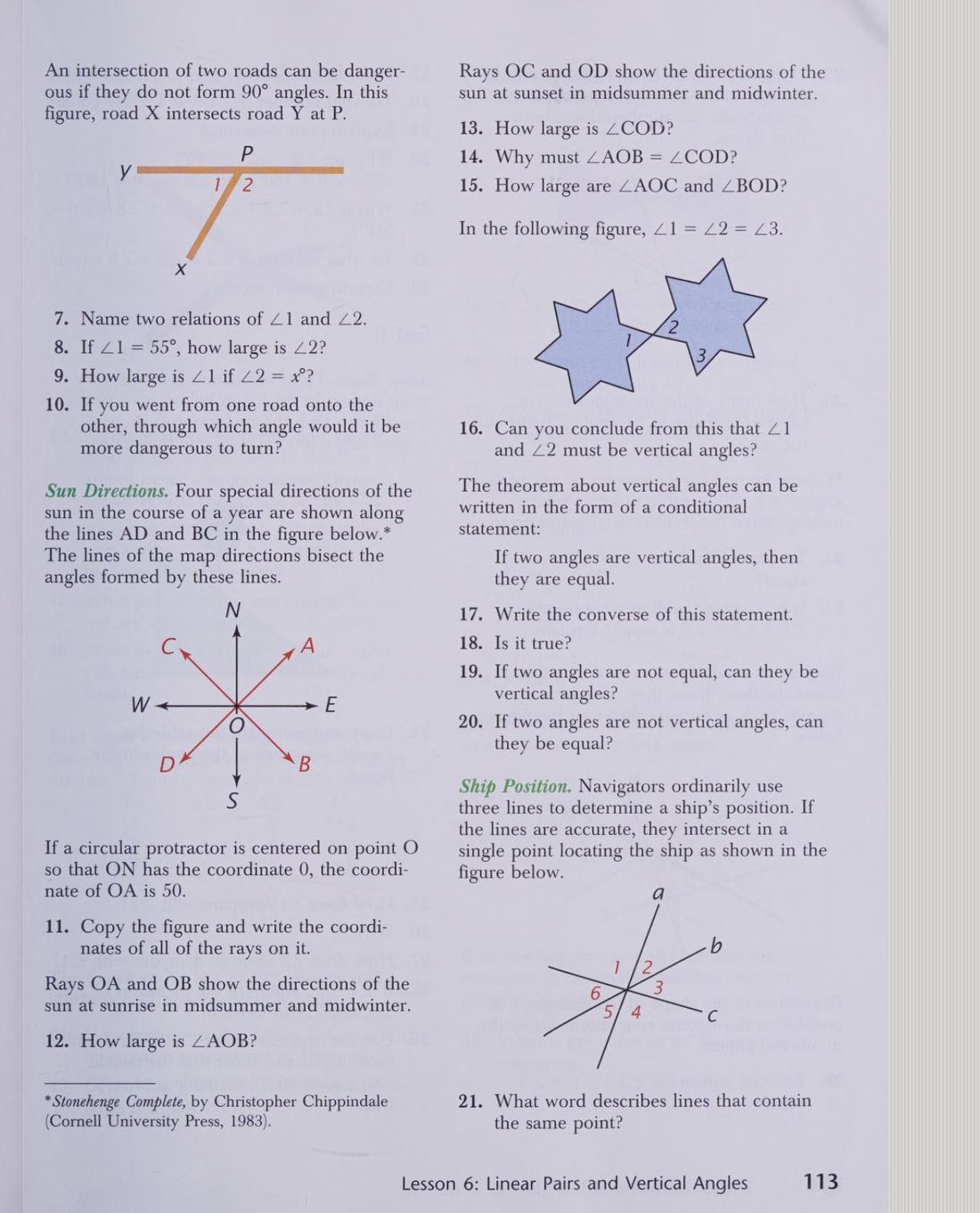
Questions 11 to 15: the solstice sun
Lines AD and BC mark midsummer and midwinter sunrise and sunset; the compass directions bisect the angles they form. With a circular protractor at O, ON = 0 and OA = 50. Find every coordinate, then ∠AOB, ∠COD, ∠AOC, and ∠BOD.
- OE (due east, 90) bisects ∠AOB, so B sits as far past east as A sits before it: ∠AOE = 40, so OB = 130.
- Opposite rays differ by 180 on a circular scale: A and D are the same line (line AD), so OD = 230; B and C likewise give OC = 310. The compass rays fill in at 0, 90, 180, 270.
- Question 12: ∠AOB = 130 − 50 = 80°. Question 13: ∠COD = 310 − 230 = 80°.
- Question 14: they had to match: sunrise pair and sunset pair are vertical angles (each side of one is the opposite ray of a side of the other), and Theorem 6 says equal. The bisecting compass directions were a hint, not a necessity.
- Question 15: ∠AOC and ∠BOD are the other vertical pair: each is 180 − 80 = 100° by Theorem 5. Check the family: 80 + 100 = 180 twice over, and the four angles sum to 360 around O. Stonehenge's builders aligned stones on exactly these lines four thousand years before the theorem had a number.
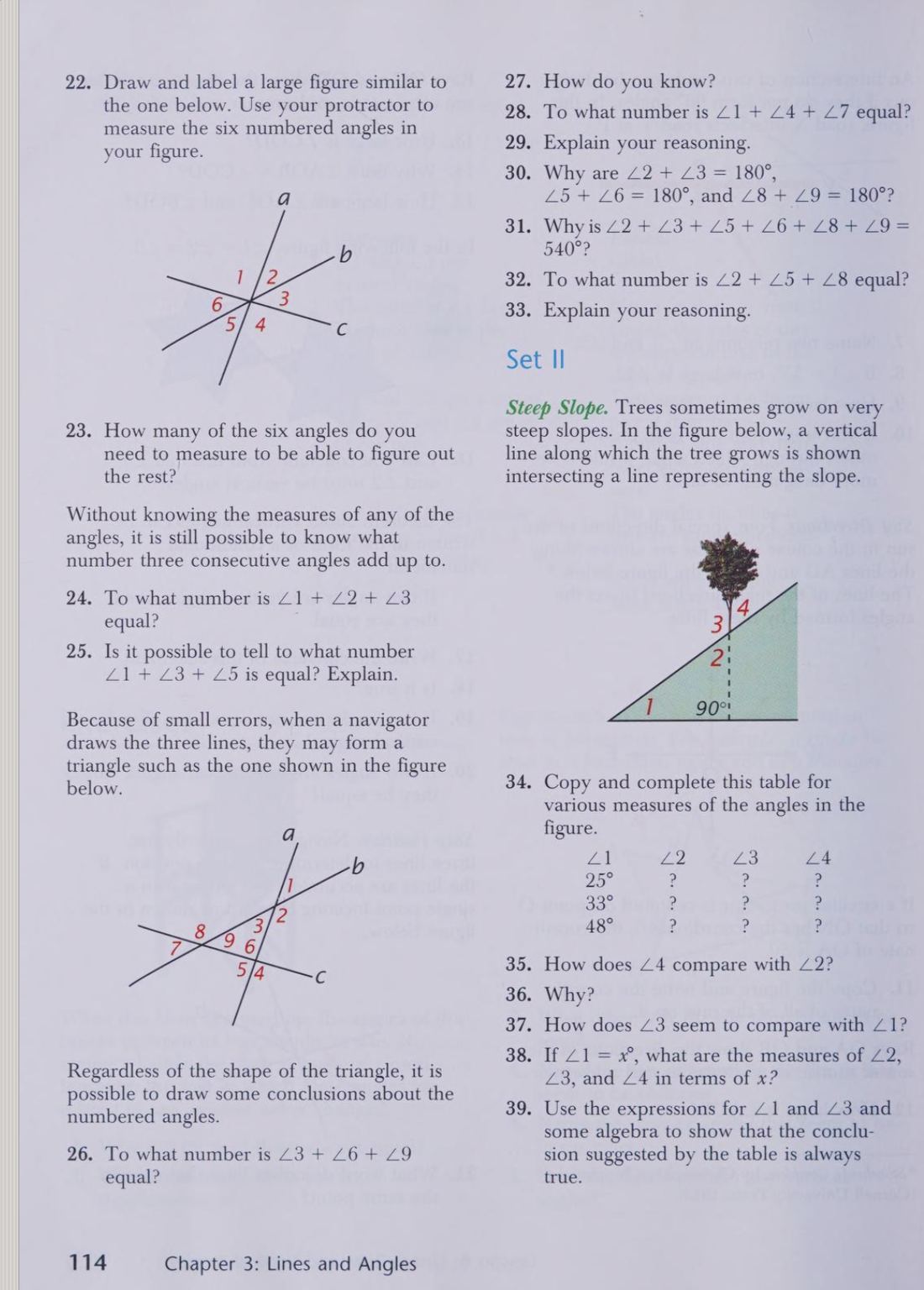
Questions 26 to 33: the navigator's triangle
Three slightly-off position lines form a small triangle with nine numbered angles: interior angles 3, 6, 9, and pairs 1-2, 4-5, 7-8 around each corner. Find the totals asked for.
- Questions 26 and 27: angles 3, 6, 9 are the little triangle's interior angles, so ∠3 + ∠6 + ∠9 = 180° by the Triangle Angle Sum Theorem from page 66.
- Questions 28 and 29: at each corner, the angle numbered 1 (or 4, or 7) is the vertical angle of the triangle's interior angle there, equal by Theorem 6. Three vertical copies of the interior angles: ∠1 + ∠4 + ∠7 = 180° too.
- Question 30: each remaining pair (∠2 with ∠3, ∠5 with ∠6, ∠8 with ∠9) is a linear pair along one of the position lines, so each sums to 180° by Theorem 5.
- Question 31: add the three linear-pair equations: ∠2 + ∠3 + ∠5 + ∠6 + ∠8 + ∠9 = 540°.
- Questions 32 and 33: subtract step 1's 180 from the 540: ∠2 + ∠5 + ∠8 = 360°. Every total came from exactly three theorems, and none required measuring a single angle of a figure drawn by a shaky hand at sea, which is rather the point of having theorems.
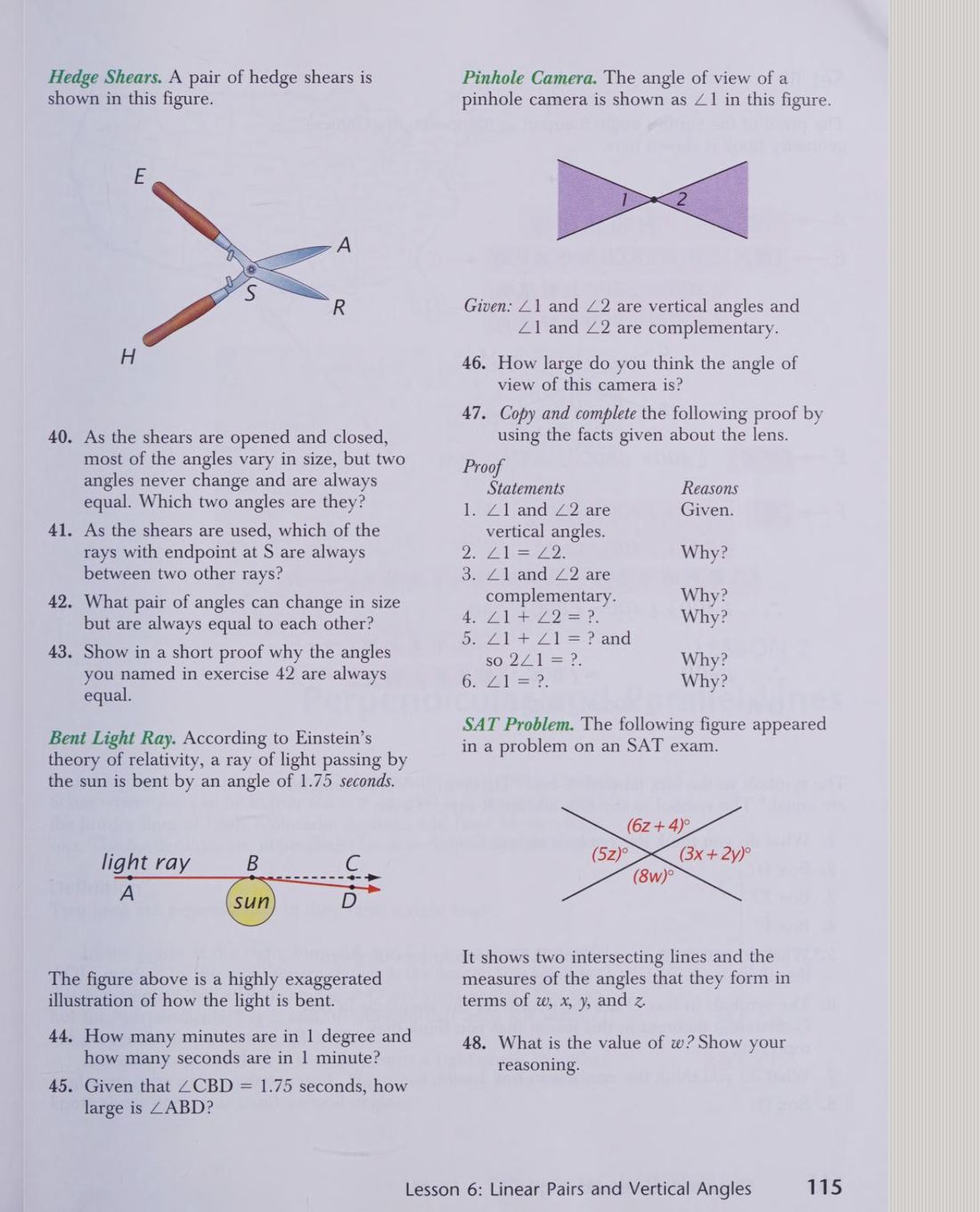
Questions 46 and 47: the pinhole camera
∠1 and ∠2 are vertical angles, and they are also complementary. Complete the proof and find the camera's angle of view.
- Line 2: ∠1 = ∠2. Reason: vertical angles are equal, Theorem 6.
- Line 4: ∠1 + ∠2 = 90°. Reason: two complementary angles sum to 90°, the definition from page 105.
- Line 5: substitute ∠1 for ∠2: ∠1 + ∠1 = 90°, so 2∠1 = 90°. Reason: substitution.
- Line 6: ∠1 = 45°. Reason: division property. Question 46's answer: the angle of view is 45°.
- Notice the proof's shape is page 108's hammer throw with the bisector swapped for Theorem 6: whenever two equal angles must share a fixed total, each is half of it. You now own that argument in three costumes.
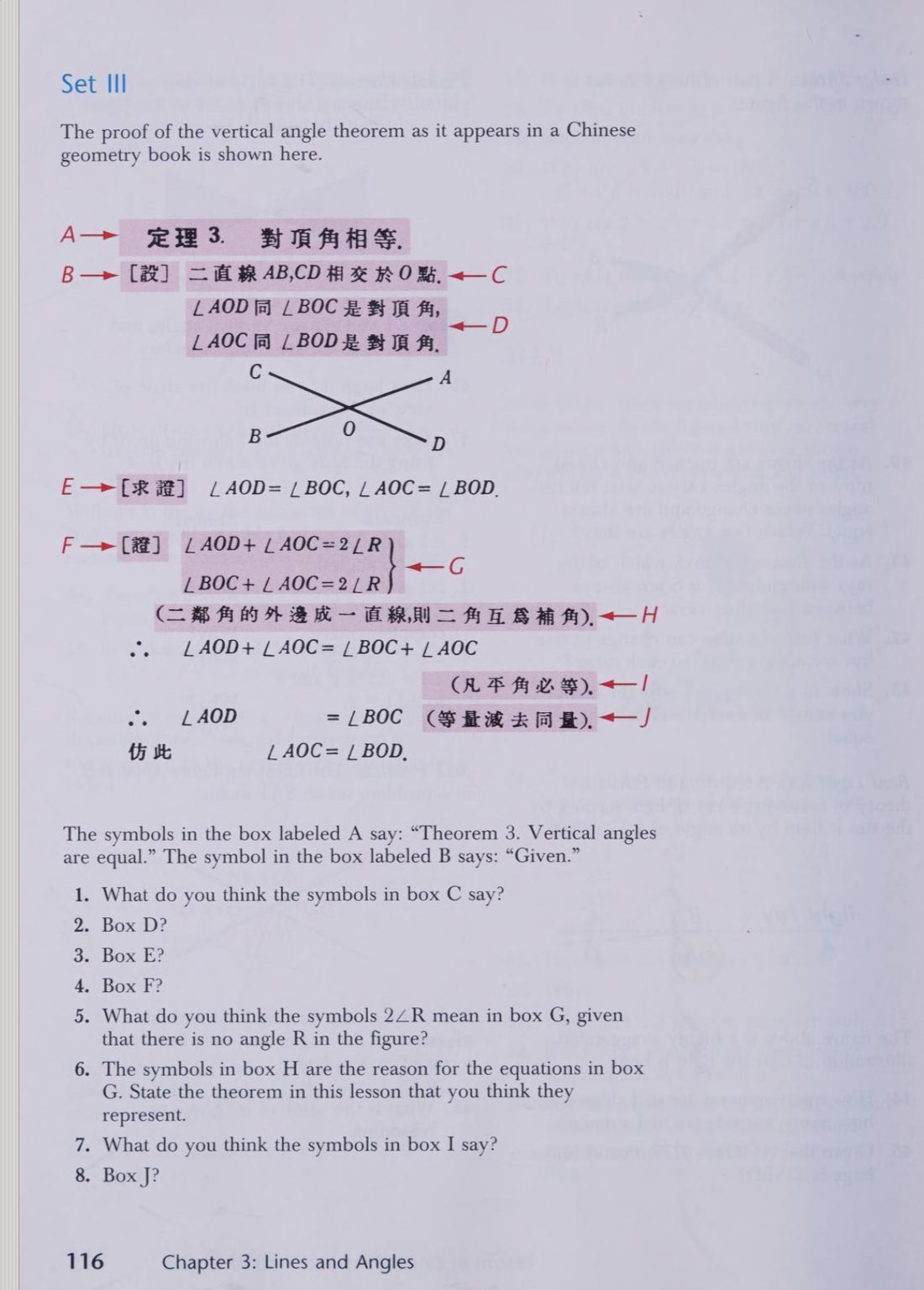
Set III: reading the Chinese proof
Boxes A and B are translated for you ("Theorem 3. Vertical angles are equal" and "Given"). Reconstruct C through J.
- Box C sits with the given figure setup: "Two lines AB and CD intersect at point O." Box D finishes the given: "∠AOD and ∠BOC are vertical angles; ∠AOC and ∠BOD are vertical angles."
- Box E introduces the goal, our "Prove:" (the equations after it are exactly Theorem 6's conclusion), and box F is "Proof."
- Box G's equations say ∠AOD + ∠AOC = 2∠R and ∠BOC + ∠AOC = 2∠R. Question 5: 2∠R is two right angles, 180°. Box H, the reason: angles whose outer sides form a straight line are supplementary, our Theorem 5, the linear pair theorem.
- Box I justifies setting the two sums equal: quantities equal to the same quantity are equal, our substitution step.
- Box J justifies dropping ∠AOC from both sides: equals subtracted from equals leave equals, the subtraction property, and the proof ends where page 112's did. Same theorems, same order, same logic, different alphabet; Euclid's system is the shared language.