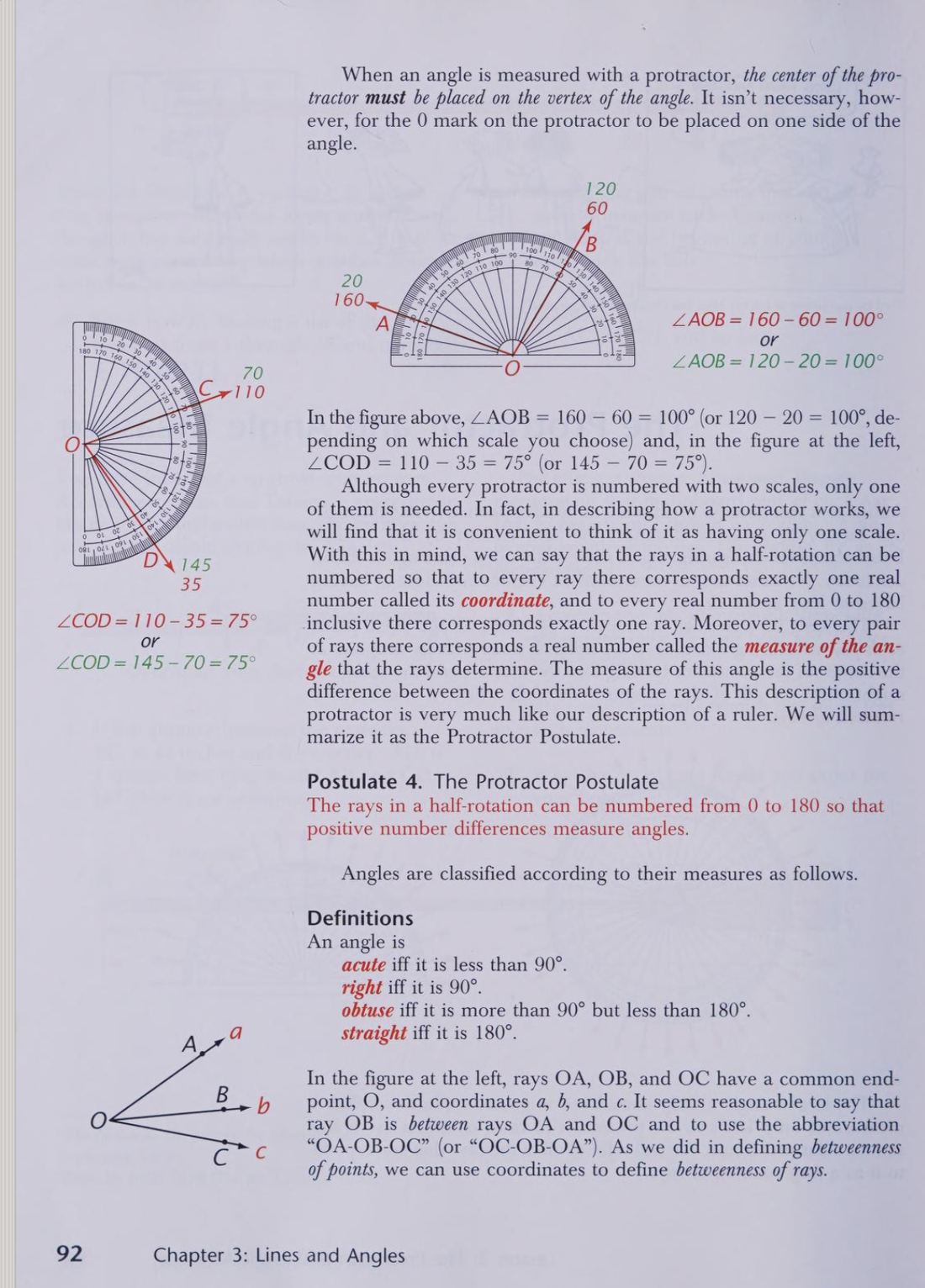
Questions 4 to 7: rays HE, HI, and HO
Ray HE has coordinate 81, ray HI has 18, ray HO has 180. Which ray is between the other two? Find the three angles, and name the statement that justifies each answer.
- Question 4: compare coordinates, not the picture: 18 < 81 < 180, so ray HE is between rays HI and HO. Reason (question 6): the definition of betweenness of rays.
- Question 5: subtract coordinates pairwise. ∠IHE = 81 − 18 = 63°.
- ∠EHO = 180 − 81 = 99°.
- ∠IHO = 180 − 18 = 162°.
- Check the sum: 63 + 99 = 162, and the statement that promised it (question 7) is the Betweenness of Rays Theorem. Also classify while you are here, using page 92: 63° acute, 99° obtuse, 162° obtuse. Drawing the figure with your protractor makes all three subtractions visible.
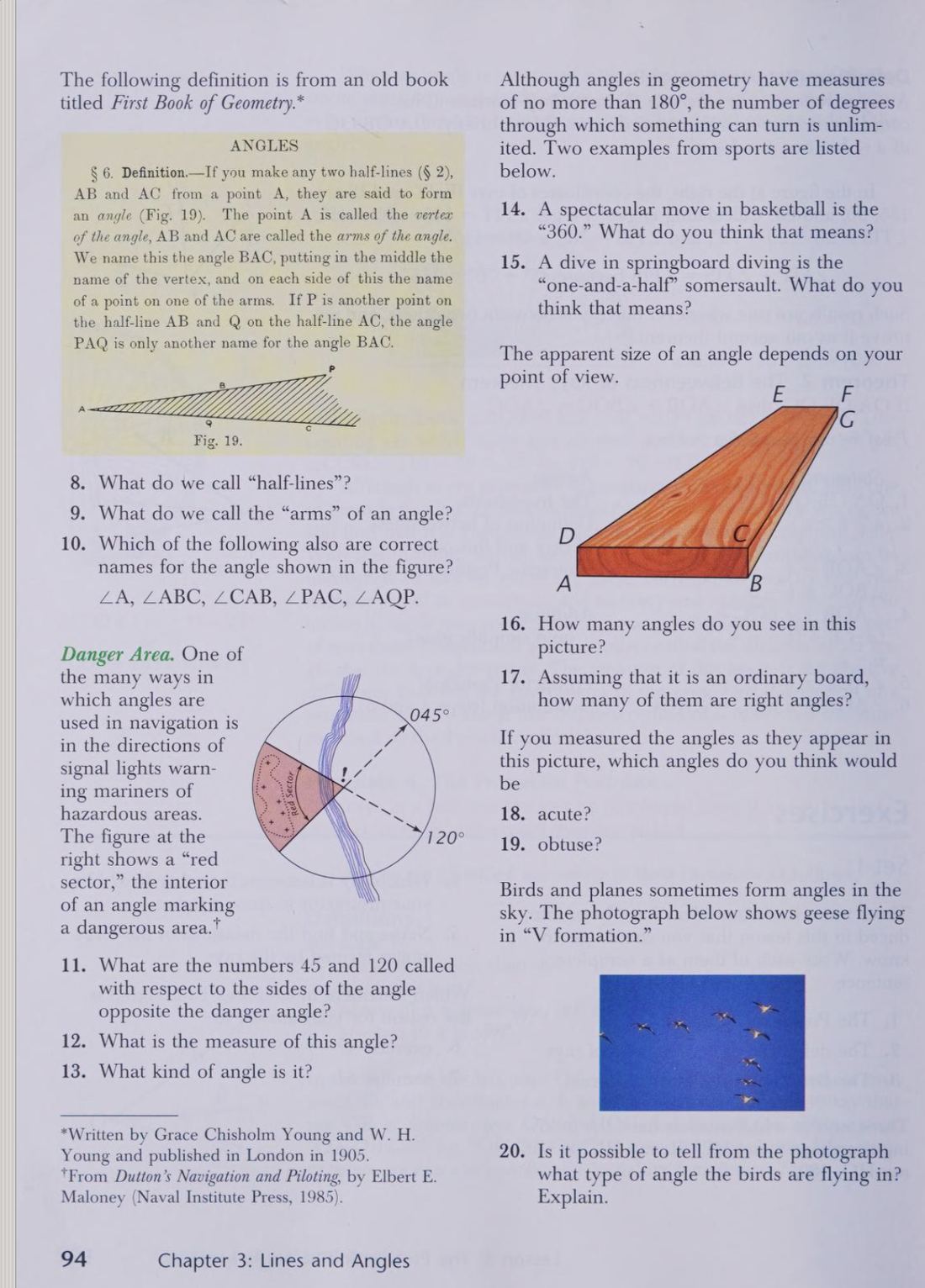
Questions 11 to 13: the red sector
A signal light's danger area lies between bearings 045° and 120°. What are those two numbers with respect to the sides of the angle? What is the angle's measure, and what kind of angle is it?
- Question 11: the chart is a circular protractor centered on the light, so 45 and 120 are the coordinates of the angle's two sides, exactly as in Postulate 4.
- Question 12: measure = positive difference of coordinates: 120 − 45 = 75°.
- Question 13: classify with page 92's definitions: 75 is less than 90, so the danger angle is acute.
- Self-check the setup: a mariner reads those same numbers off a compass card, and the subtraction they do at sea is the Protractor Postulate verbatim. Runway numbers on page 95 will be the same idea divided by ten.
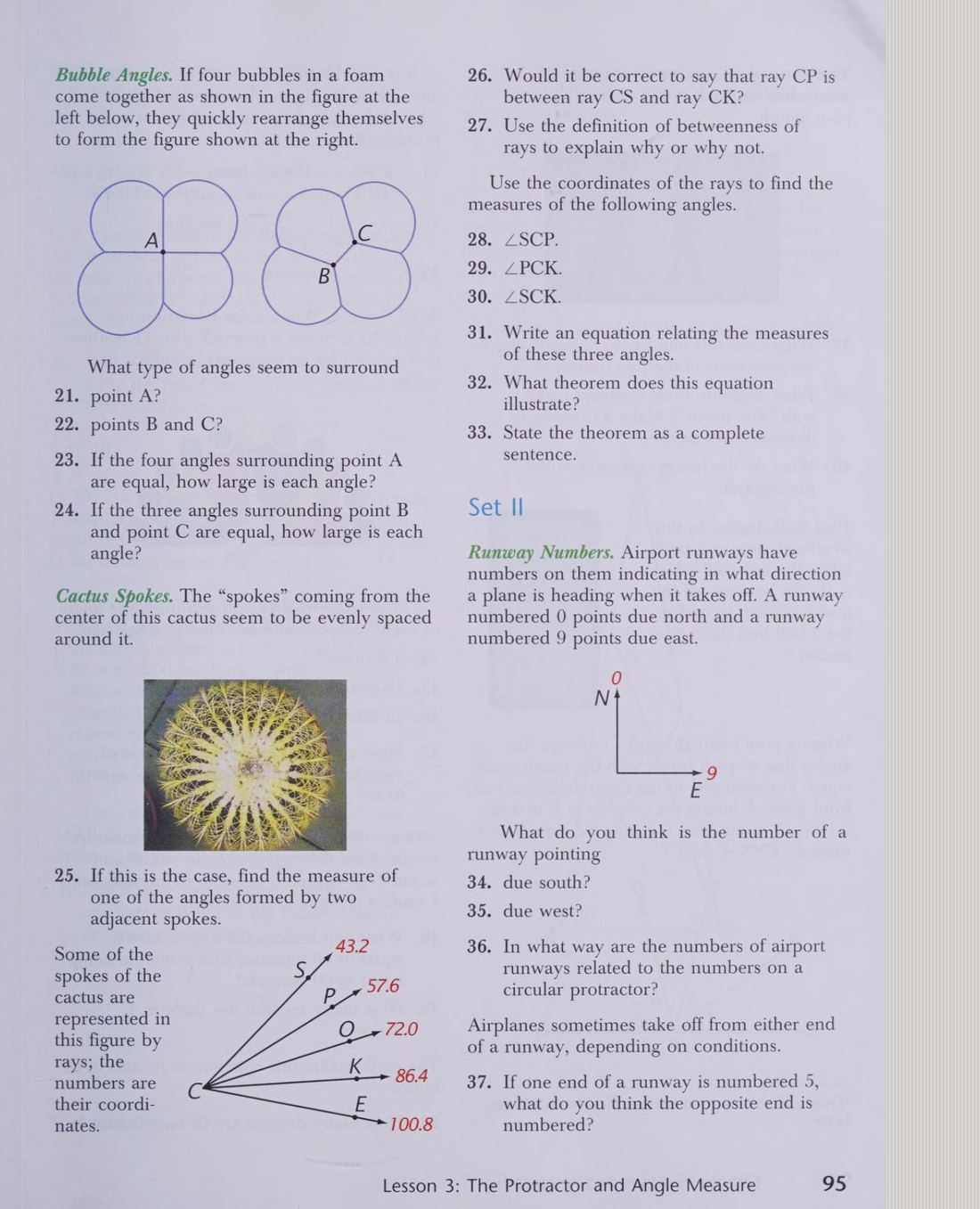
Questions 26 to 33: the cactus spokes
Rays CS, CP, CK have coordinates 43.2, 57.6, 86.4. Is ray CP between rays CS and CK? Find ∠SCP, ∠PCK, and ∠SCK, write the equation relating them, and name the theorem it illustrates.
- Questions 26 and 27: test the definition, not the picture: 43.2 < 57.6 < 86.4, so yes, CP is between CS and CK because its coordinate is between theirs.
- Question 28: ∠SCP = 57.6 − 43.2 = 14.4°. Notice 14.4 = 360/25: the cactus carries 25 evenly spaced spokes.
- Question 29: ∠PCK = 86.4 − 57.6 = 28.8°, two spoke gaps.
- Question 30: ∠SCK = 86.4 − 43.2 = 43.2°.
- Questions 31 to 33: 14.4 + 28.8 = 43.2, which is ∠SCP + ∠PCK = ∠SCK, the Betweenness of Rays Theorem: if one ray is between two others, its two angles add to the whole angle. Same skeleton as the light-years on page 89, now in degrees.
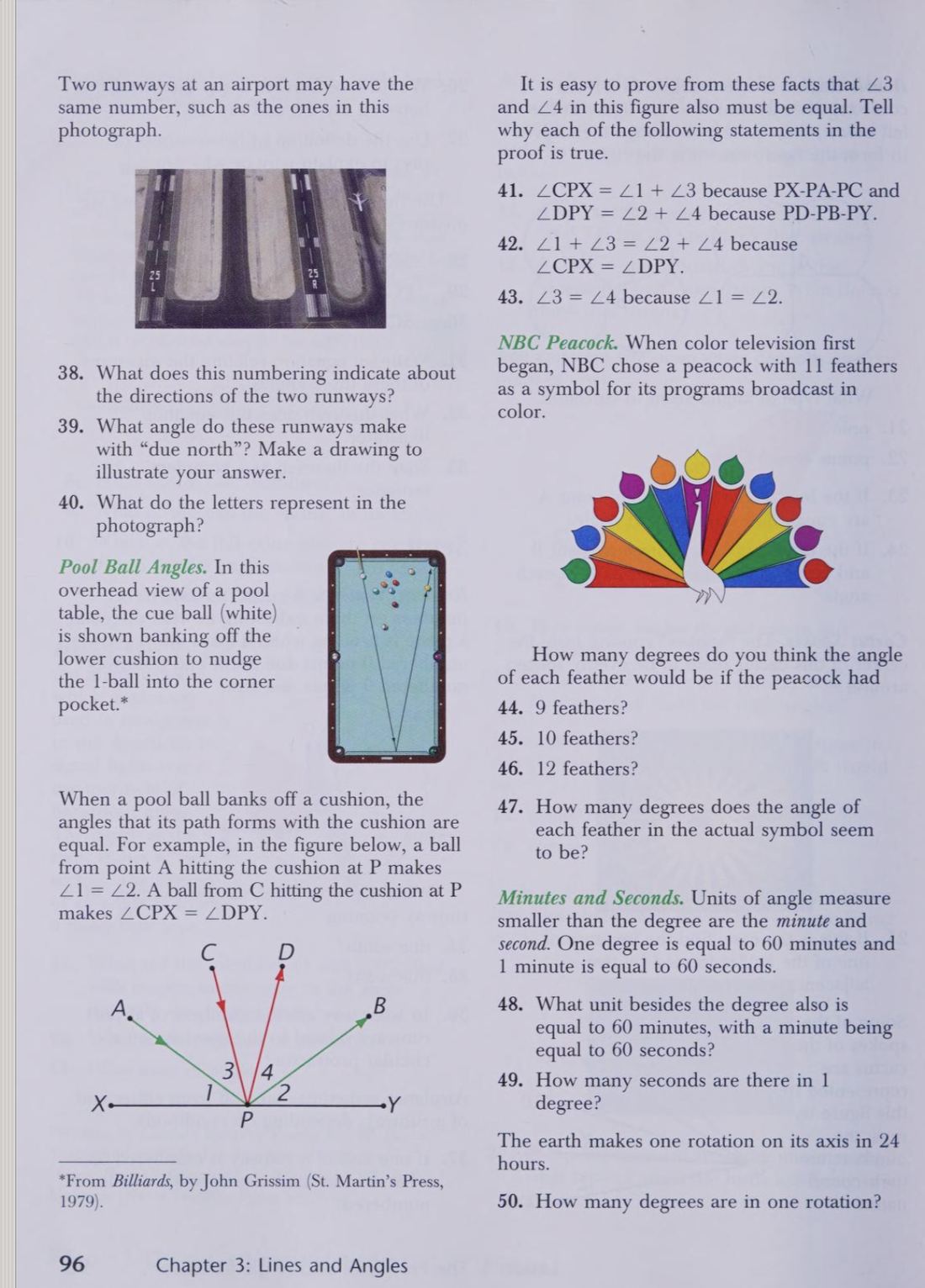
Questions 41 to 43: the pool-ball proof
Given ∠1 = ∠2 and ∠CPX = ∠DPY, prove ∠3 = ∠4. Justify each of the three listed statements.
- Question 41: ∠CPX = ∠1 + ∠3 because ray PA is between rays PX and PC (PX-PA-PC), and likewise ∠DPY = ∠2 + ∠4 because PD-PB-PY. Reason: the Betweenness of Rays Theorem, splitting each big angle at the ball's path.
- Question 42: the two big angles are equal (given), so substitute the sums from step 1 for them: ∠1 + ∠3 = ∠2 + ∠4. Reason: substitution.
- Question 43: ∠1 = ∠2 is given, so subtract it from both sides: ∠3 = ∠4. Reason: the subtraction property of equality.
- Step back and count ingredients: one physical fact about cushions, one theorem about rays, one property of equality. That little proof is the pattern of half the proofs in this book: geometry splits, algebra cancels.
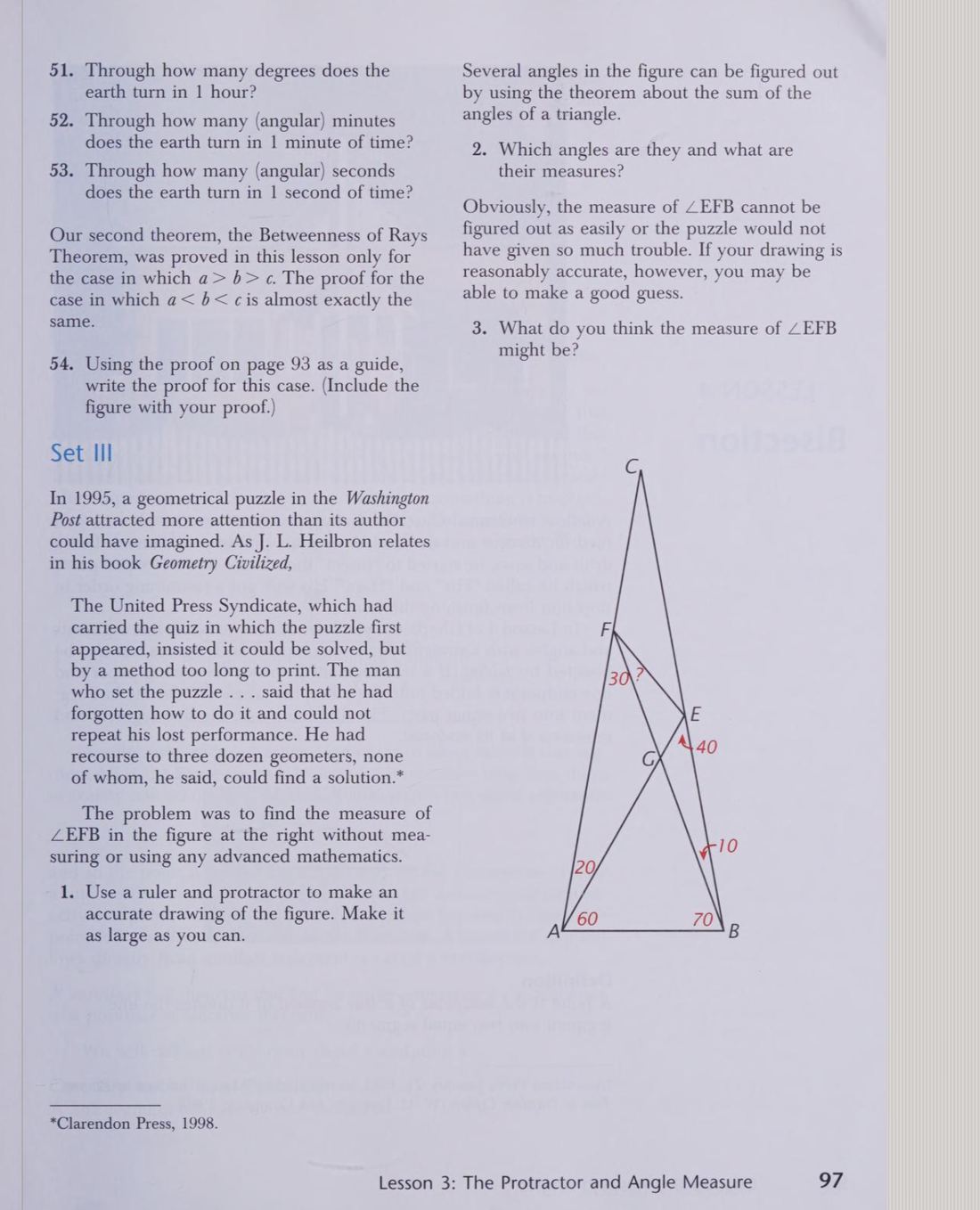
Questions 1 to 3: cornering the Post puzzle
In the figure, angle A is split 60° and 20°, angle B is split 70° and 10°. Which angles can the triangle angle sum deliver, and what is a good guess for ∠EFB?
- Draw it big, as told: the effect of a small figure is the page 12 lesson in reverse; crossings blur and guesses go bad.
- Whole triangle first: ∠A = 60 + 20 = 80 and ∠B = 70 + 10 = 80, so the apex angle at C is 180 − 80 − 80 = 20°.
- Triangle ABF (the one using all of ∠A and B's lower 70): ∠AFB = 180 − 60 − 80 = 40°. Triangle ABE (all of ∠B and A's lower 60... check which crossing your drawing labels): the same recipe gives ∠AEB = 30°. Each crossing point surrenders to one more angle-sum.
- ∠EFB refuses the recipe; every triangle containing it has two unknowns. That refusal is the puzzle's fame. Measure your drawing: a good figure reads close to 20°, and 20° is in fact the answer.
- Keep the moral, because it is the chapter's: measurement can suggest 20° but cannot prove it, and the proof needs a line nobody asked you to draw. Auxiliary lines arrive officially in a later chapter; this puzzle is why they exist.
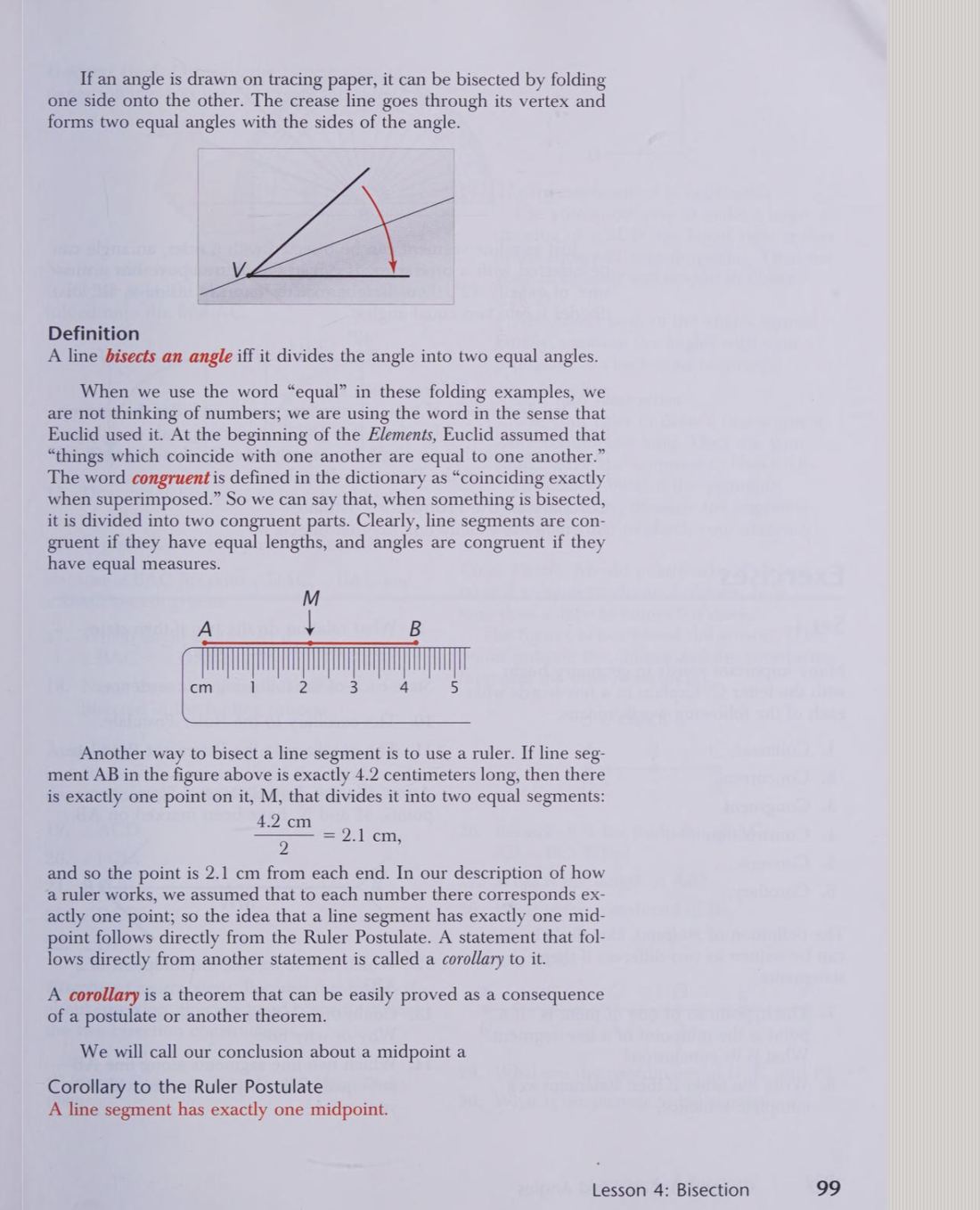
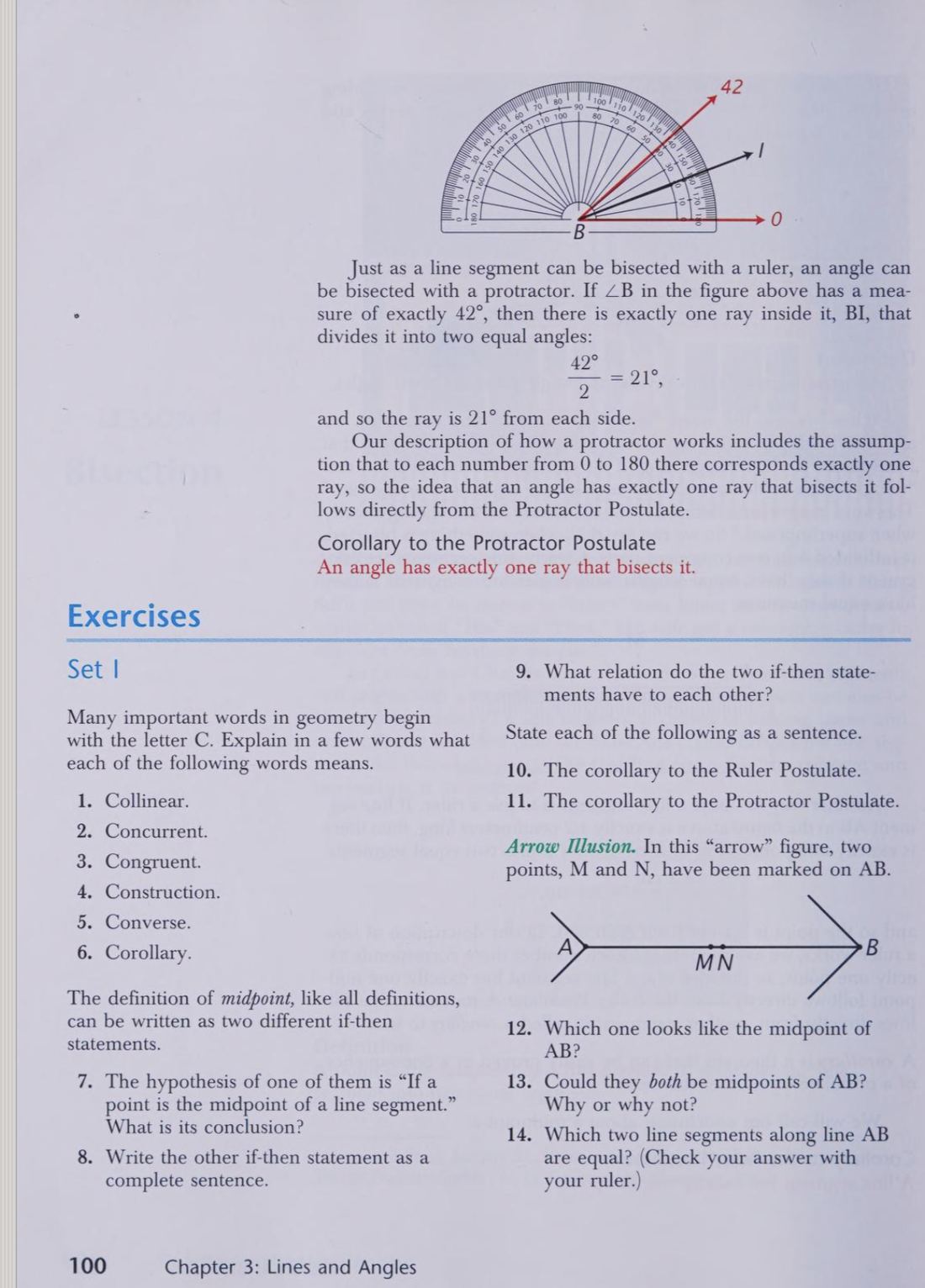
Questions 12 to 14: the arrow illusion
Points M and N are marked on segment AB between two arrowheads. Which looks like the midpoint? Could both be midpoints? Which two segments along line AB are equal?
- Question 12: to nearly every eye, N looks like the midpoint; the inward and outward arrowheads stretch and shrink the halves.
- Question 13: both cannot be midpoints, and you can cite the exact statement: the Corollary to the Ruler Postulate says a segment has exactly one midpoint. Two would need one number to own two points.
- Now measure with your ruler, as question 14 orders. The measurement says AM = MB: M is the true midpoint, and the segments AM and MB are the equal pair.
- Sit with the punchline: your eye voted N, the corollary said one winner only, the ruler crowned M. Perception proposes, deduction disposes; that division of labor is why this chapter keeps postulates between you and your eyes.
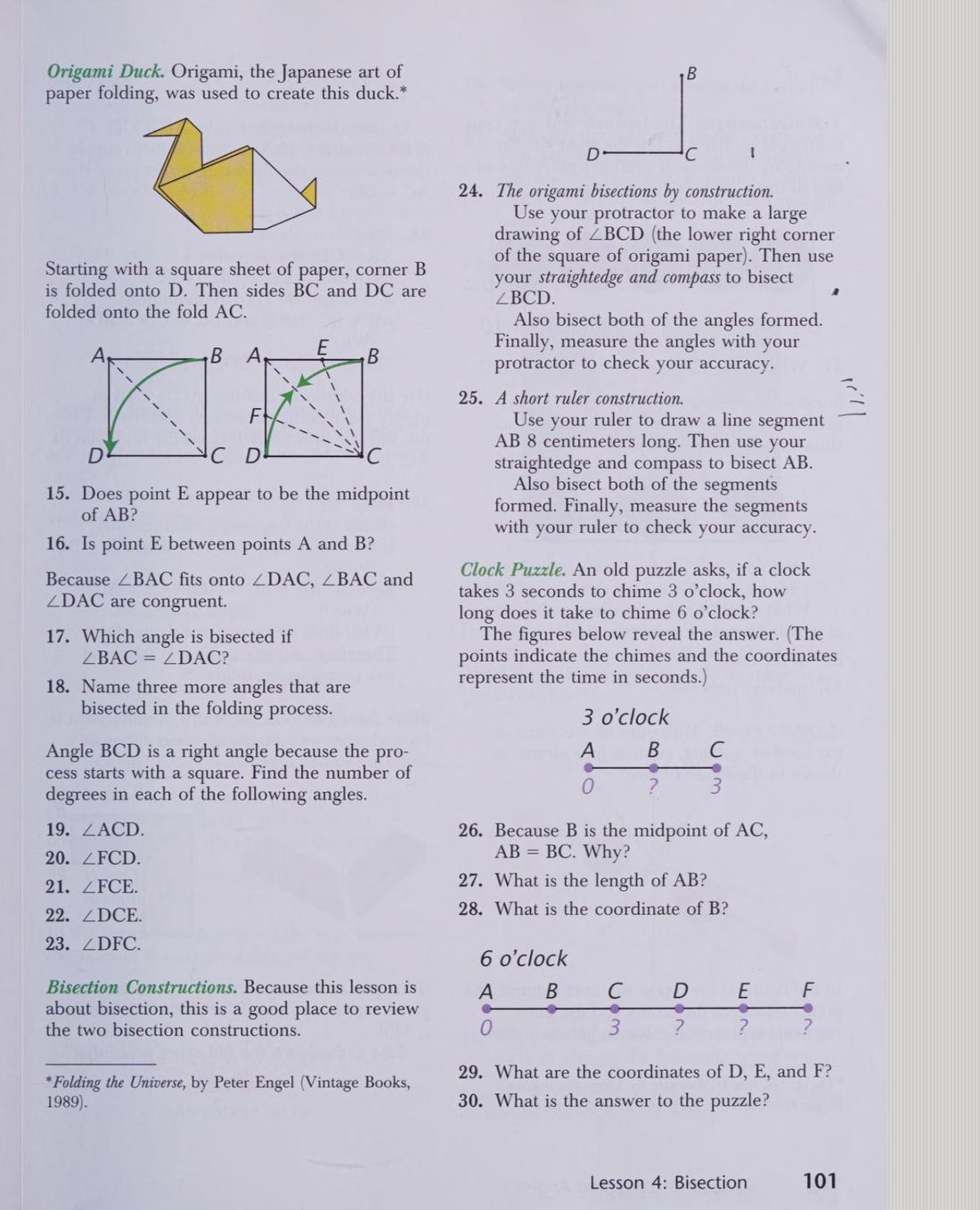
Questions 26 to 30: the chiming clock
A clock takes 3 seconds to chime 3 o'clock. The chimes are points A, B, C with coordinates 0, ?, 3, and B is the midpoint of AC. How long to chime 6 o'clock?
- Question 26: B is the midpoint of AC, so AB = BC by the definition of midpoint; the segment is cut into two equal parts.
- Questions 27 and 28: AC = 3 seconds covers two equal gaps, so each gap is 1.5 seconds and B's coordinate is 1.5. Three chimes make two gaps, not three; that is the puzzle's hinge.
- Question 29: six chimes make five gaps of 1.5 seconds each, so the six points sit at A 0, B 1.5, C 3, D 4.5, E 6, F 7.5.
- Question 30: the sixth chime lands at 7.5 seconds, so 6 o'clock takes 7.5 seconds, not the "obvious" 6. Gaps, not chimes, carry the time.
- Check with the ruler picture: the chimes are points, the gaps are segments, and doubling the chime count does not double the segment count. Counting fence posts versus fence rails, on a clock.
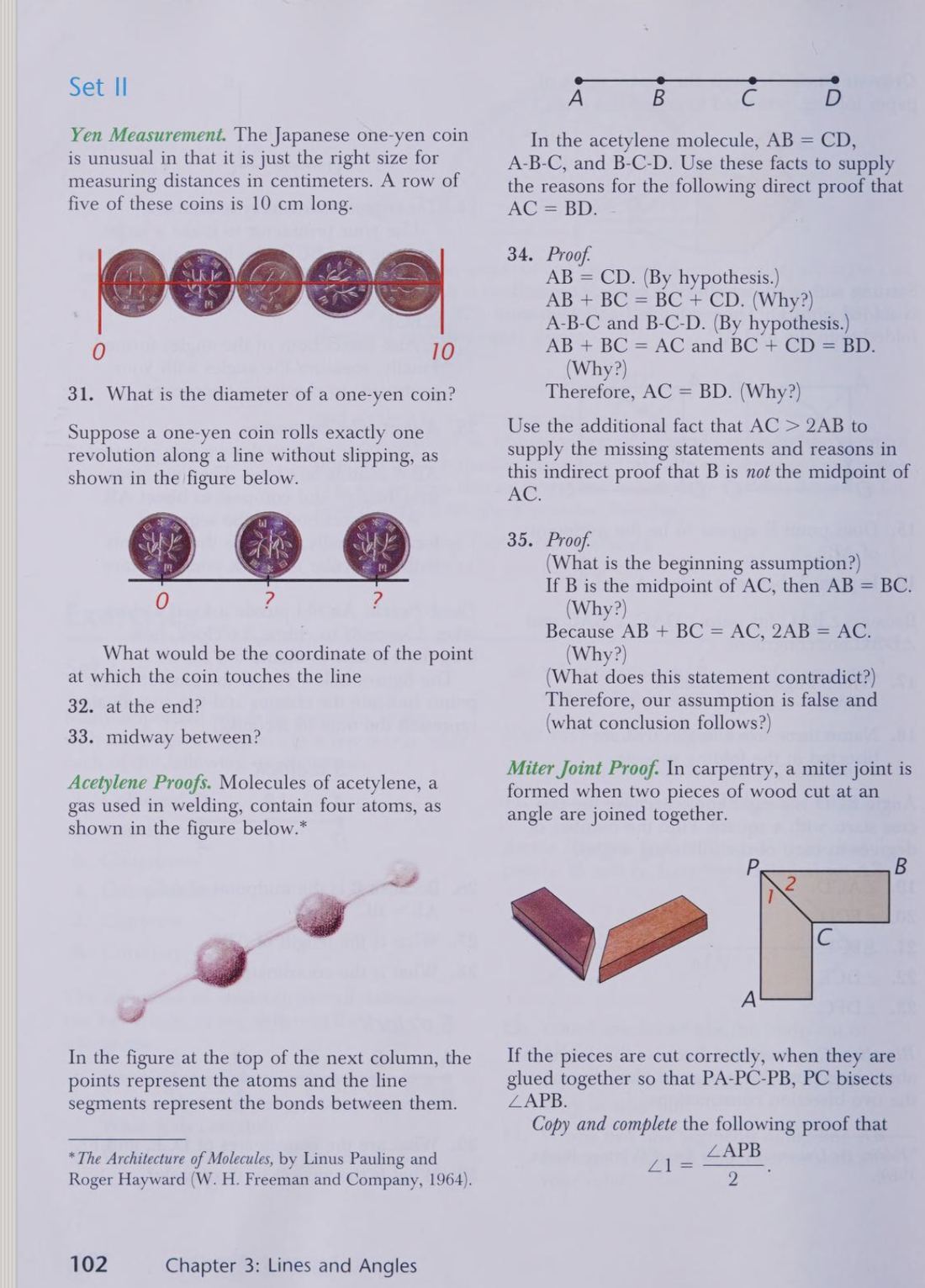
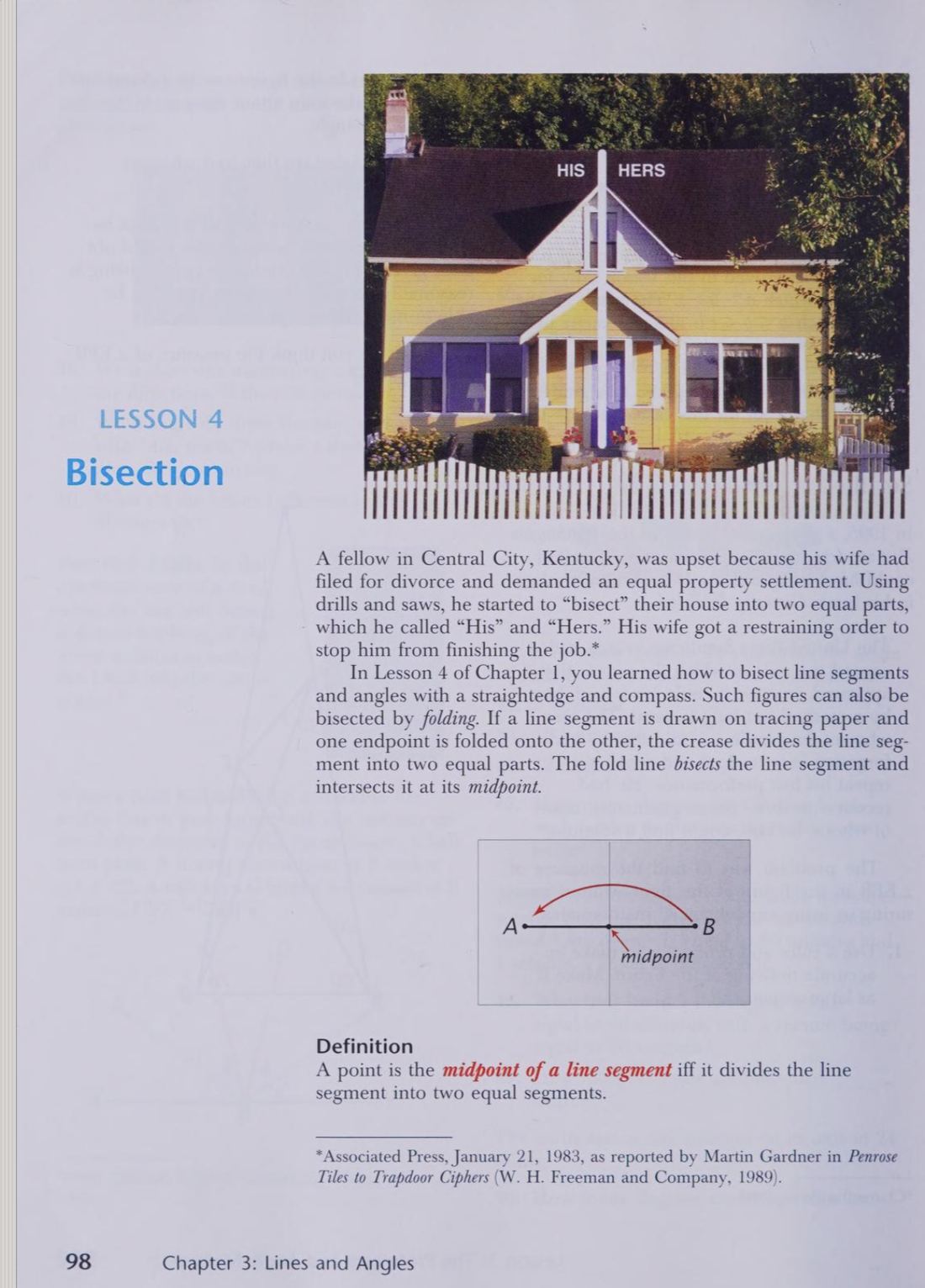
Question 35: B is not the midpoint
In the acetylene molecule, A-B-C with AC > 2AB. Complete the indirect proof that B is not the midpoint of AC.
- Beginning assumption, opposite of the claim: suppose B is the midpoint of AC.
- If B is the midpoint, then AB = BC. Reason: definition of midpoint.
- Because A-B-C, AB + BC = AC (Betweenness of Points Theorem), and substituting AB for BC gives 2AB = AC. Reason: substitution.
- The contradiction: 2AB = AC collides with the given fact AC > 2AB. A quantity cannot equal what it exceeds.
- Therefore the assumption is false, and B is not the midpoint of AC. Chemistry agrees: the carbon-carbon bond in acetylene really is longer than a carbon-hydrogen bond, and this proof is how you know from lengths alone, without a tape measure small enough for molecules.
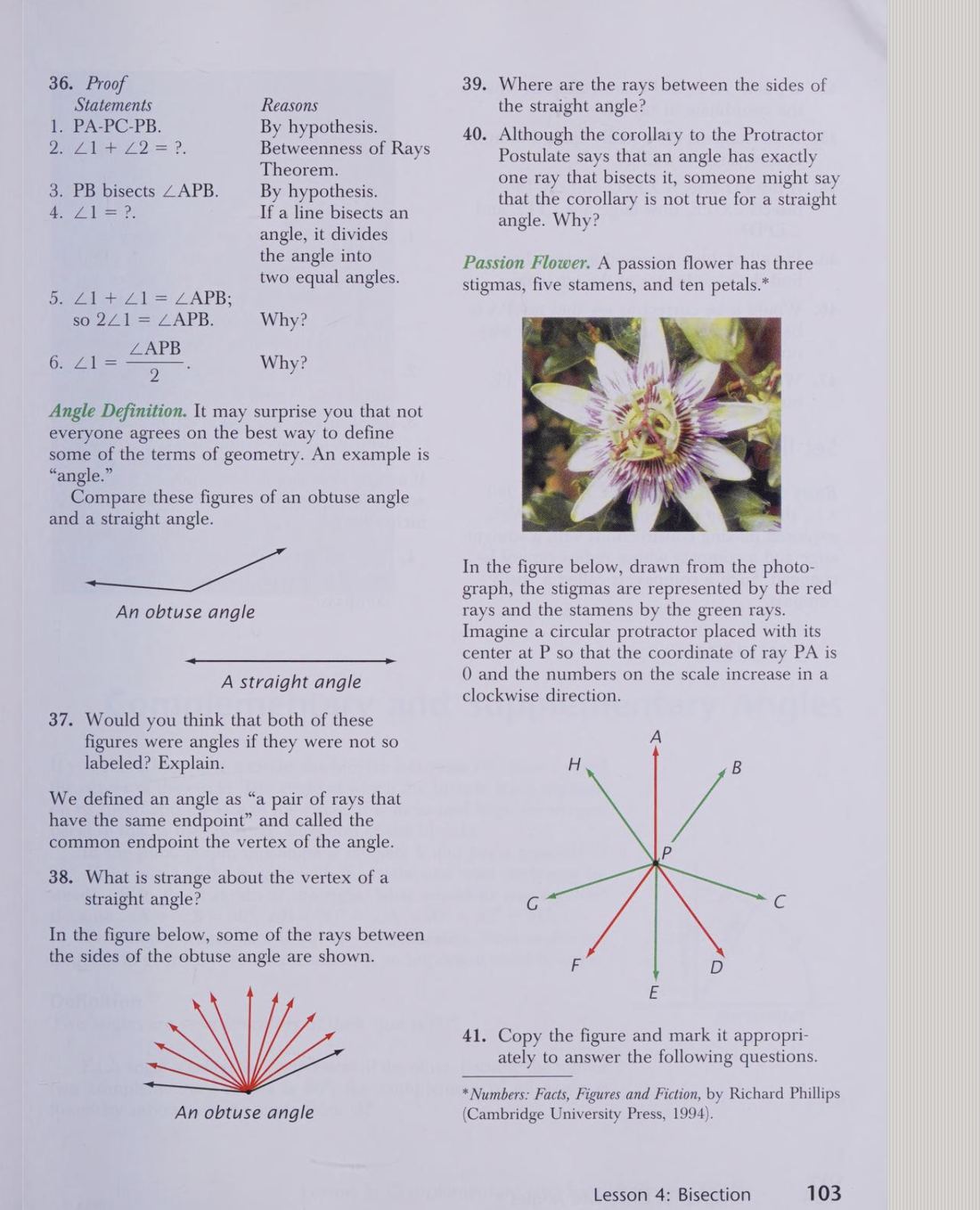
Question 36: the miter joint
Given PA-PC-PB and that PC bisects ∠APB, complete the proof that ∠1 = ∠APB / 2.
- Line 2: ∠1 + ∠2 = ∠APB. Reason: PA-PC-PB and the Betweenness of Rays Theorem; the middle ray splits the whole angle.
- Line 4: ∠1 = ∠2. Reason: PC bisects ∠APB, and a bisecting line divides an angle into two equal angles (the page 99 definition).
- Line 5: substitute ∠1 for ∠2 in line 2: ∠1 + ∠1 = ∠APB, so 2∠1 = ∠APB. Reason: substitution.
- Line 6: divide both sides by 2: ∠1 = ∠APB / 2. Reason: the division property of equality (and 2 ≠ 0, as page 83 taught you to mutter).
- Compare this with page 80's questions 11 and 12: same skeleton, then done informally, now done as a listed proof. The chapter has been teaching you one proof in slow motion all along.
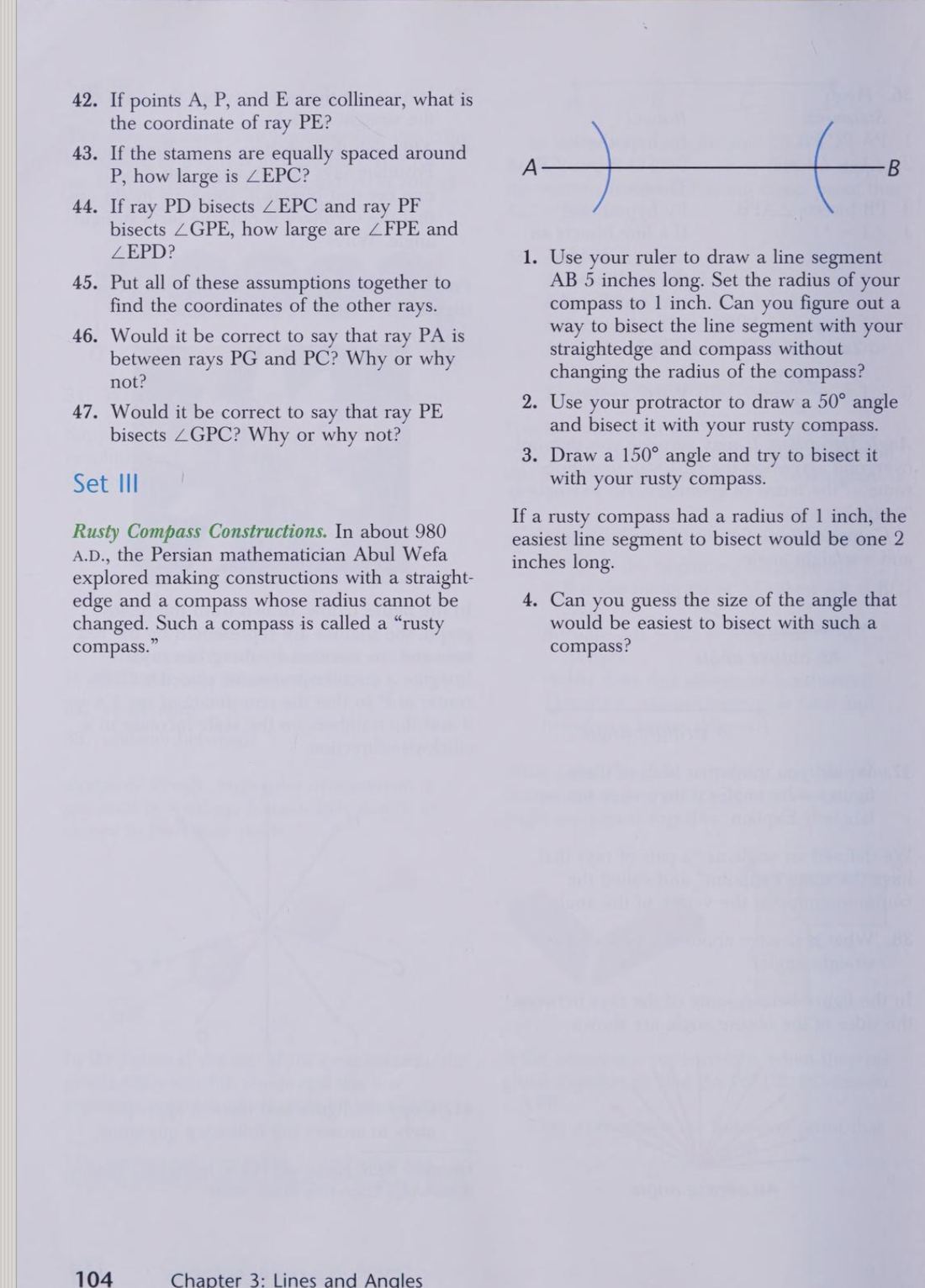
Questions 42 to 45: coordinates for the flower
Ray PA has coordinate 0 on a circular protractor, clockwise. A, P, E are collinear; the five stamens (B, C, E, G, H) are equally spaced; PD bisects ∠EPC and PF bisects ∠GPE. Find all the coordinates.
- Question 42: A, P, E collinear puts ray PE half a rotation from ray PA: coordinate 180.
- Question 43: five equally spaced stamens divide the full 360 into five gaps of 360/5 = 72°, so ∠EPC = 72°.
- Anchor the stamens from E = 180 and step by 72 against the clockwise scale: C = 108, B = 36, and on the other side G = 252, H = 324.
- Question 44: bisectors halve the 72s: ∠EPD = ∠FPE = 36°, so D = 144 and F = 216.
- Question 45's full list, in scale order: A 0, B 36, C 108, D 144, E 180, F 216, G 252, H 324. Now the two traps: PA "between" PG and PC fails the definition (0 is not between 108 and 252), and PE does bisect ∠GPC, since 252 − 180 = 180 − 108 = 72. One no, one yes, both settled by coordinates rather than by the photograph.