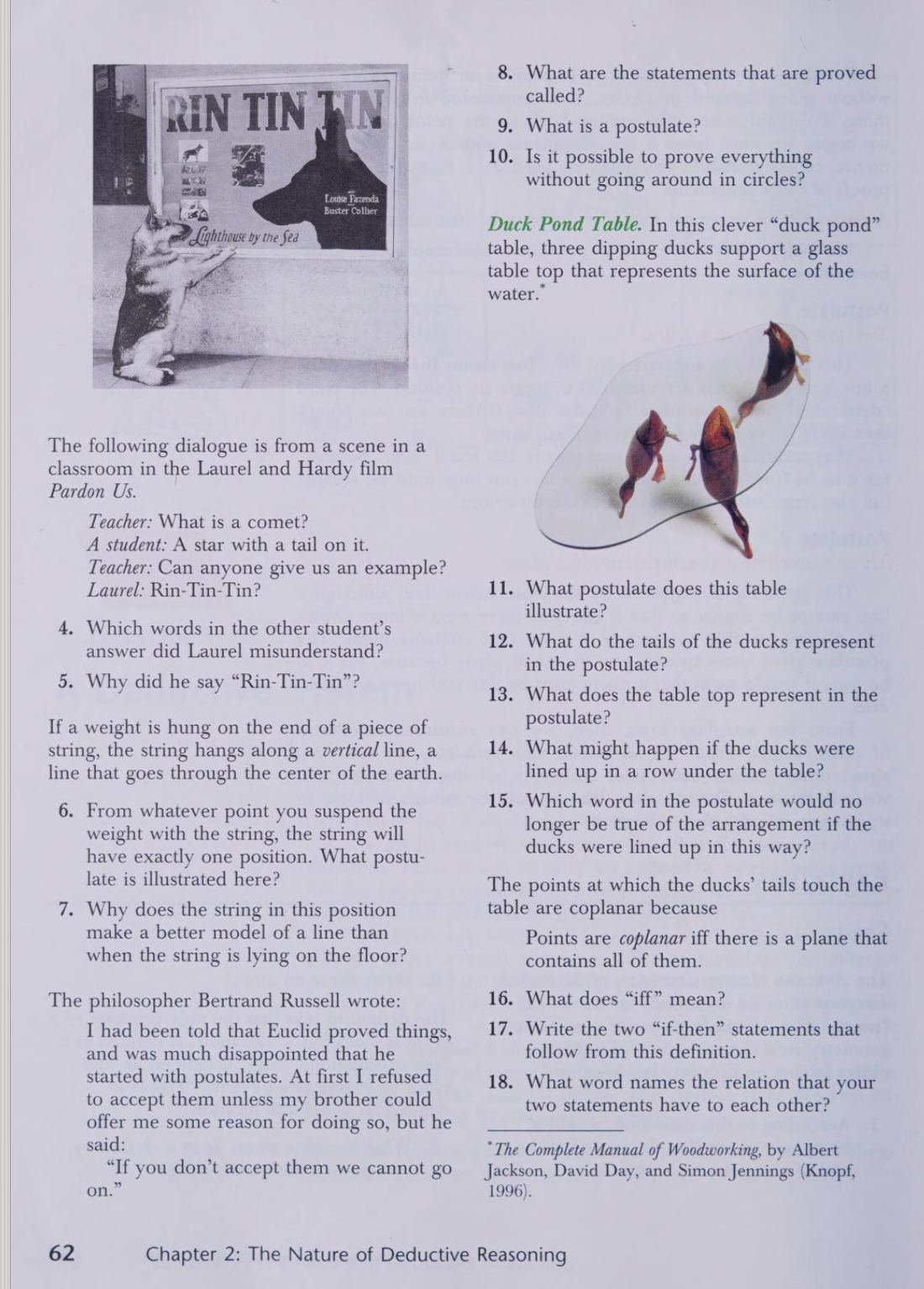
Questions 11 to 15: the duck pond table
Three dipping ducks support a glass table top. What postulate does the table illustrate, what plays each role, and what goes wrong if the ducks line up?
- Question 11: a flat surface resting on three supports is Postulate 2: three noncollinear points determine a plane.
- Questions 12 and 13: match the parts. The ducks' tail tips are the three points; the glass top is the plane they determine.
- Question 14: slide the ducks into a row in your head. The glass now balances on a single line and can tip to either side of it; the top has lost its one fixed position. That wobble is what "determine" rules out.
- Question 15: the word that fails is "noncollinear." Three points in a row are collinear, and the postulate deliberately excludes them.
- Check yourself on question 6 the same way: the plumb line hangs through two points (the suspension point and the weight's pull), and Postulate 1 is why it has exactly one position. One postulate per object, and each object shows why the postulate's wording earns its keep.
Questions 32 to 36: the credit card agreement
Five statements from a credit card agreement. Which are definitions? Which are postulates? Which two combine into a syllogism, and what theorem does it prove?
- Question 32: a definition names a word and gives its meaning. Statement (1) defines "transaction finance charge" and statement (3) defines "supercheck." Those two; question 33's answer is those two terms.
- Question 34: the rest are rules laid down without proof, the agreement's postulates: (2), (4), and (5).
- Question 35: hunt for a conclusion that feeds a hypothesis, the page 51 splice. Statement (2) ends "you will be charged a fee"; statement (4) begins "If you are charged a fee." They chain.
- Question 36: run the syllogism. If you go over your credit limit, you will be charged a fee; if you are charged a fee, it will be added to your balance; therefore, if you go over your credit limit, a fee will be added to your balance. A theorem, proved from the bank's own postulates.
- Notice what just happened: an entire deductive system (undefined terms, definitions, postulates, one theorem) was hiding in a credit card agreement. Page 61's structure is not special to geometry.
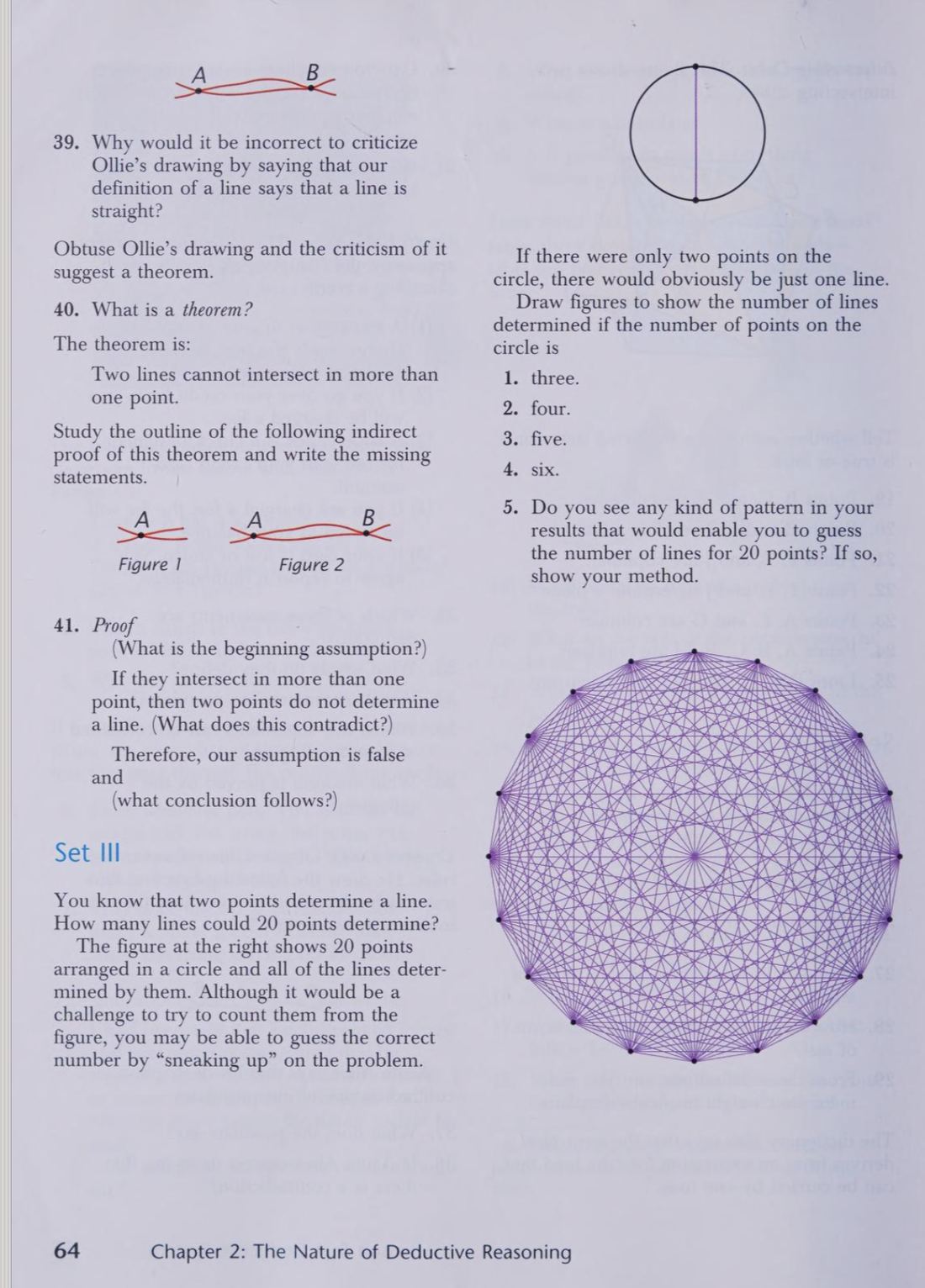
Set III: how many lines do 20 points determine?
Twenty points sit on a circle, no three collinear. Sneak up on the number of lines through the small cases: 3, 4, 5, 6 points.
- Count the small cases by drawing: 2 points give 1 line, 3 give 3, 4 give 6, 5 give 10, 6 give 15. The gaps between answers are 2, 3, 4, 5: each new point adds a line to every point already there.
- So the seventh point will add 6 lines, the eighth 7, and the pattern is forced by Postulate 1 itself: one new line per old point, no more (each pair determines a line) and no fewer (exactly one).
- Shortcut to 20 without adding eighteen numbers: each of the 20 points pairs with 19 others, giving 20 × 19 = 380 ordered pairs, but the pair AB and the pair BA name the same line. Divide by 2: 190 lines.
- Check the formula against a case you drew: 5 points give 5 × 4 ÷ 2 = 10. It matches. A counting argument you can verify on small cases and then trust at 20 is deduction doing the work your pencil cannot.
Questions 8 to 10: Raoul's paper triangle
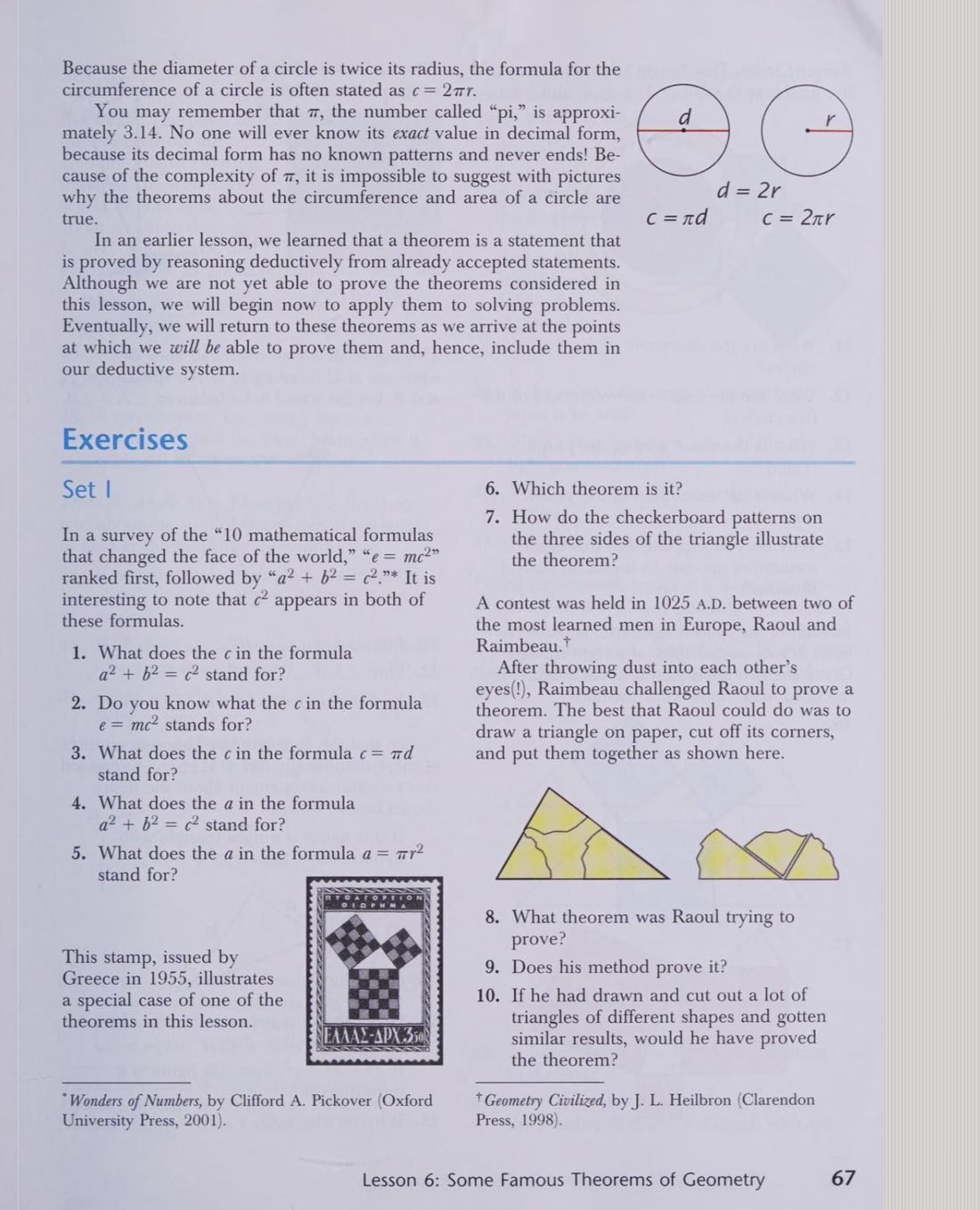
Challenged to prove a theorem, Raoul drew a triangle, cut off its corners, and fit them together. What theorem was he after? Does his method prove it? Would a thousand triangles prove it?
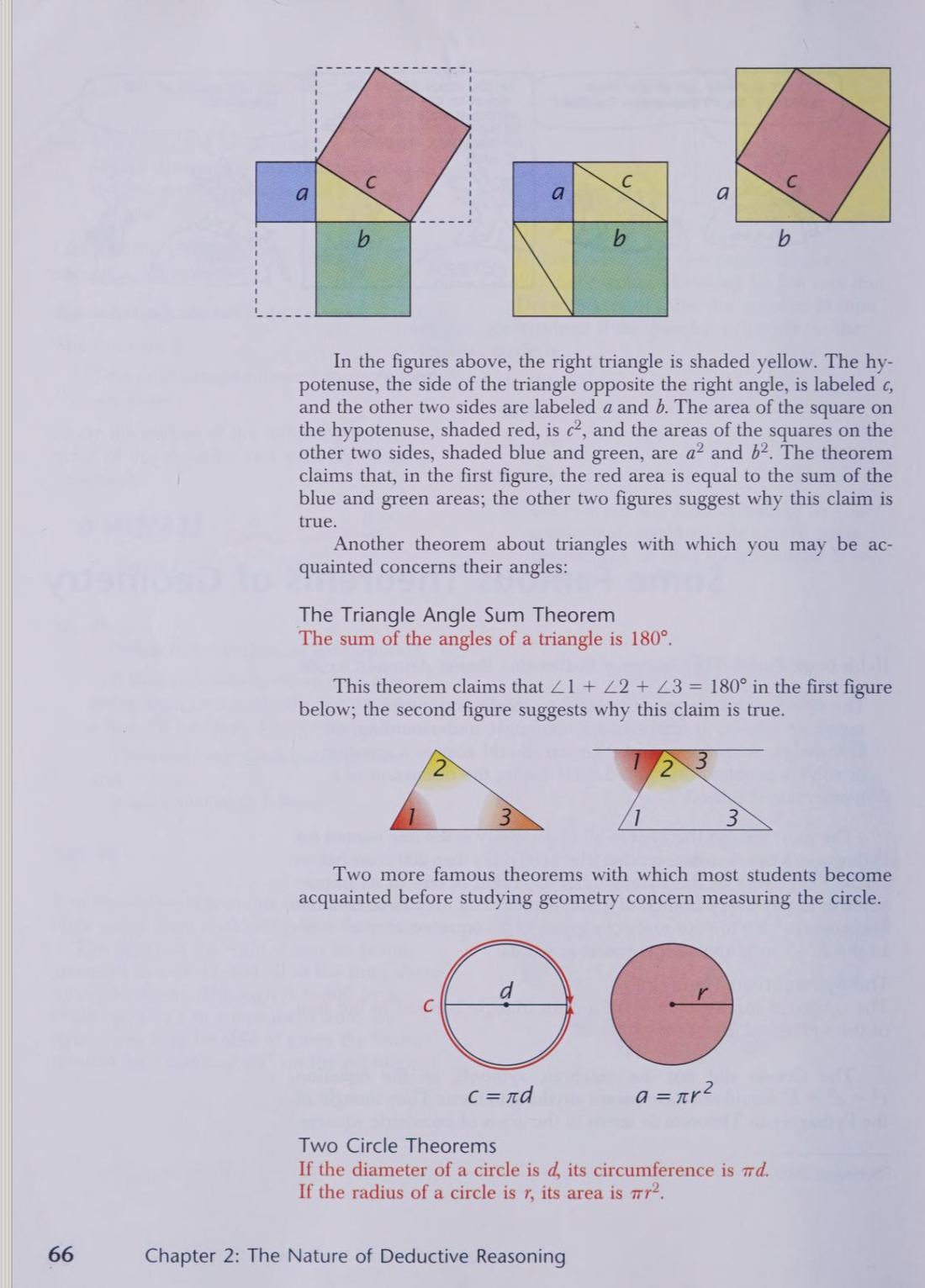
- Question 8: the three corners, reassembled, line up along a straight edge, the second figure on page 66 exactly. He was demonstrating the Triangle Angle Sum Theorem: the angles total 180°.
- Question 9: no. The cutting shows that this one triangle's angles total a straight angle, as closely as scissors can show anything. It says nothing about the triangle Raoul did not draw.
- Question 10: still no. A thousand triangles are a thousand instances, and the theorem claims every triangle, an infinite family. Piling up instances is induction; page 51 defined proof as deduction from accepted statements, and no pile of examples becomes a deduction.
- Self-check: page 12's colored-pencil experiment already taught this moral from the other side. Seeing a pattern persist is the invitation to prove; it is never the proof. Keep Raoul in mind whenever a measurement agrees with a theorem suspiciously well.
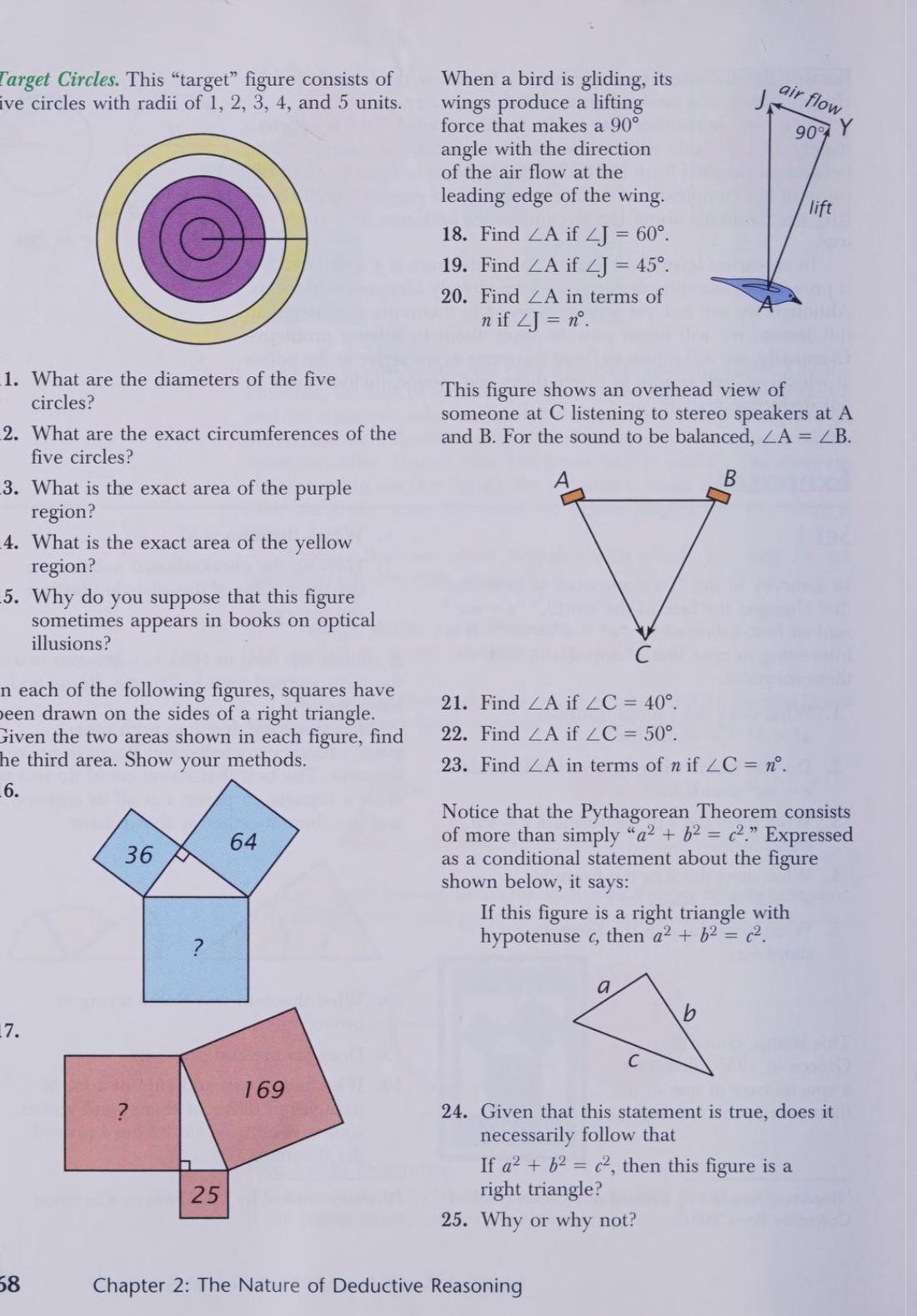
Questions 16 and 17: the third square
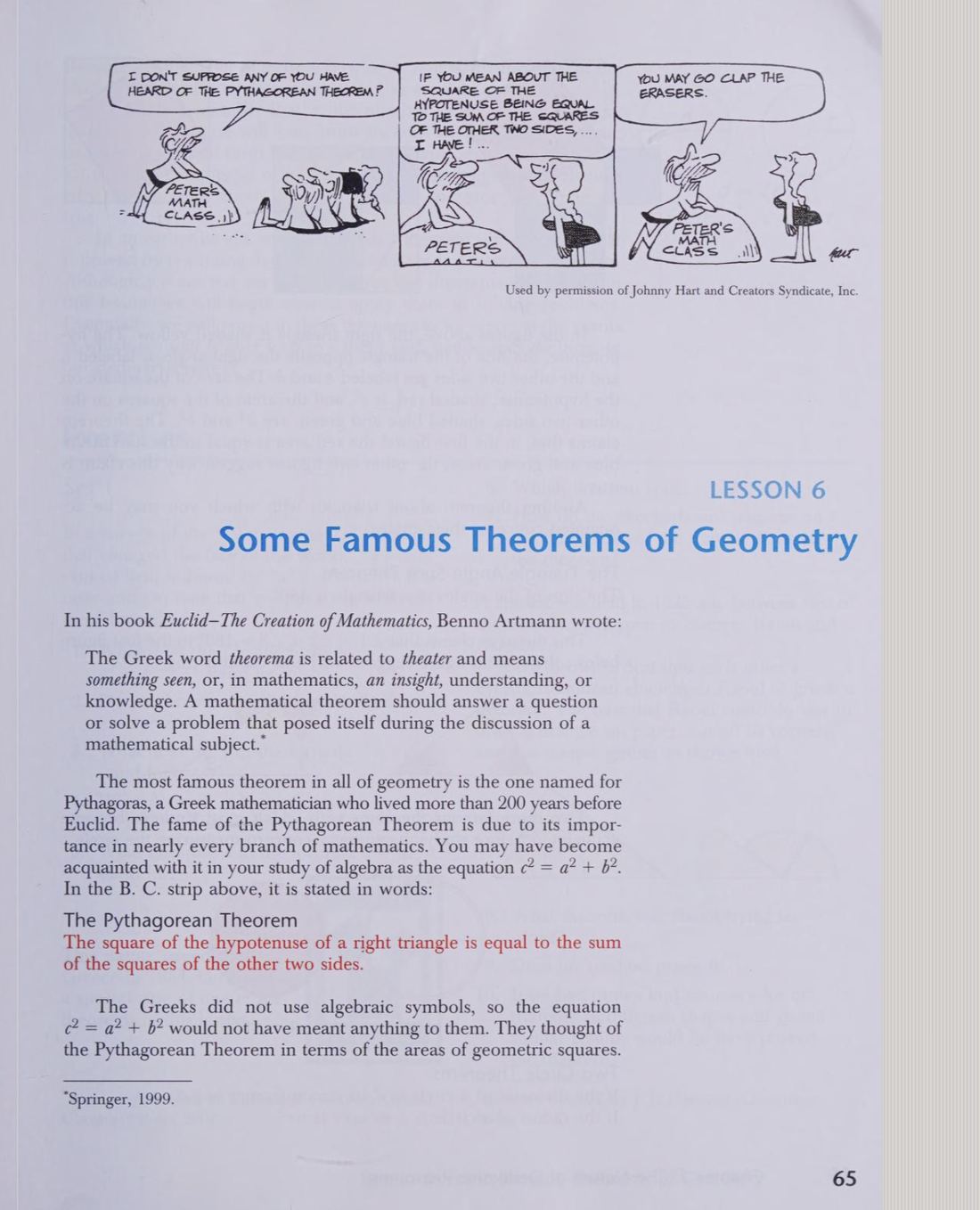
Squares are drawn on the sides of a right triangle. In the first figure the two smaller squares have areas 36 and 64; in the second, the hypotenuse square is 169 and one leg square is 25. Find each missing area.
- Read the theorem as an area statement: leg square plus leg square equals hypotenuse square. No side lengths needed; the areas do the arithmetic.
- Figure 16: the missing square sits on the hypotenuse, so it is 36 + 64 = 100.
- Figure 17: the missing square sits on a leg, so subtract: 169 − 25 = 144.
- Check against hidden triangles you already know: areas 36, 64, 100 mean sides 6, 8, 10; areas 25, 144, 169 mean sides 5, 12, 13. Both are famous right triangles, scaled cousins of the 3-4-5 on the Greek stamp one page back.
- Notice the direction of each move: add to reach the hypotenuse, subtract to reach a leg. Page 73's ladder question will want the adding direction with real feet.
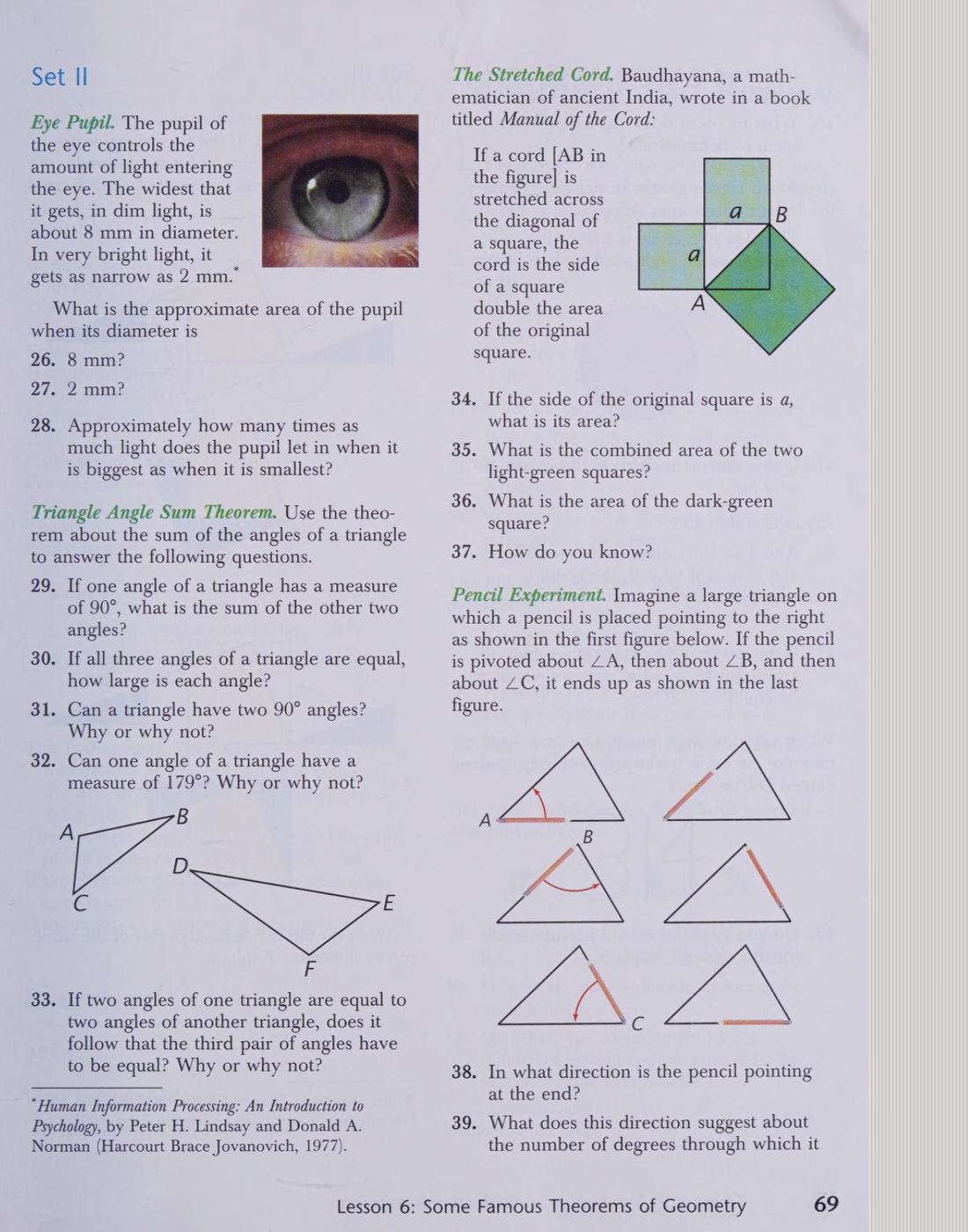
Questions 26 to 28: the pupil of the eye
The pupil dilates from 2 mm to 8 mm in diameter. What is its approximate area at each size, and how many times as much light does the wide pupil admit?
- The theorem wants the radius, and the questions give diameters. Halve first: 8 mm across is r = 4; 2 mm across is r = 1.
- Question 26: area = πr² = π × 16 ≈ 50 square millimeters.
- Question 27: area = π × 1 ≈ 3.14 square millimeters.
- Question 28: divide, and π cancels: 16π ÷ π = 16 times the light. You could have skipped the areas entirely: the diameter ratio is 4, and area scales by its square, 4² = 16.
- Self-check: the ratio question never needed π's value, which is why "approximately" only appears in 26 and 27. Exact ratios from an unknowable number; that is the algebra and the geometry splitting the work cleanly.
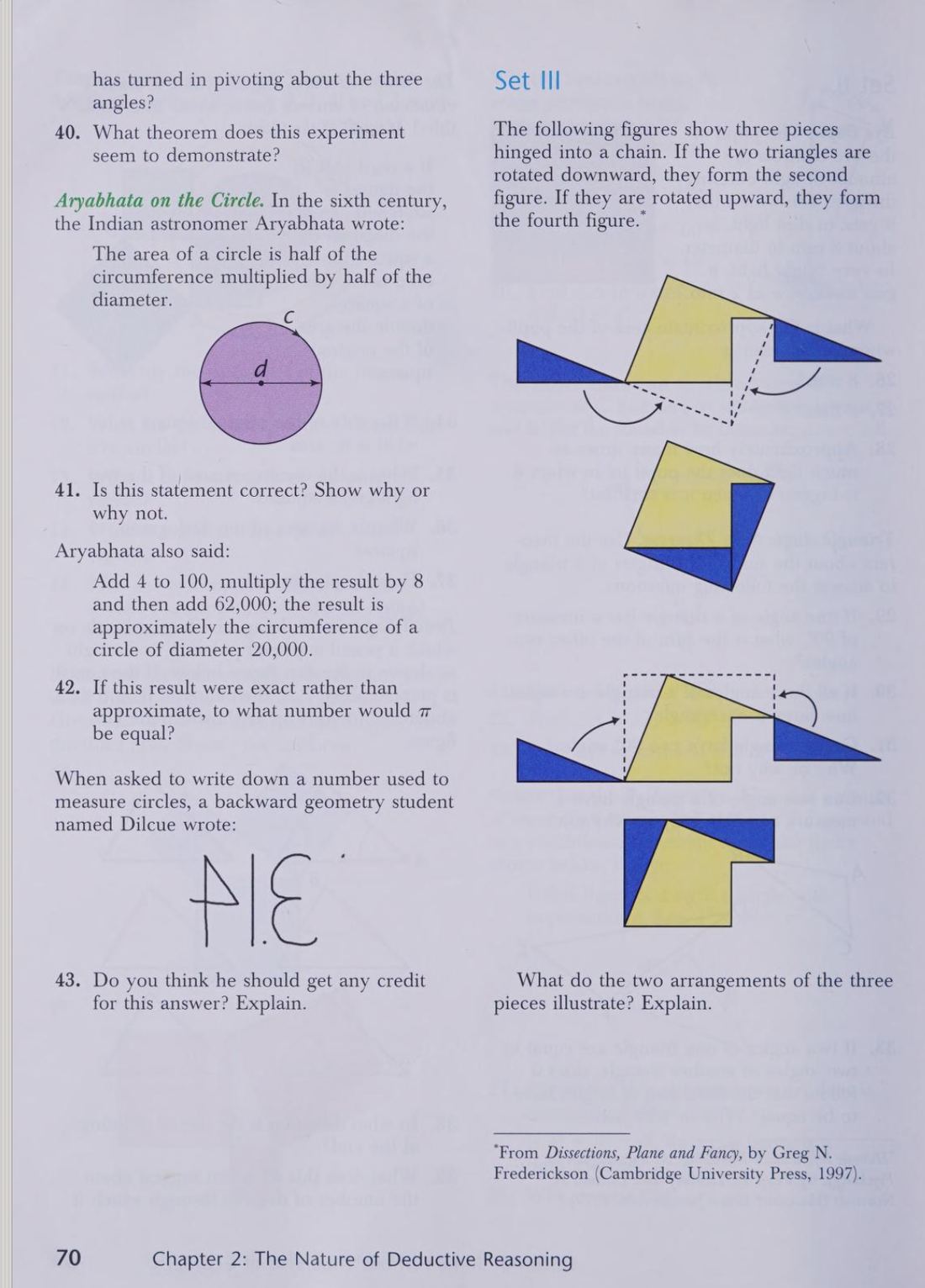
Questions 41 and 42: checking Aryabhata
Aryabhata: the area of a circle is half the circumference times half the diameter. Is he right? And if 8 × (100 + 4) + 62,000 were exactly the circumference of a circle of diameter 20,000, what would π be?
- Question 41: write his recipe in the book's symbols. Half the circumference is ½(πd) and half the diameter is r, so his area is ½πd × r.
- Replace d with 2r: ½π(2r) × r = πr × r = πr². Exactly the page 66 theorem; Aryabhata is correct.
- Question 42: follow his arithmetic. 100 + 4 = 104, times 8 is 832, plus 62,000 is 62,832. So π would equal circumference over diameter: 62,832 ÷ 20,000 = 3.1416.
- Compare: π is 3.14159..., so his rule is off by less than one part in 100,000, from the sixth century. And note which theorem his recipe leans on: circumference = πd is doing the work, the same theorem you used, because c ÷ d is what π means.
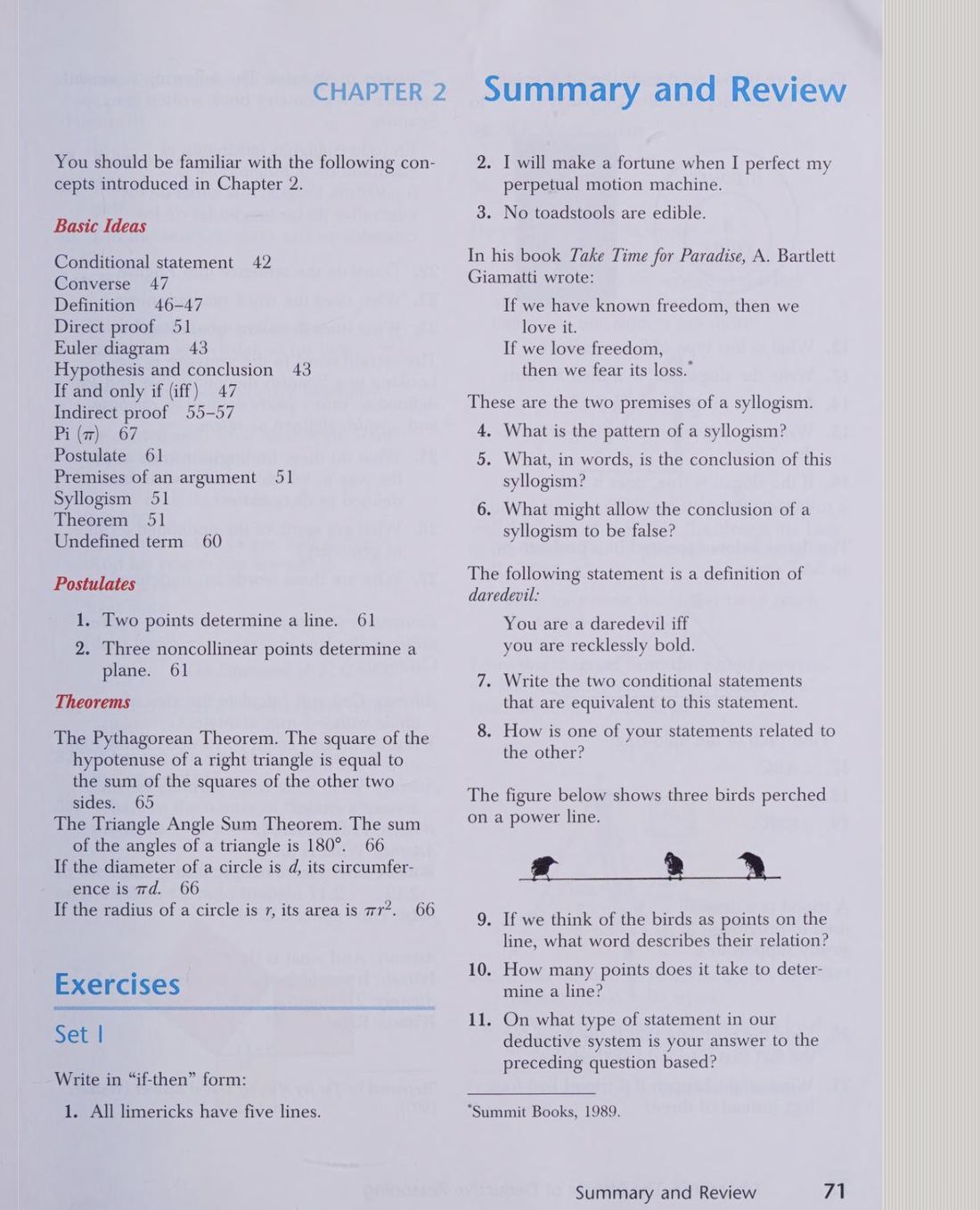
Questions 4 to 6: Giamatti's syllogism
"If we have known freedom, then we love it. If we love freedom, then we fear its loss." What is the pattern of a syllogism, what is this one's conclusion, and what might allow a syllogism's conclusion to be false?
- Question 4: the pattern, from page 51: a → b, b → c, therefore a → c.
- Check the splice before using it: premise one ends "we love it (freedom)" and premise two begins "if we love freedom." The conclusion of one is the hypothesis of the other, so the chain is legal.
- Question 5: jump from first hypothesis to last conclusion. If we have known freedom, then we fear its loss.
- Question 6: only one thing can betray a syllogism whose form is right: a false premise. The logic never fails; the inputs can. That was Aristotle's statue lesson on page 52, and it is the answer the review wants in one sentence.
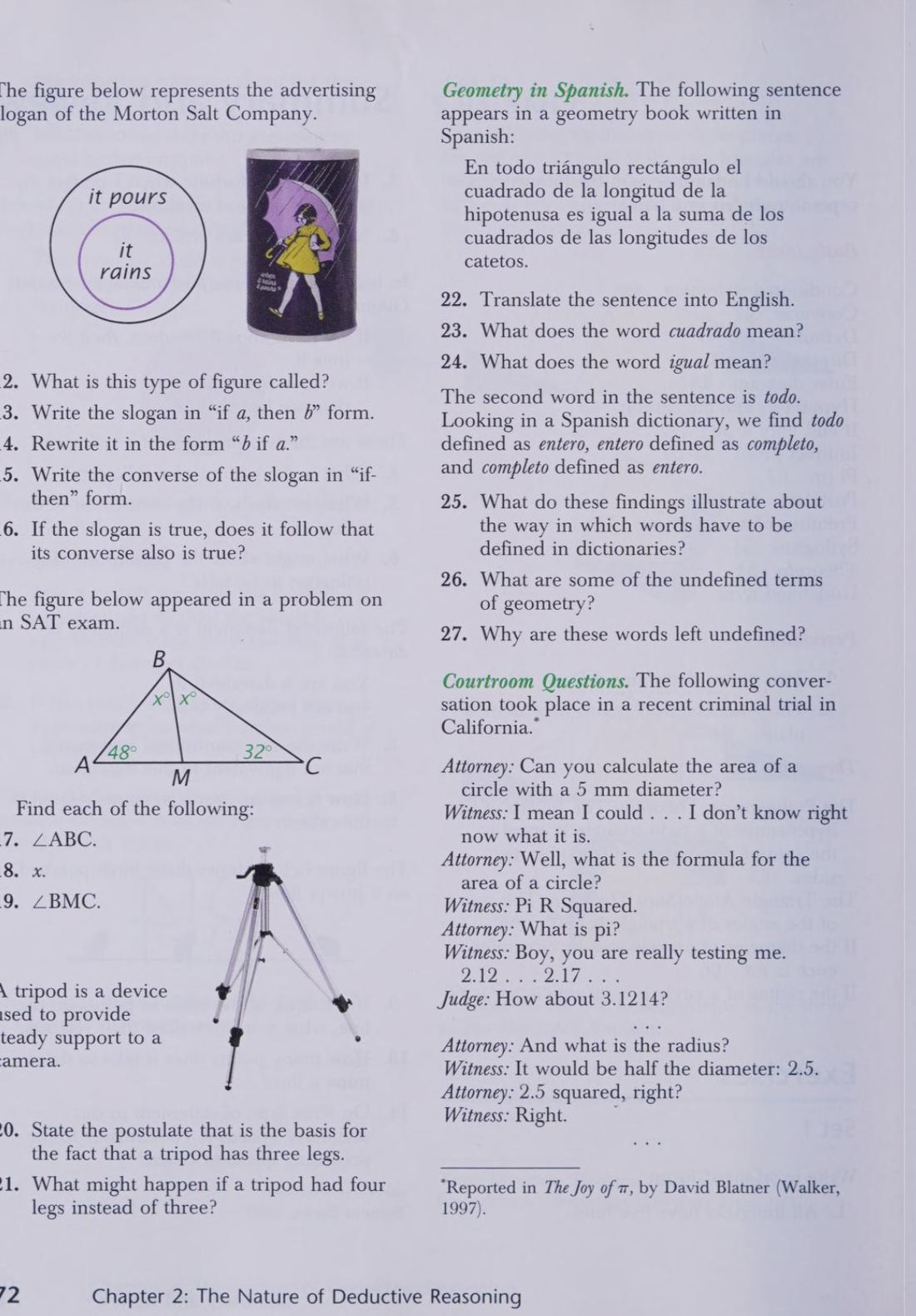
Questions 17 to 19: the SAT triangle
In triangle ABC, angle A = 48° and angle C = 32°. Segment BM splits angle B into two equal parts marked x°. Find angle ABC, x, and angle BMC.
- Question 17: angle sum in the big triangle. ∠ABC = 180 − 48 − 32 = 100°.
- Question 18: the two marked angles are equal and total 100°, so x = 50.
- Question 19: work inside triangle ABM. Its angles are 48°, x = 50°, and ∠AMB, so ∠AMB = 180 − 48 − 50 = 82°.
- ∠BMC sits beside ∠AMB on the straight line AC, and angles along a straight line total 180°: ∠BMC = 180 − 82 = 98°.
- Check with the other triangle: BMC's angles should be 50, 32, and 98, and 50 + 32 + 98 = 180. It closes. One theorem, used three times, each answer feeding the next; that is what "in terms of the figure" questions reward.
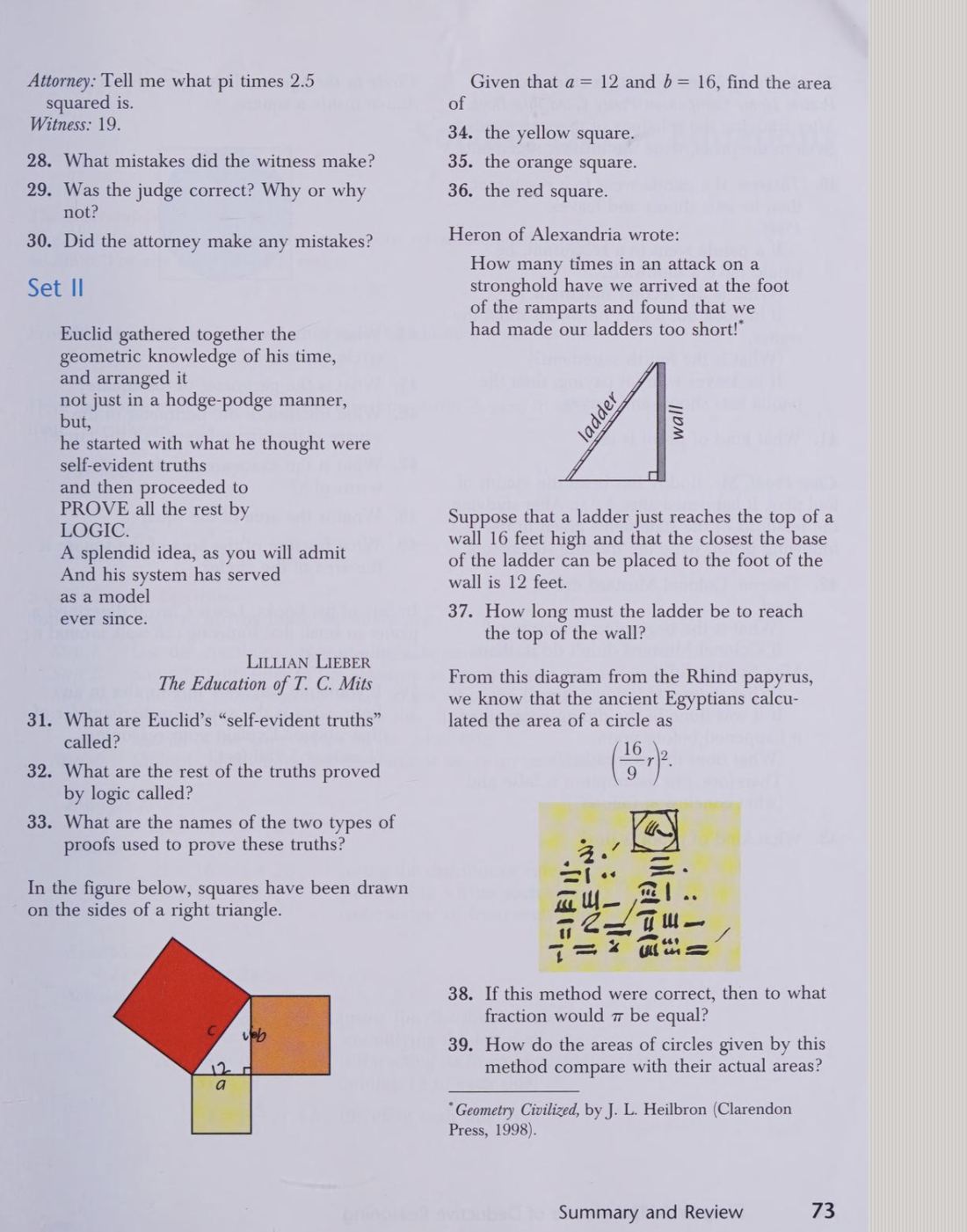
Question 37: Heron's ladder
A ladder just reaches the top of a wall 16 feet high, and the closest its base can stand to the foot of the wall is 12 feet. How long must the ladder be?
- Draw what the figure draws: wall vertical, ground horizontal, the ladder as hypotenuse. The right angle is between wall and ground, so the ladder is c and the legs are 12 and 16.
- Add the leg squares, page 68's adding direction: 12² + 16² = 144 + 256 = 400.
- The ladder's square is 400, so the ladder is 20 feet, since 20 × 20 = 400.
- Check against the family: 12-16-20 is 3-4-5 scaled by four, the stamp triangle yet again. Heron's soldiers needed exactly this computation before an assault, which is as applied as geometry gets.
- Compare with the sliding ladder on page 17: there you measured angles as the ladder slid; here one theorem replaces the measuring. That trade, measurement for deduction, is the chapter's whole argument.
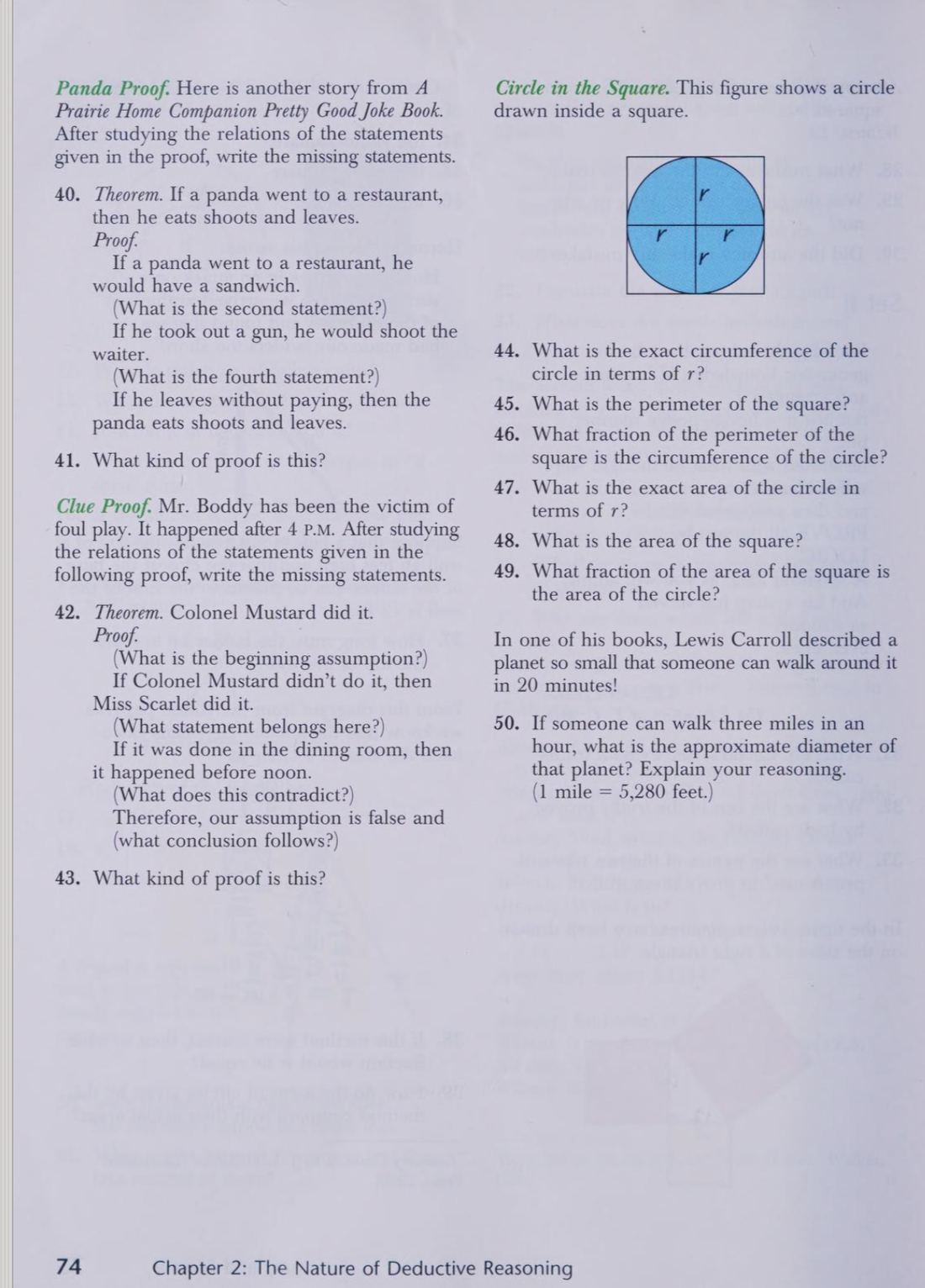
Questions 44 to 49: the circle in the square
A circle of radius r is drawn inside a square, touching all four sides. Find the circumference, the square's perimeter, and what fraction one is of the other; then the same for the areas.
- The circle touches all four sides, so the square's side is the circle's diameter, 2r.
- Questions 44 and 45: circumference = 2πr; perimeter = 4 × 2r = 8r.
- Question 46: 2πr ÷ 8r = π/4. The r cancels, so the answer holds for every such circle, not just one.
- Questions 47 and 48: area of circle = πr²; area of square = (2r)² = 4r². Watch the exponent: the whole side gets squared, a page 21 trap in new clothes.
- Question 49: πr² ÷ 4r² = π/4 again, about 0.785. Same fraction twice is a coincidence worth staring at; it says the circle is exactly as efficient with the square's boundary as with its interior. Carry π/4 ≈ 78% as a number worth knowing.
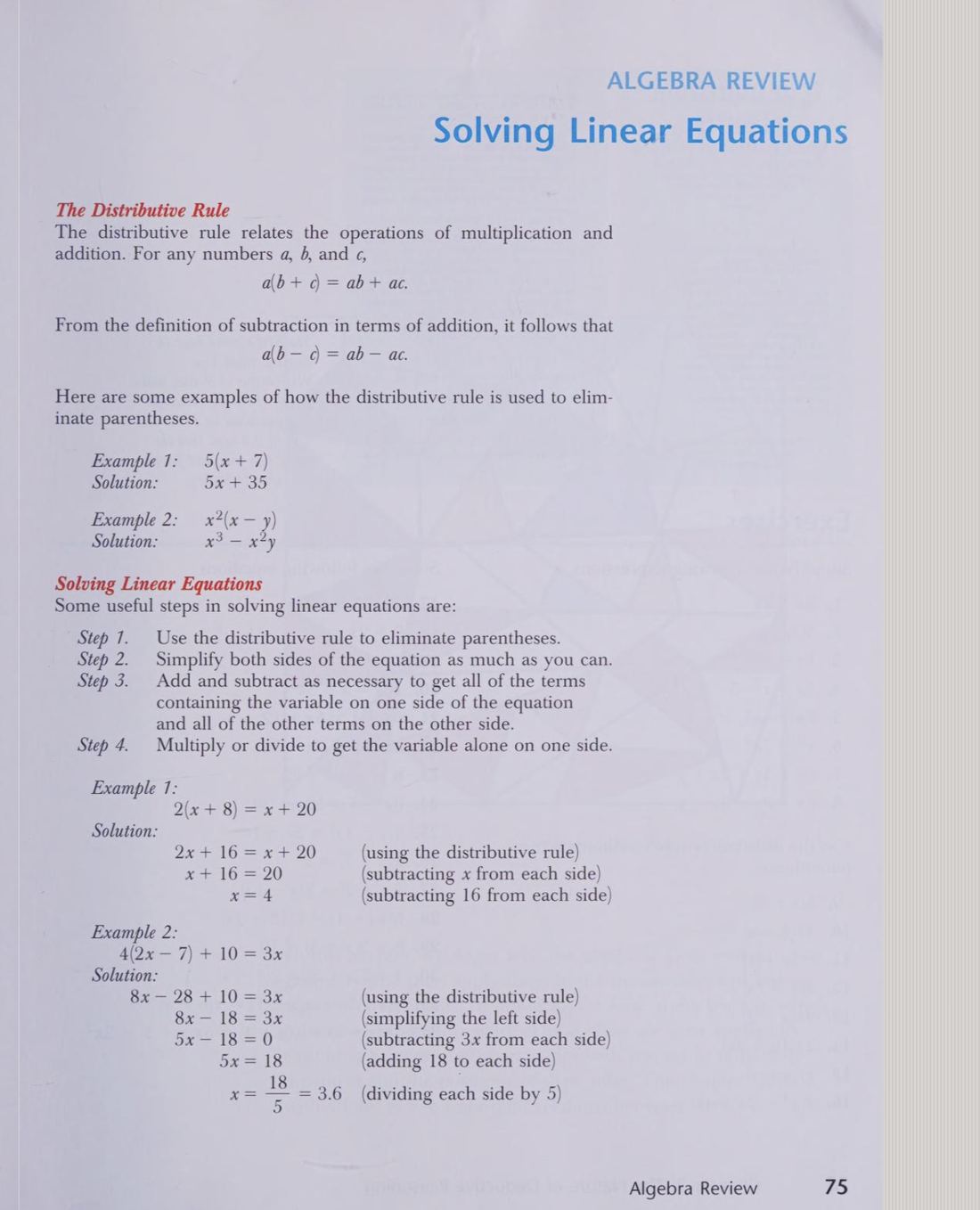
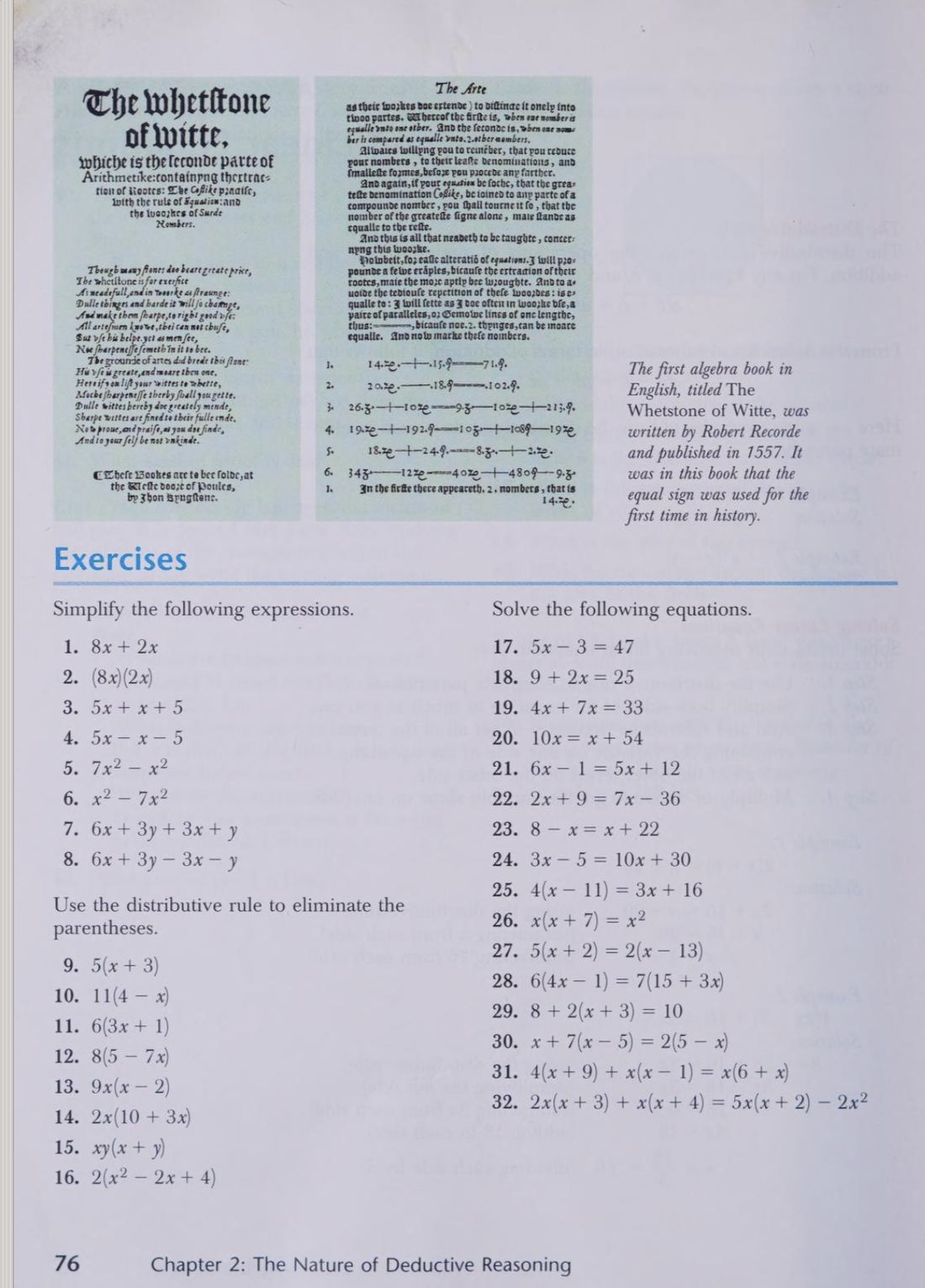
Question 25: the four steps in one equation
Solve 4(x − 11) = 3x + 16.
- Step 1, distribute: 4x − 44 = 3x + 16.
- Step 2, simplify each side: nothing to combine; both sides are already tidy.
- Step 3, gather the variable: subtract 3x from each side to get x − 44 = 16, then add 44 to each side: x = 60.
- Step 4 (divide the variable free) was not needed; the coefficient was already 1. Not every equation uses all four steps, but the steps always come in this order.
- Check the way the book checks: substitute back. 4(60 − 11) = 4 × 49 = 196, and 3(60) + 16 = 196. Equal, as Recorde's parallel lines insist. Now try question 26 and watch the x² terms erase each other before your eyes.