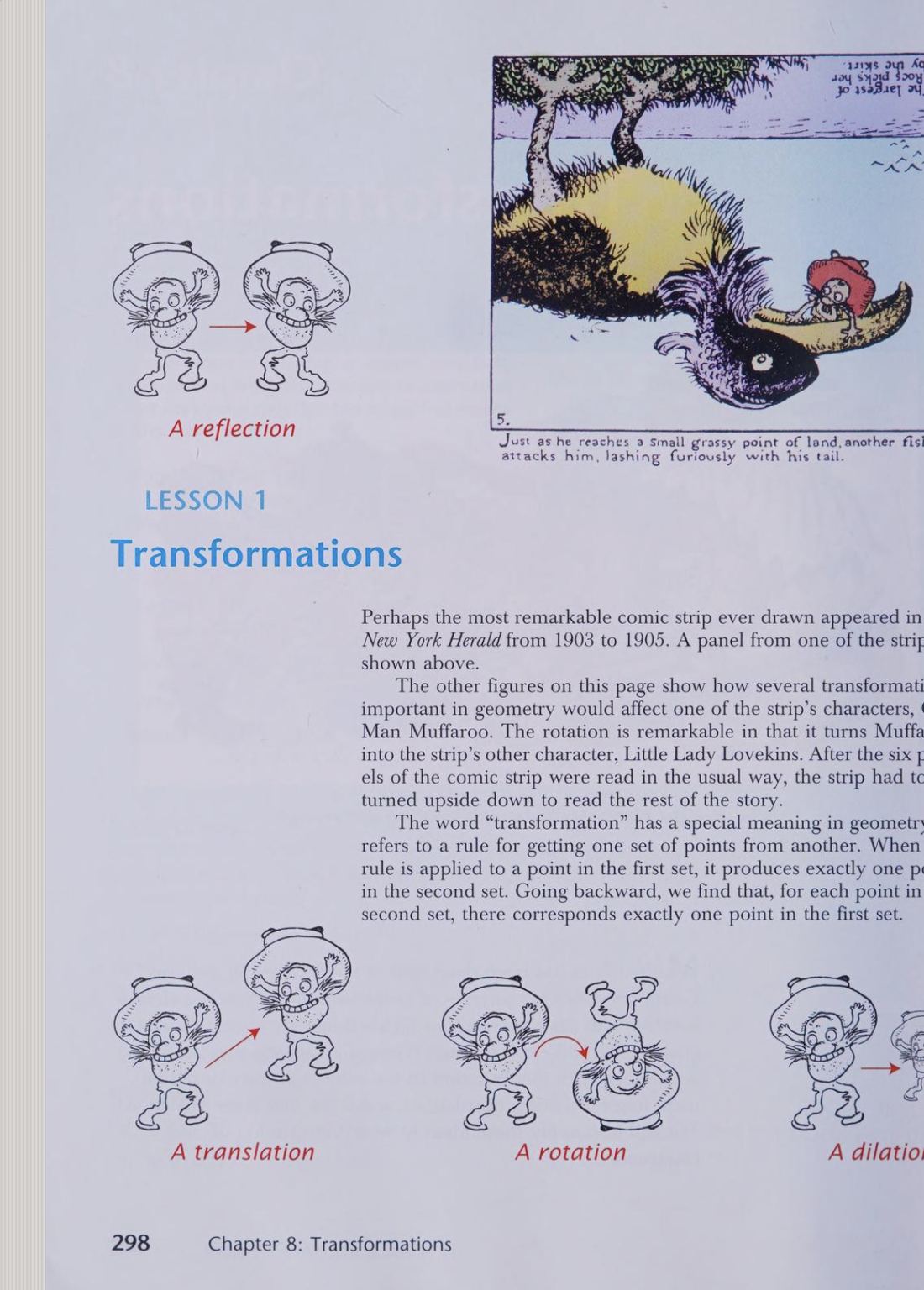
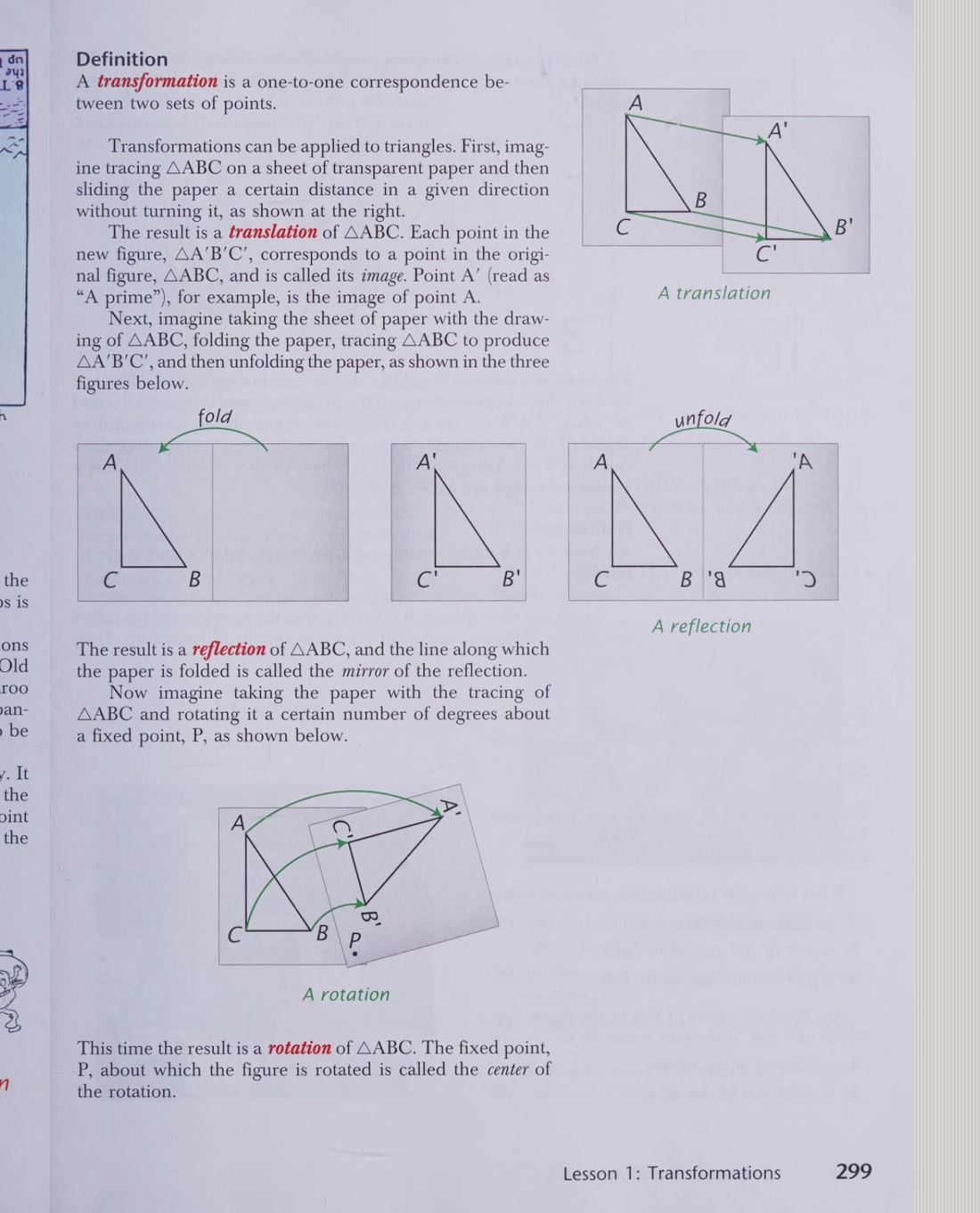
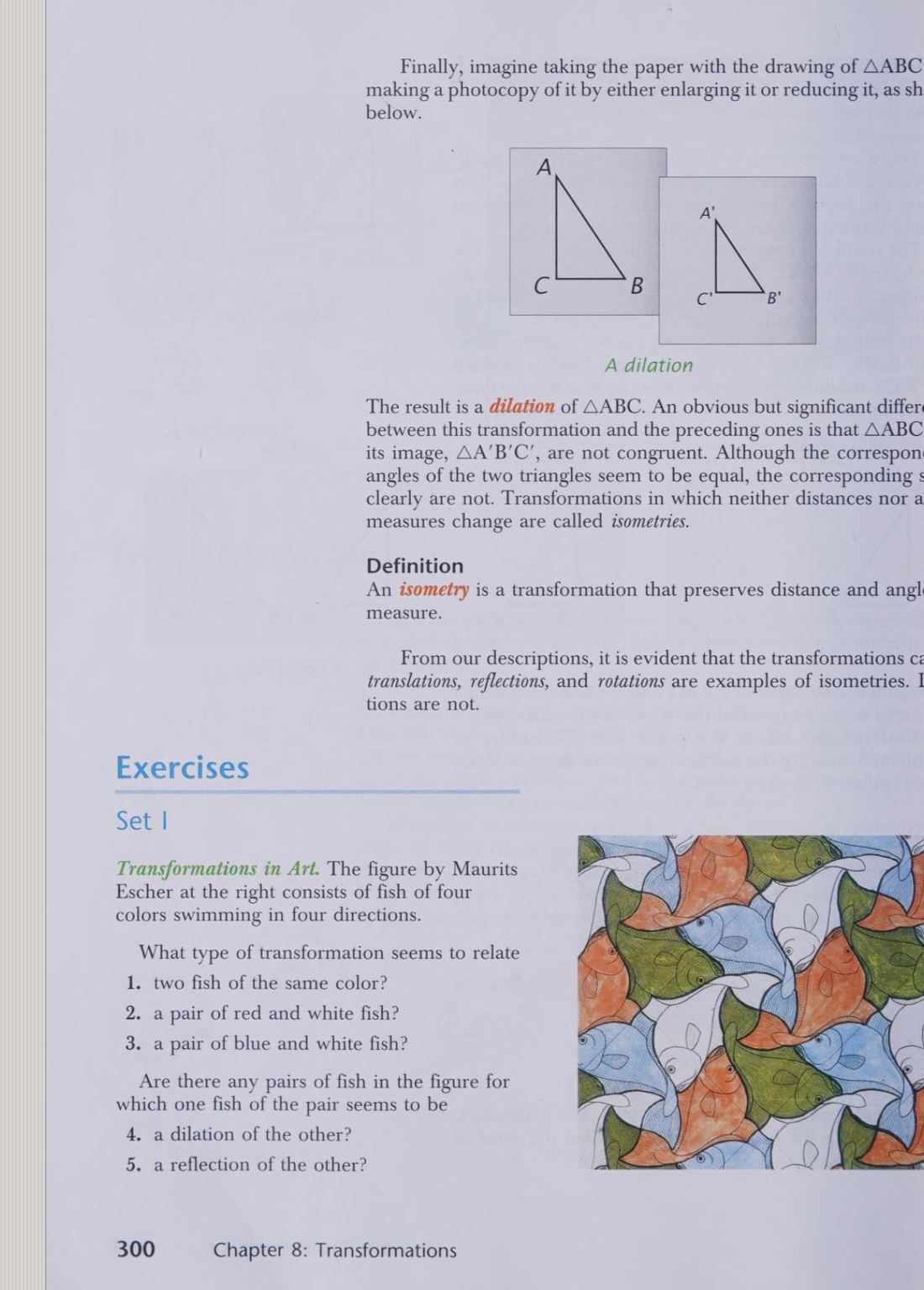
Questions 1 to 5: sorting Escher's fish
Fish of four colors swim in four directions. What transformation relates same-color fish? Red to white? Blue to white? Any dilations? Any reflections?
- Question 1: two fish of the same color point the same way and differ only in position: a translation, the tessellation's basic repeat.
- Questions 2 and 3: differently colored neighbors point in different directions, and turning one fish about the right point lands it on the other: rotations, through the angles the four swim-directions demand.
- Question 4: no dilations anywhere: every fish is the same size, as a tiling requires; a bigger fish would tear the fabric.
- Question 5: no reflections either, and the tell is handedness: every fish curls the same way. A mirrored fish would curl oppositely, like page 301's amino acids, and none does.
- Four questions, and you have audited a masterpiece for its symmetry group: translations and rotations only. That is precisely how crystallographers classify patterns, and Escher learned his trade from their papers.
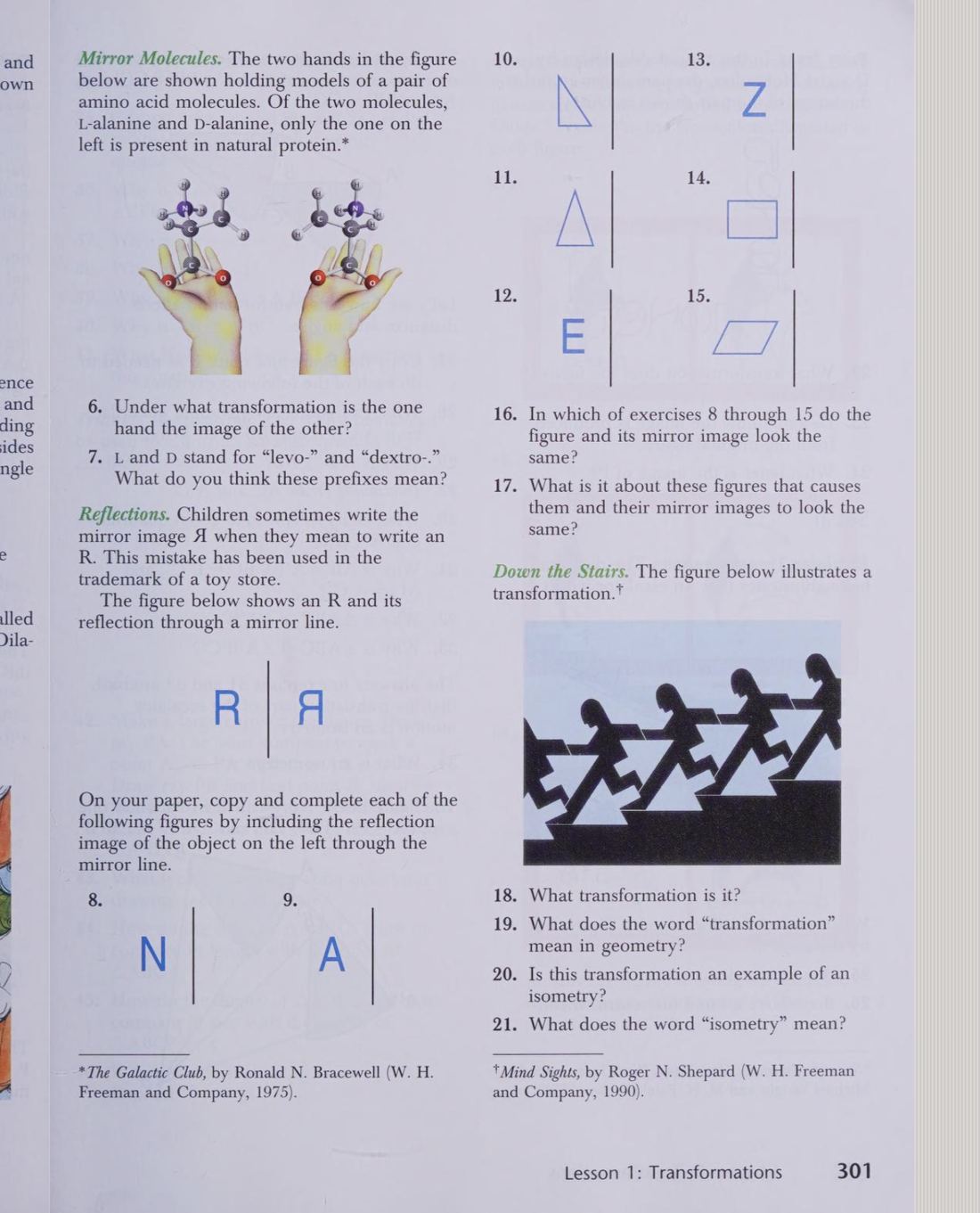
Questions 8 to 17: letters in the mirror
Reflect N, A, a triangle, an E, a Z, a square, and a parallelogram through a vertical mirror line. Which look unchanged, and why?
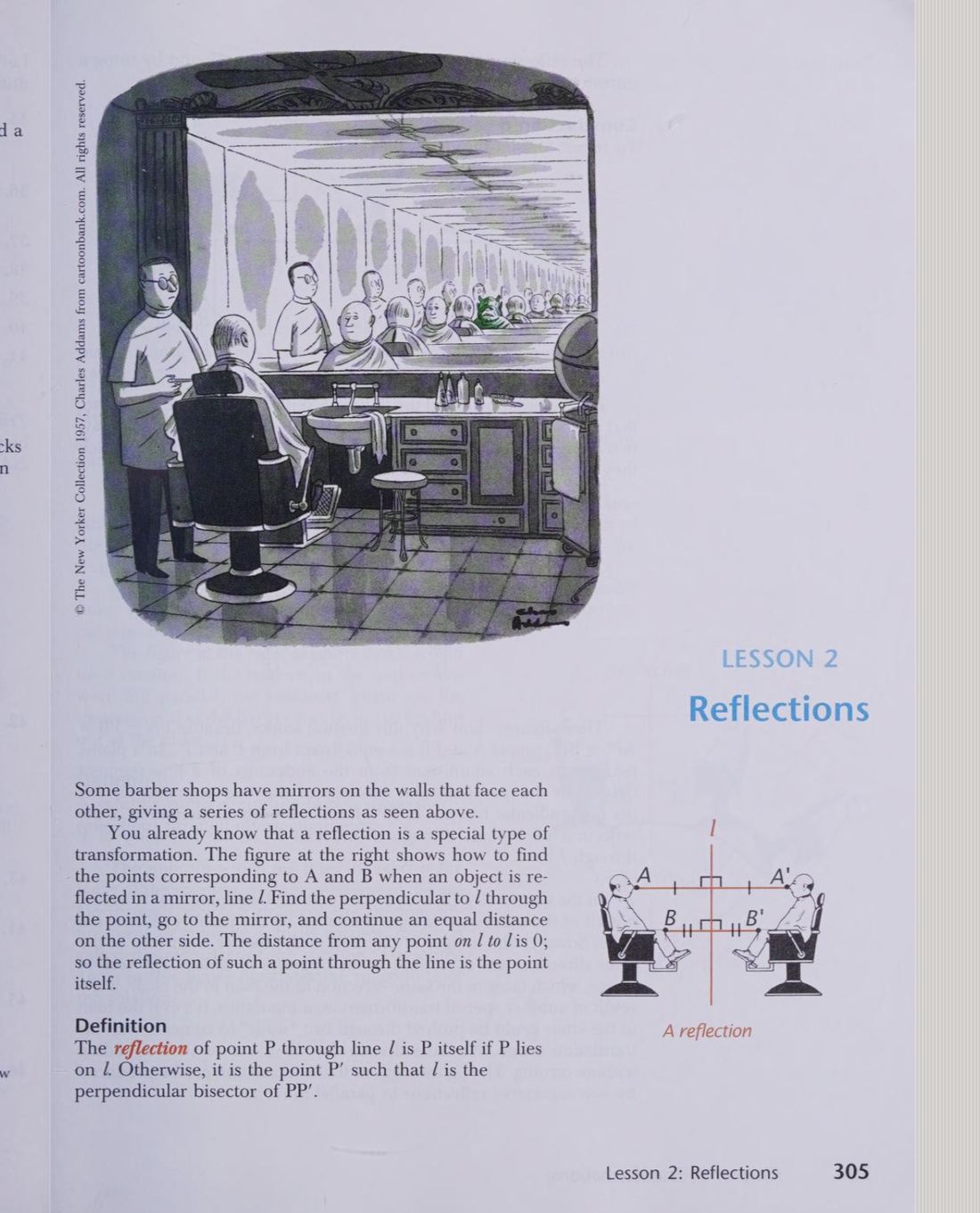
- Sketch each reflection by the page 305 recipe in miniature: every point crosses the mirror perpendicularly to the same distance beyond.
- Question 16's survivors: A, the triangle drawn point-up, and the square look the same reflected. N, E, Z, and the parallelogram come out backward (Z becomes an S-ish flip, N reverses its diagonal).
- Question 17, the why: the survivors have a vertical line of symmetry, and reflecting a figure through a mirror parallel to its own symmetry line reproduces it. The mirror only relocates what the figure's internal mirror already fixes.
- The failures are exactly the letters whose symmetry is point symmetry (N, Z) or none in the vertical direction (E has a horizontal line instead: it would survive a horizontal mirror).
- Toy-store signage exploits the R-versus-Я mistake for charm; chemistry, as the facing column shows, is deadly serious about the same distinction. Symmetry decides what reflection can and cannot change.
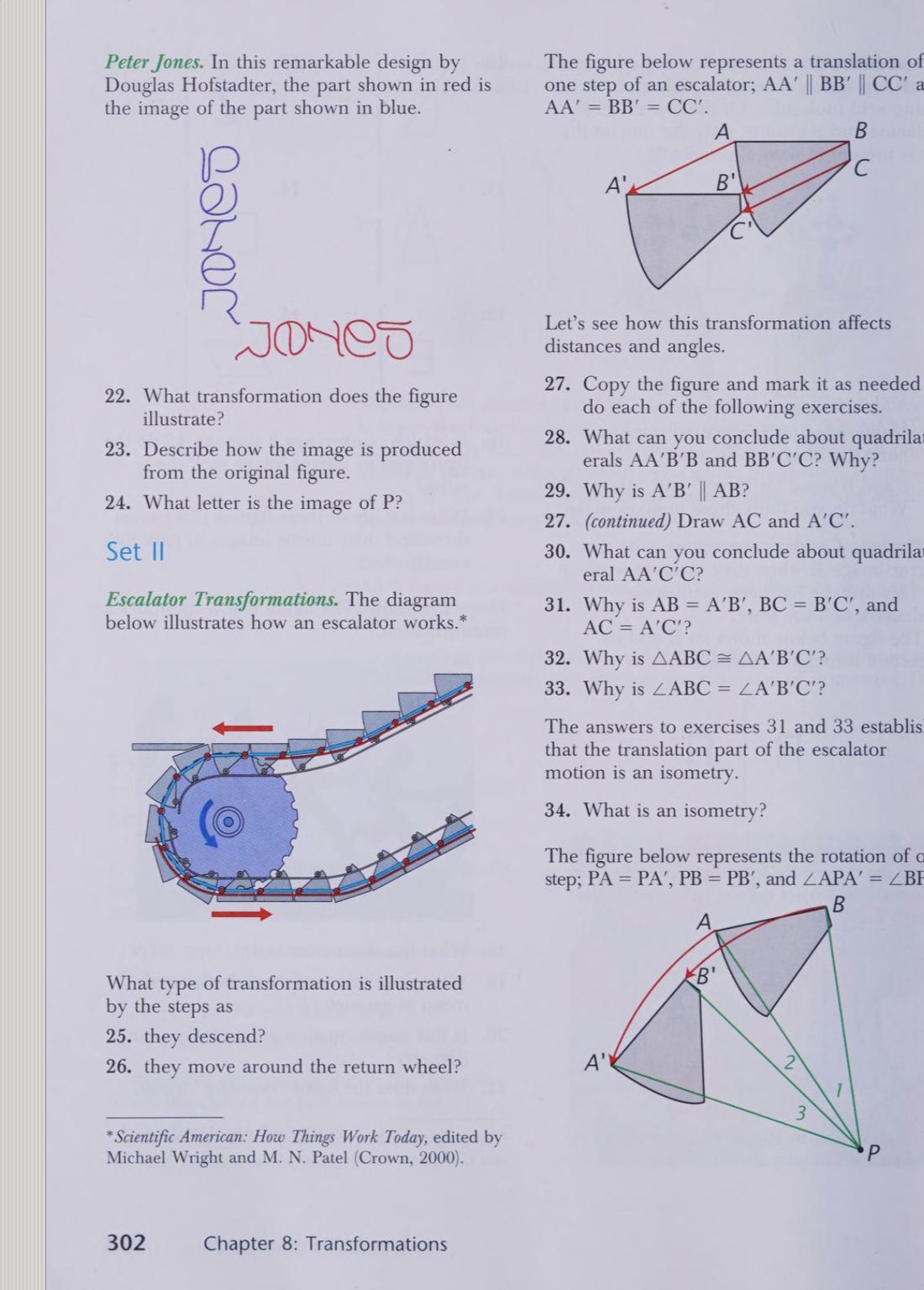
Questions 27 to 34: the escalator's translation
A step translates: AA′ ∥ BB′ ∥ CC′ and AA′ = BB′ = CC′. Prove distances and angles are preserved.
- Question 28: quadrilaterals AA′B′B and BB′C′C each have one pair of opposite sides both parallel and equal (the translation arrows): parallelograms by Theorem 29.
- Question 29: then A′B′ ∥ AB and A′B′ = AB, the parallelogram's other pair (Theorem 25); likewise B′C′ = BC.
- Questions 30 and 31: drawing AC and A′C′ makes AA′C′C a parallelogram the same way, so A′C′ = AC. All three distances survive.
- Questions 32 and 33: SSS then assembles △ABC ≅ △A′B′C′, and corresponding parts preserve the angles too.
- Question 34: that is the definition of isometry, verified rather than assumed: a translation moves everything and changes nothing measurable, which is why every escalator step carries its passengers undistorted. Chapter 7 built the tools; chapter 8 is spending them.
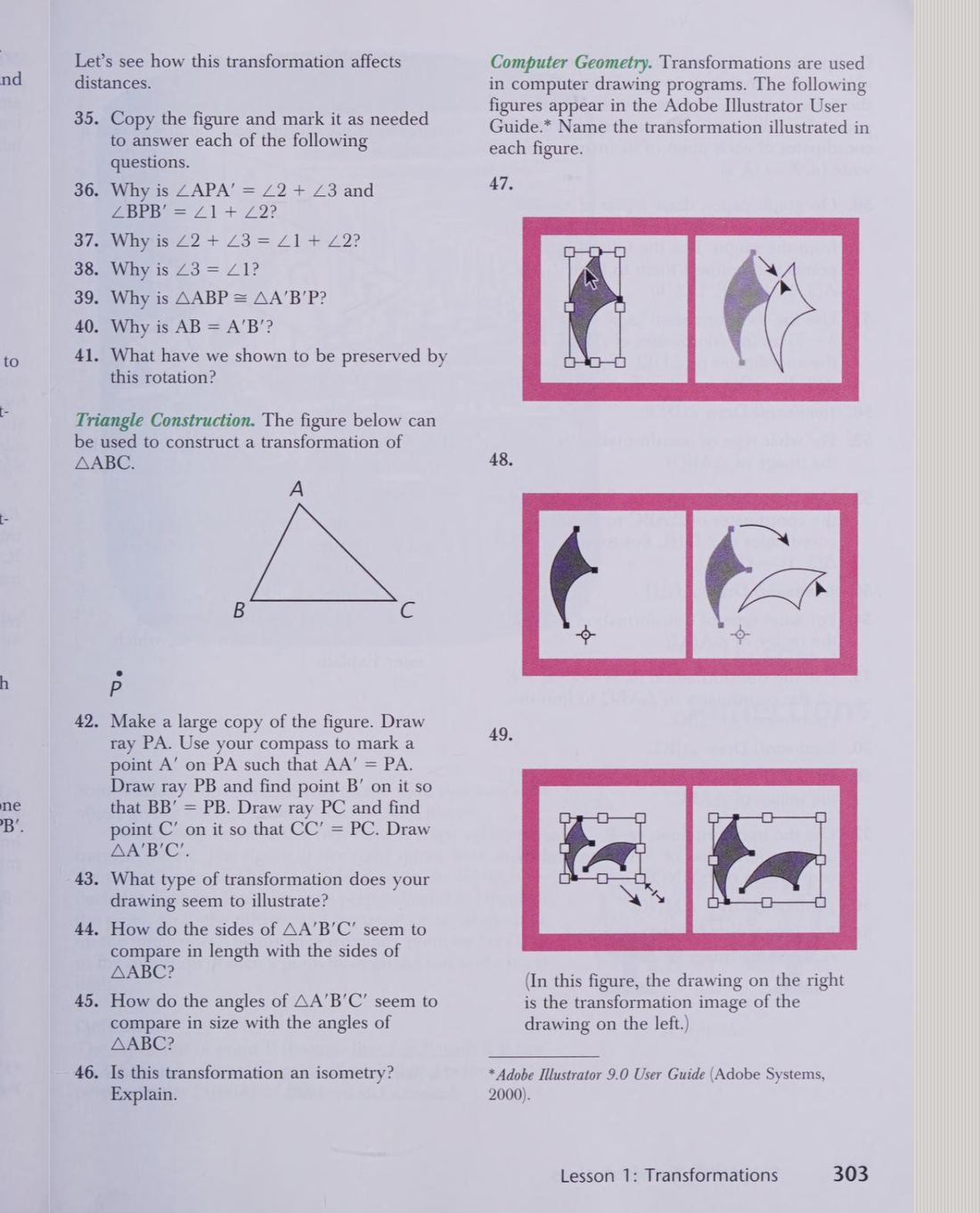
Questions 35 to 41: the rotation preserves distance
PA = PA′, PB = PB′, and ∠APA′ = ∠BPB′. Show AB = A′B′.
- Question 36: the Betweenness of Rays Theorem splits the two turning angles: ∠APA′ = ∠2 + ∠3 and ∠BPB′ = ∠1 + ∠2.
- Questions 37 and 38: the turning angles are equal (given), so ∠2 + ∠3 = ∠1 + ∠2, and subtracting the shared ∠2 leaves ∠3 = ∠1.
- Question 39: SAS assembles △ABP ≅ △A′B′P: two radii pairs equal, included angles just proved equal.
- Question 40: corresponding parts: AB = A′B′.
- Question 41: distance is preserved, and (running the same argument on any angle) so is angle measure: rotations are isometries. Note the proof's rhythm, split-subtract-SAS: it is page 96's pool-ball proof spinning on a wheel.
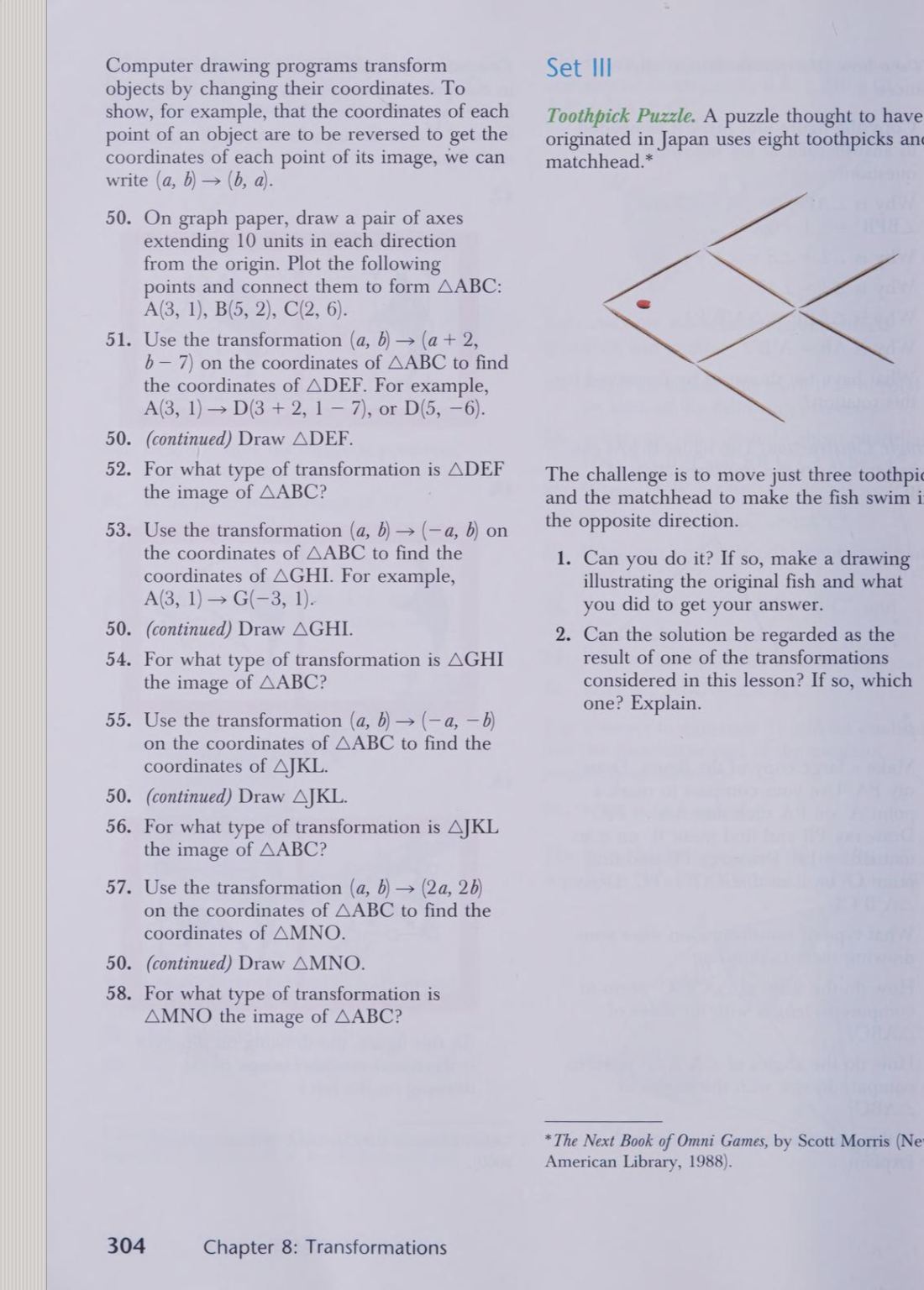
Questions 50 to 58: four rules, four transformations
Apply (a, b) → (a + 2, b − 7), (−a, b), (−a, −b), and (2a, 2b) to △ABC with A(3, 1), B(5, 2), C(2, 6), and name each transformation.
- Questions 51 and 52: adding constants slides every point the same amount: (a + 2, b − 7) is a translation, 2 right and 7 down; DEF sits congruent in the fourth quadrant.
- Questions 53 and 54: negating x alone flips left-right: (−a, b) is a reflection through the y-axis, the page 155 fold returning with a formula.
- Questions 55 and 56: negating both coordinates is a 180° rotation about the origin (equivalently, point symmetry through it): JKL hangs upside down across the origin.
- Questions 57 and 58: doubling both coordinates pushes every point twice as far from the origin: a dilation with center O and factor 2, the only non-isometry of the four.
- Read the ledger the way a programmer would: add for translation, negate for reflection or rotation, multiply for dilation. Four one-line formulas, and the whole lesson runs on arithmetic.
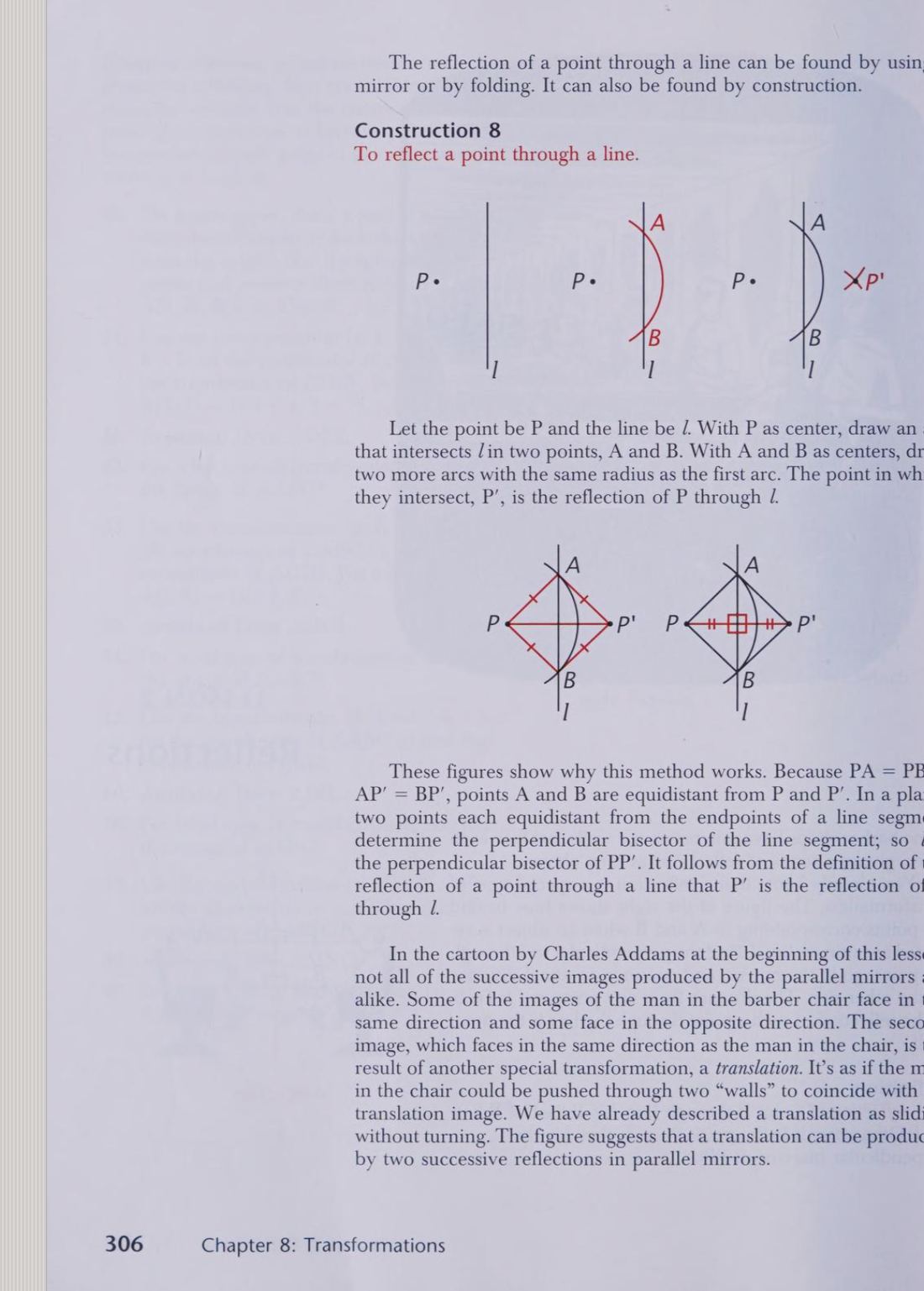
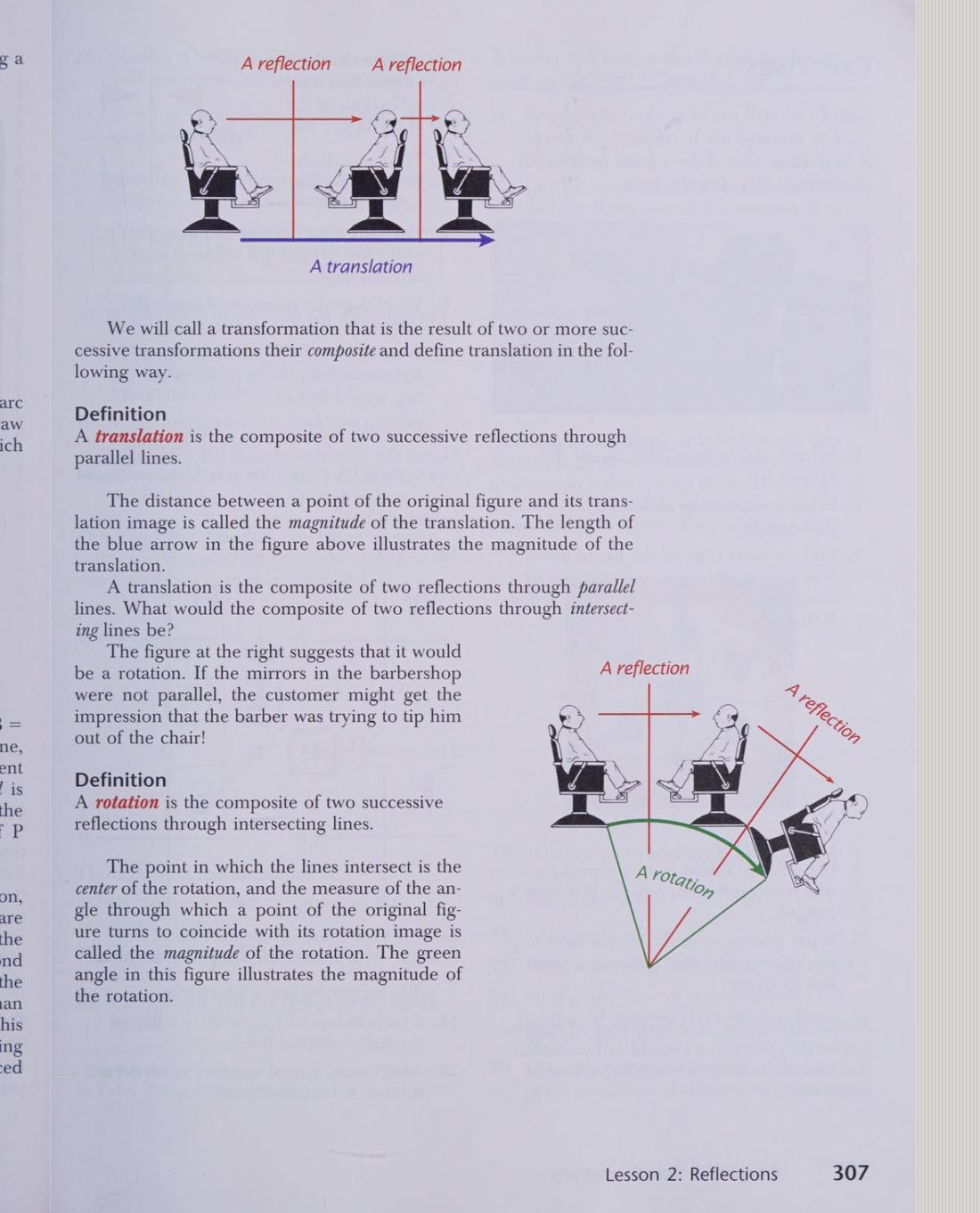
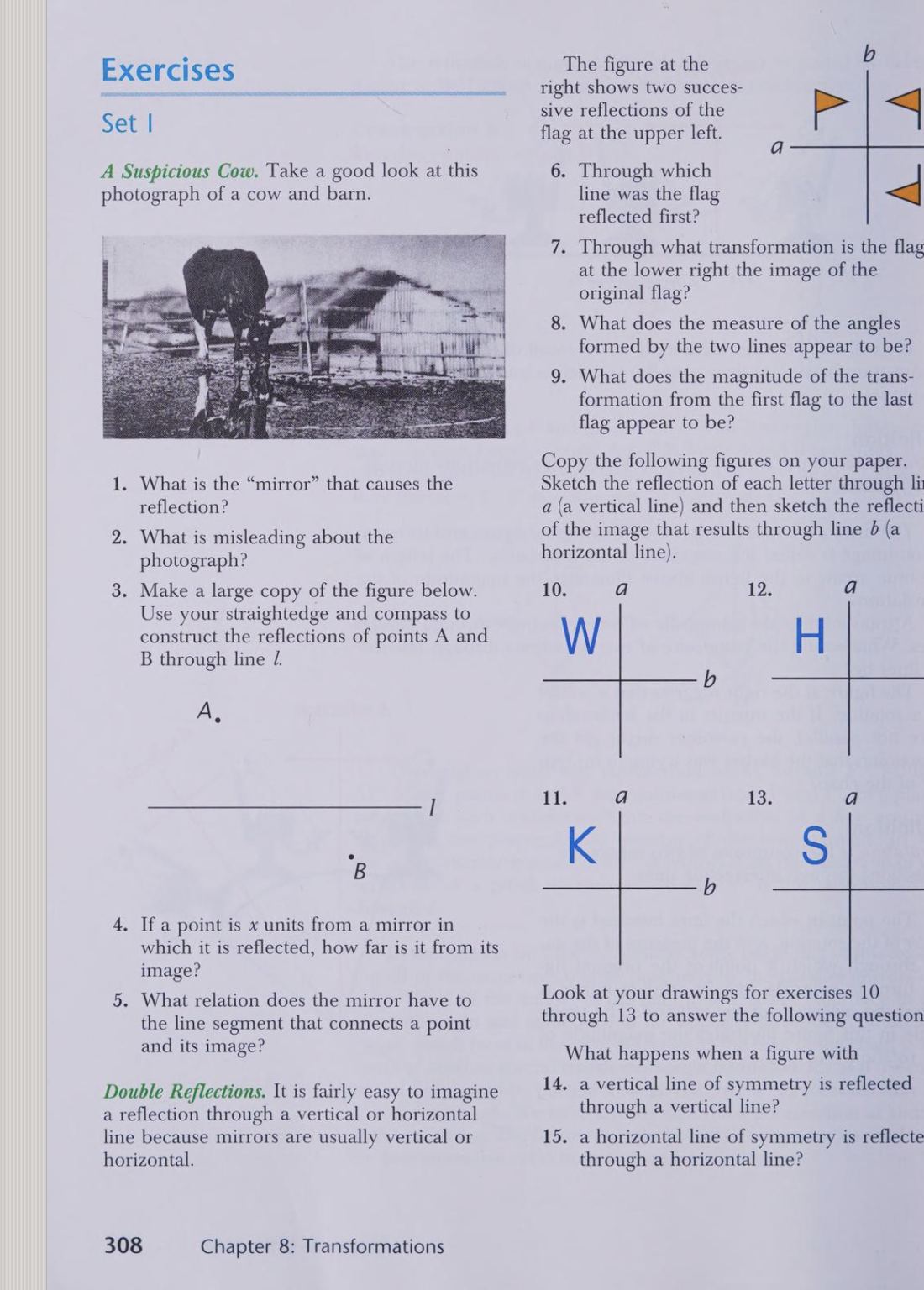
Questions 6 to 9: the twice-reflected flag
A flag is reflected through vertical line b, then the image through vertical line a (the lines are parallel). Trace the path and measure the composite.
- Question 6: follow the handedness: the middle flag is backward, so it is the mirror image; the flag was reflected first through the line between the original and the backward copy.
- Question 7: the final flag faces the same way as the original: two flips cancel the handedness, and the composite is a translation, by page 307's definition.
- Question 8: the drawn lines meet nowhere and make equal corresponding angles with any transversal: parallel, as the definition of translation requires... and the marked angles confirm perpendicularity to the flags' baseline.
- Question 9: measure original-to-final: the magnitude comes out exactly twice the distance between the two mirror lines. Hold that factor of two; page 311 proves it in general, and it is the reason parallel barbershop mirrors space their images evenly.
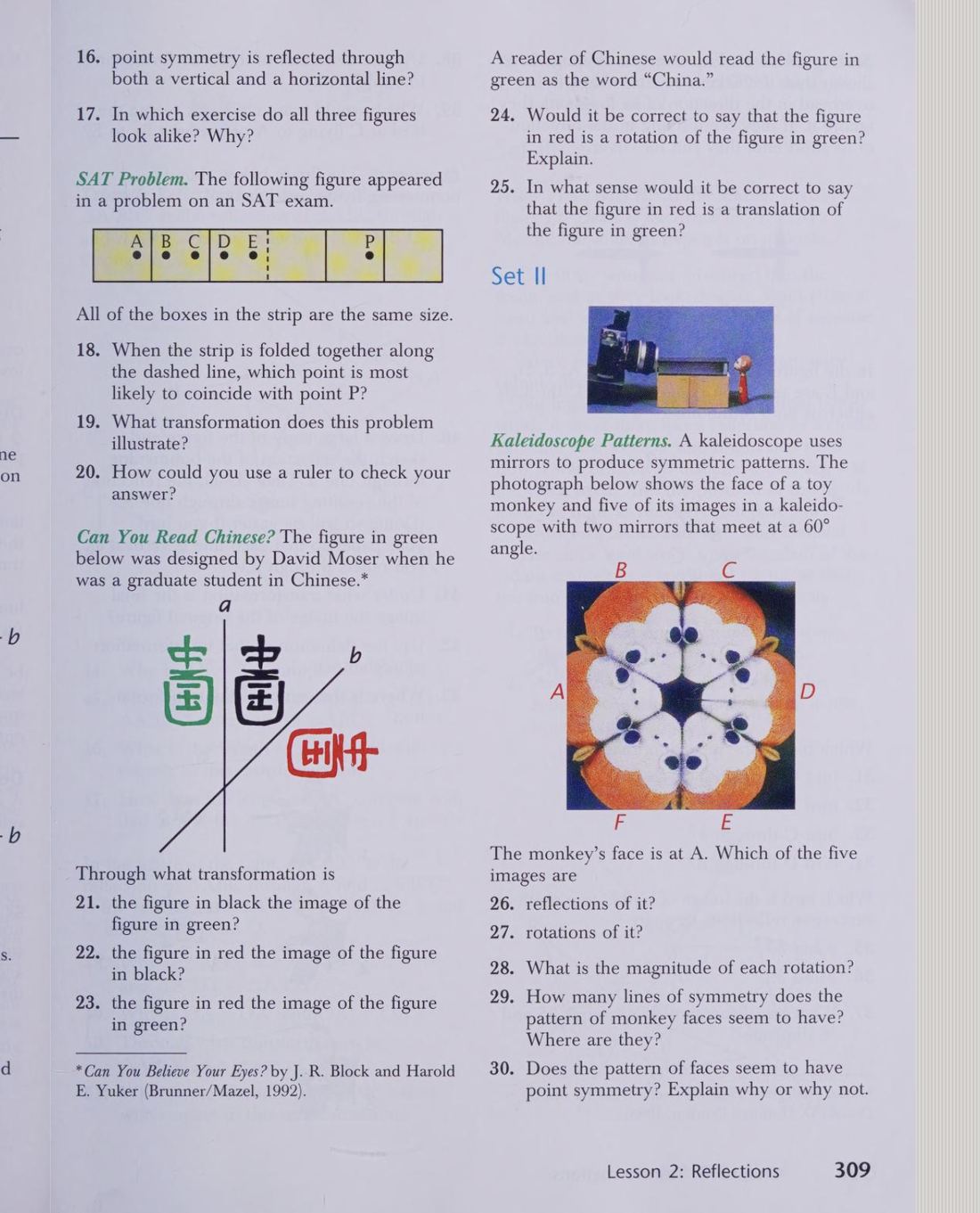
Questions 26 to 30: the sixfold monkey
A monkey's face at A and five images B through F fill a kaleidoscope built from two mirrors at 60°. Which images are reflections, which rotations, with what magnitudes and symmetries?
- Question 26: the images adjacent across each mirror, and the one flipped across both in turn oddly, carry reversed handedness: B, D, and F are reflections of A.
- Question 27: C and E face with A's own handedness: composites of two reflections, hence rotations about the mirrors' crossing.
- Question 28: two mirrors at 60° rotate by twice their angle: magnitudes 120° and 240° for C and E, the page 307 doubling previewed.
- Question 29: the finished pattern has three lines of symmetry, along the mirrors and their images; question 30: no point symmetry, since a 180° turn lands monkey on monkey only if six were arranged with opposite pairs alike, and an odd alternation of flipped and unflipped faces refuses.
- A toy, fully audited: reflections as atoms, rotations as their molecules, magnitudes doubled from the mirror angle. Every kaleidoscope you ever owned was teaching this lesson.
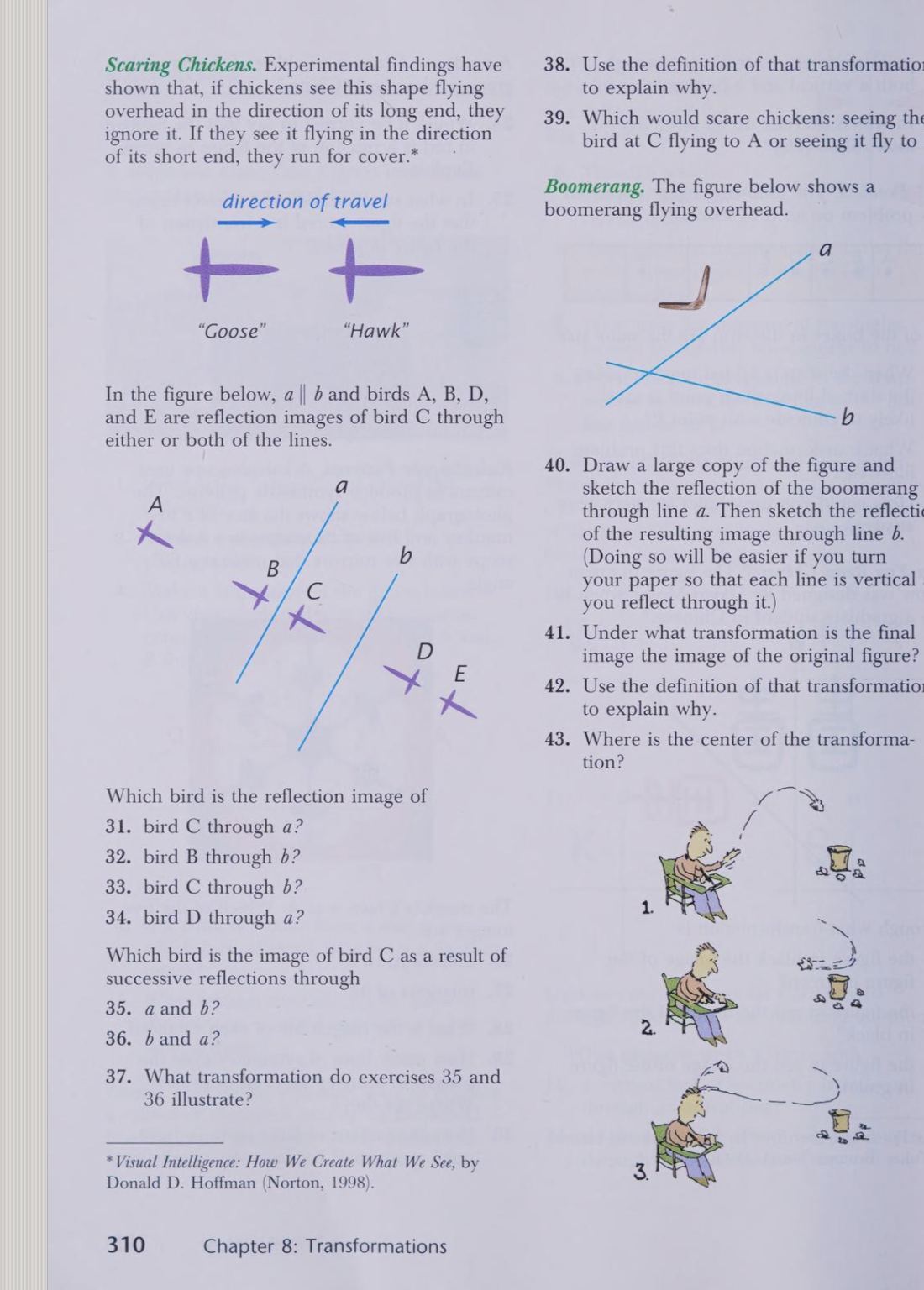
Questions 31 to 39: the chicken-scaring composite
a ∥ b; birds A, B, D, E are reflection images of bird C through one or both lines. Trace the reflections, name the composite, and answer the ethology question.
- Questions 31 to 34, one mirror at a time: C reflects through a to B, and through b to D; B reflects through b to E... follow your own figure's positions, checking each pair crosses its mirror perpendicularly at equal distances.
- Questions 35 and 36: reflecting C through a then b lands on E; through b then a lands on A. Order matters for where you land, though both composites slide the same distance.
- Question 37: two reflections through parallel lines: a translation, by definition.
- Question 38: the definition explains the handedness: two flips restore the original facing, so E is C slid along, beak-first the same way.
- Question 39: the translated bird at E flies short-end first, the hawk silhouette: that is the flight that scares chickens. The reflected bird at A flies goose-wise and is ignored. Two mirrors, one barnyard panic; the difference between a flip and a slide has survival value.
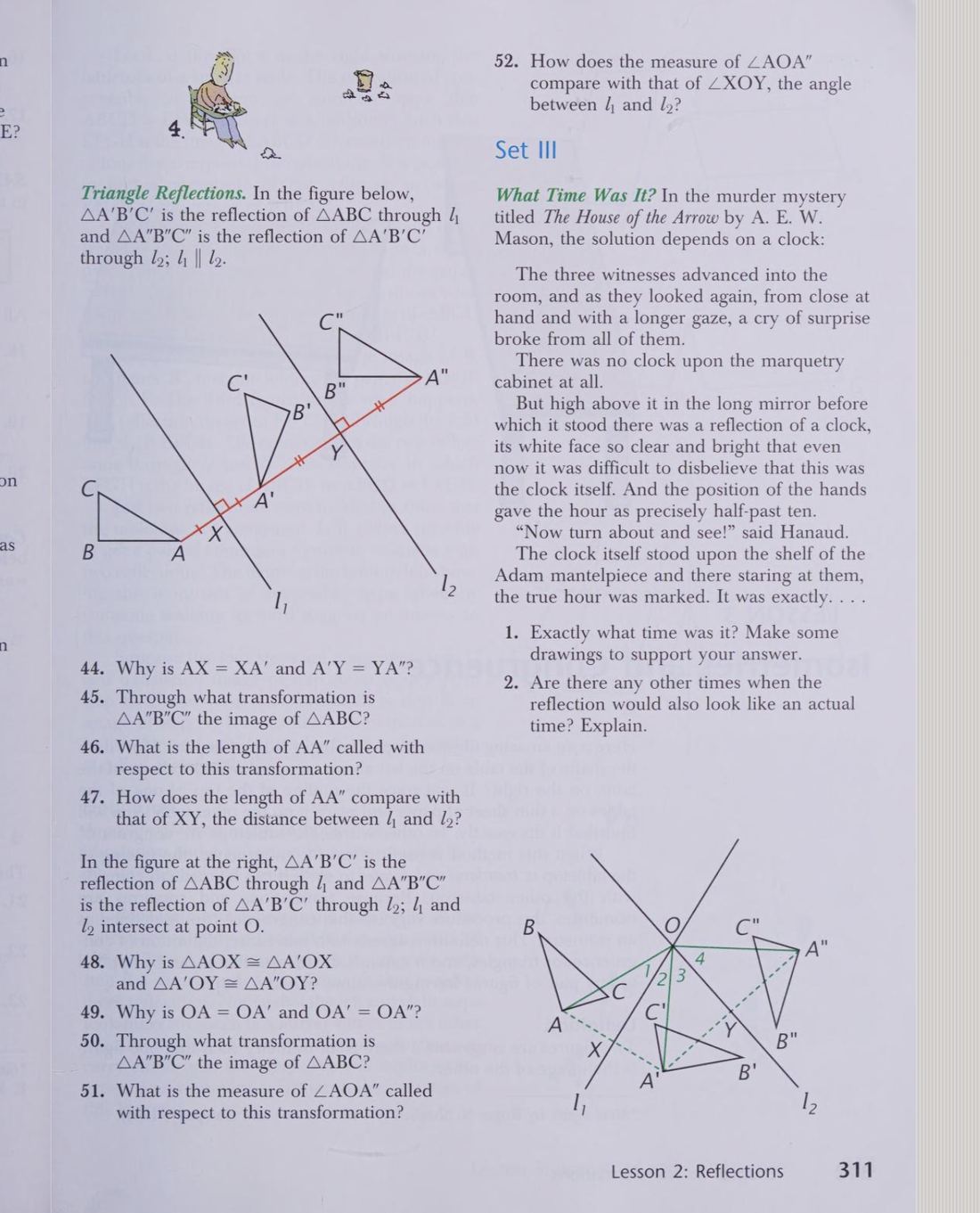
Questions 44 to 52: the doubling theorems
Reflect △ABC through l₁, then the image through l₂. If the lines are parallel, measure the translation; if they intersect at O, measure the rotation.
- Parallel case, question 44: each reflection's definition makes its mirror the perpendicular bisector: AX = XA′ and A′Y = YA″.
- Questions 45 to 47: the composite is a translation, its magnitude AA″ = AX + XA′ + A′Y + YA″ = 2XA′ + 2A′Y = 2XY: twice the distance between the mirrors, confirming the flag measurement.
- Intersecting case, question 48: SSS (equal radii from the constructions) gives △AOX ≅ △A′OX and △A′OY ≅ △A″OY.
- Questions 49 to 51: corresponding parts make OA = OA′ = OA″ (everything stays on a circle about O), and the composite is a rotation about O with magnitude ∠AOA″.
- Question 52: the angle bookkeeping doubles exactly as the distances did: ∠AOA″ = 2∠XOY. Two clean laws: mirror gap doubles into slide, mirror angle doubles into turn. Set a pocket mirror pair at 30° and count the images against the 360/60 arithmetic; the theorems run on your desk.