Questions 6 to 13: AAA, SSA, and HA on trial
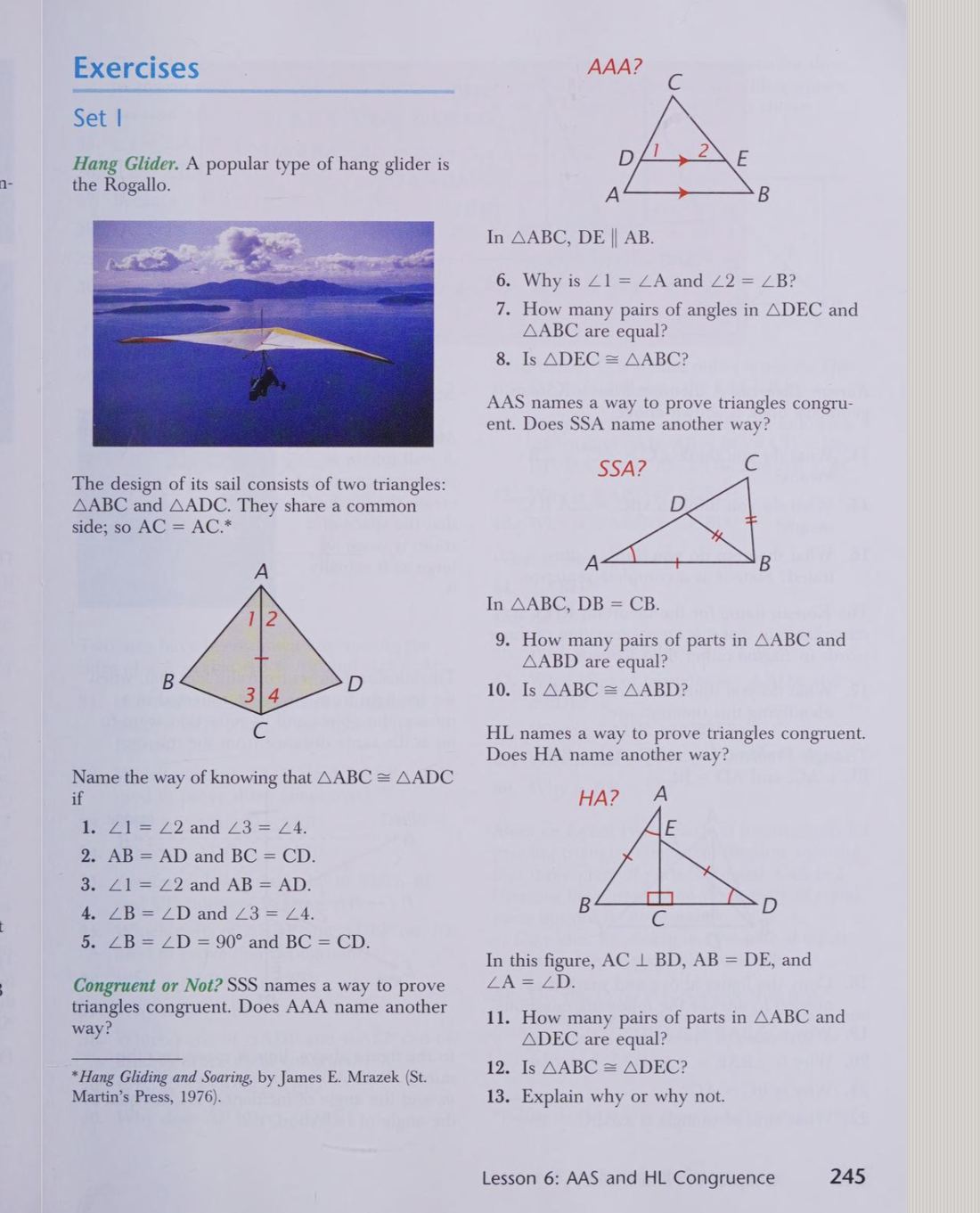
Does AAA prove congruence? Does SSA? Does HA (hypotenuse and an acute angle)?
- AAA (questions 6 to 8): with DE ∥ AB, corresponding angles make all three angle pairs of △DEC and △ABC equal, yet the small triangle sits inside the big one. Same shape, different size: AAA fails, and the failure has a future (chapter 9 will name it similarity).
- SSA (questions 9 and 10): with DB = CB, triangles ABC and ABD share ∠A, side AB, and equal sides CB = DB, three pairs of parts in SSA position, yet one triangle is visibly fatter. The free-swinging side can land in two places; SSA fails.
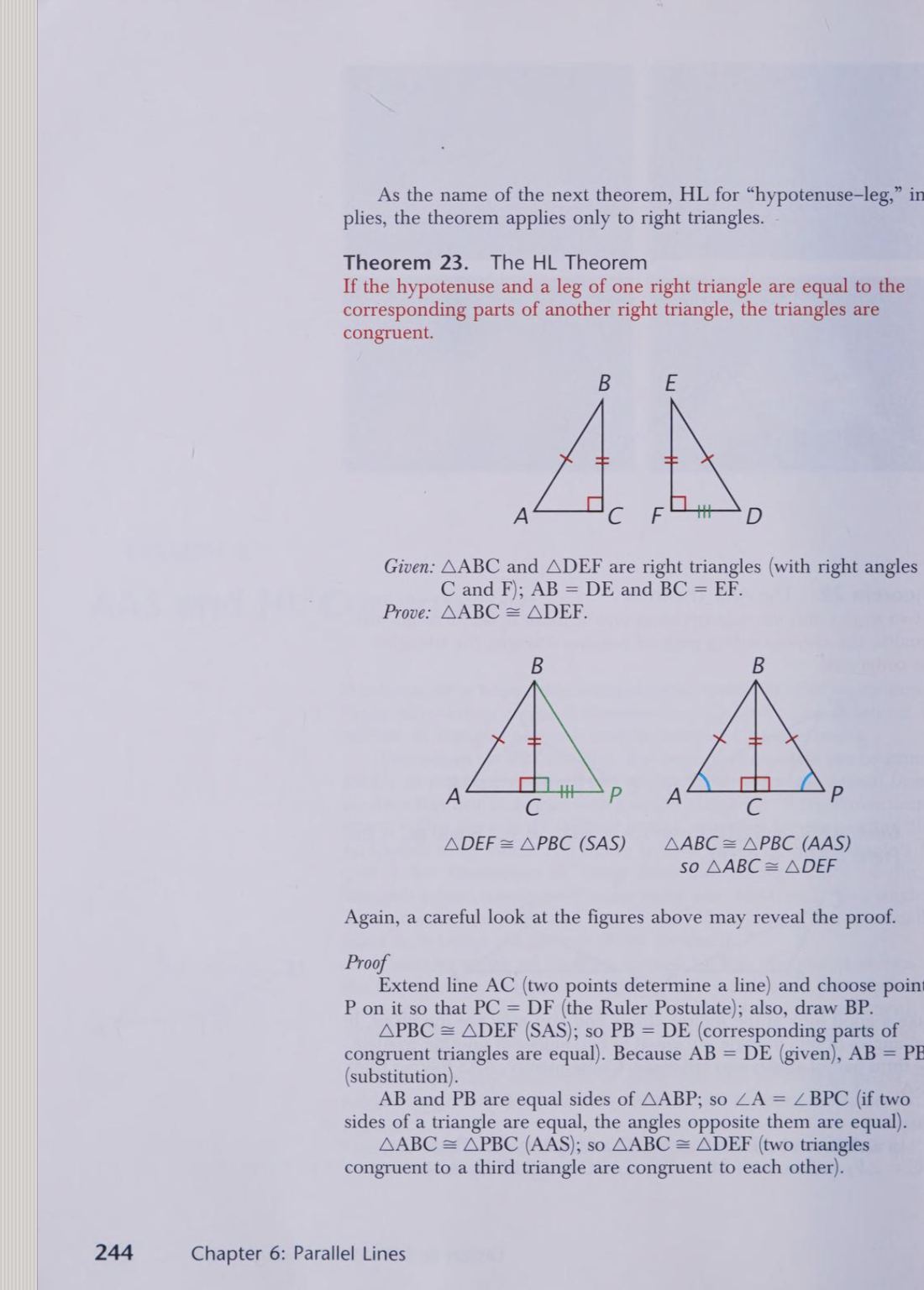
- HA (questions 11 to 13): right angles at C, AB = DE, and ∠A = ∠D. Count with AAS eyes: two angles (the right angle and the acute one) and the side opposite the right angle, the hypotenuse. That is AAS exactly, so HA succeeds: yes, △ABC ≅ △DEC.
- The scoreboard: five theorems, two named impostors, one alias. What separates winners from losers is never how many parts match but whether the arrangement pins the triangle, and the right angle is what disciplines SSA into HL and HA.
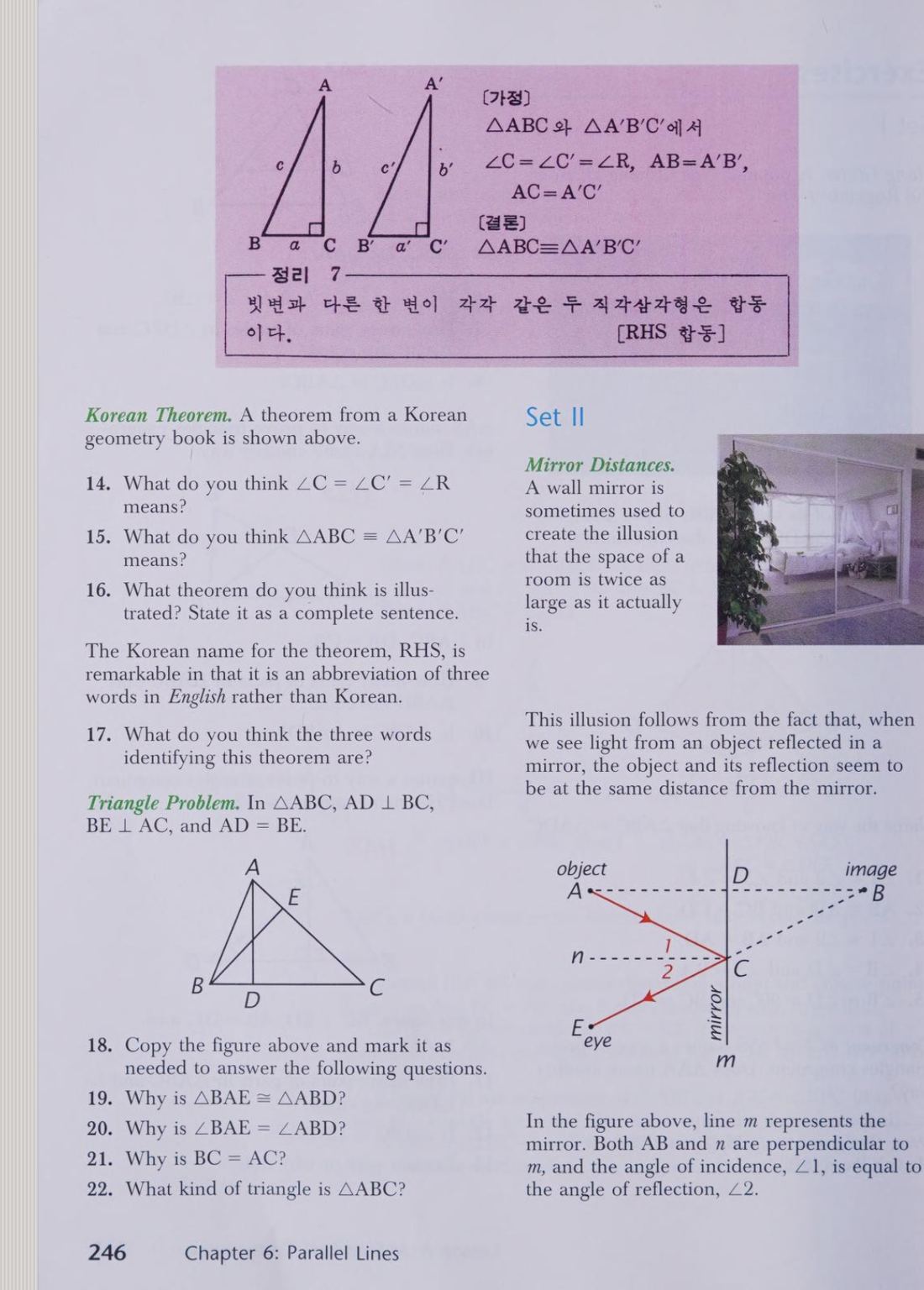
Questions 18 to 22: equal altitudes, isosceles triangle
In △ABC, AD ⊥ BC, BE ⊥ AC, and AD = BE. Prove the triangle is isosceles.
- Mark the figure: two right angles at the altitude feet, the equal altitudes ticked, and notice the two overlapping right triangles that share the base AB: △BAE and △ABD.
- Question 19: in those triangles, AB = AB (reflexive, the shared hypotenuse), and BE = AD (given legs): hypotenuse and leg of right triangles: HL, so △BAE ≅ △ABD.
- Question 20: corresponding parts: ∠BAE = ∠ABD, which are the base angles ∠A and ∠B of the big triangle.
- Question 21: equal angles force equal opposite sides (Theorem 10): BC = AC.
- Question 22: two equal sides is the definition: △ABC is isosceles. Read the theorem you just proved in words: a triangle with two equal altitudes is isosceles, the converse of a fact your drawings have suggested since page 165's plumb level. HL earned its keep on day one.
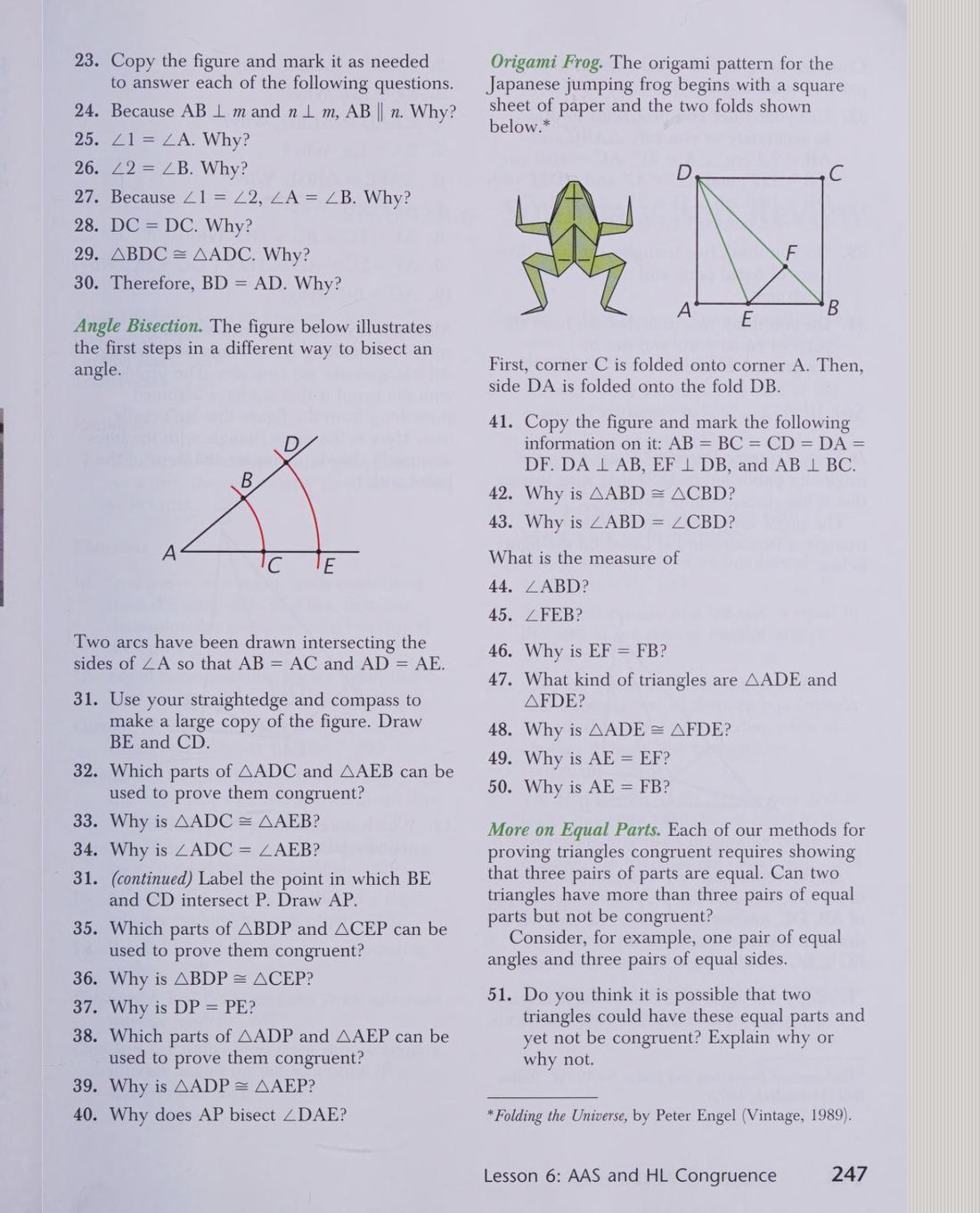
Questions 24 to 30: the mirror illusion
AB and n are perpendicular to mirror m; the incidence and reflection angles at C are equal. Prove BD = AD: the image sits as far behind the mirror as the object in front.
- Question 24: AB ⊥ m and n ⊥ m make AB ∥ n, two perpendiculars to a third line (chapter 6's oldest corollary).
- Questions 25 and 26: with AB ∥ n, transversal AC makes ∠1 and ∠A alternate interior angles, so ∠1 = ∠A, and transversal BC gives ∠2 = ∠B the same way.
- Question 27: ∠1 = ∠2 is the law of reflection (given), so ∠A = ∠B by substitution.
- Questions 28 and 29: DC = DC along the mirror, the right angles at D match, and with ∠A = ∠B we have AAS: △BDC ≅ △ADC.
- Question 30: corresponding parts: BD = AD. The eye, tracing rays backward, places the image at B, exactly the object's distance on the far side, which is why a mirror doubles a room and why your reflection keeps your size. Euclid's Optics stated it; your five theorems just proved it.
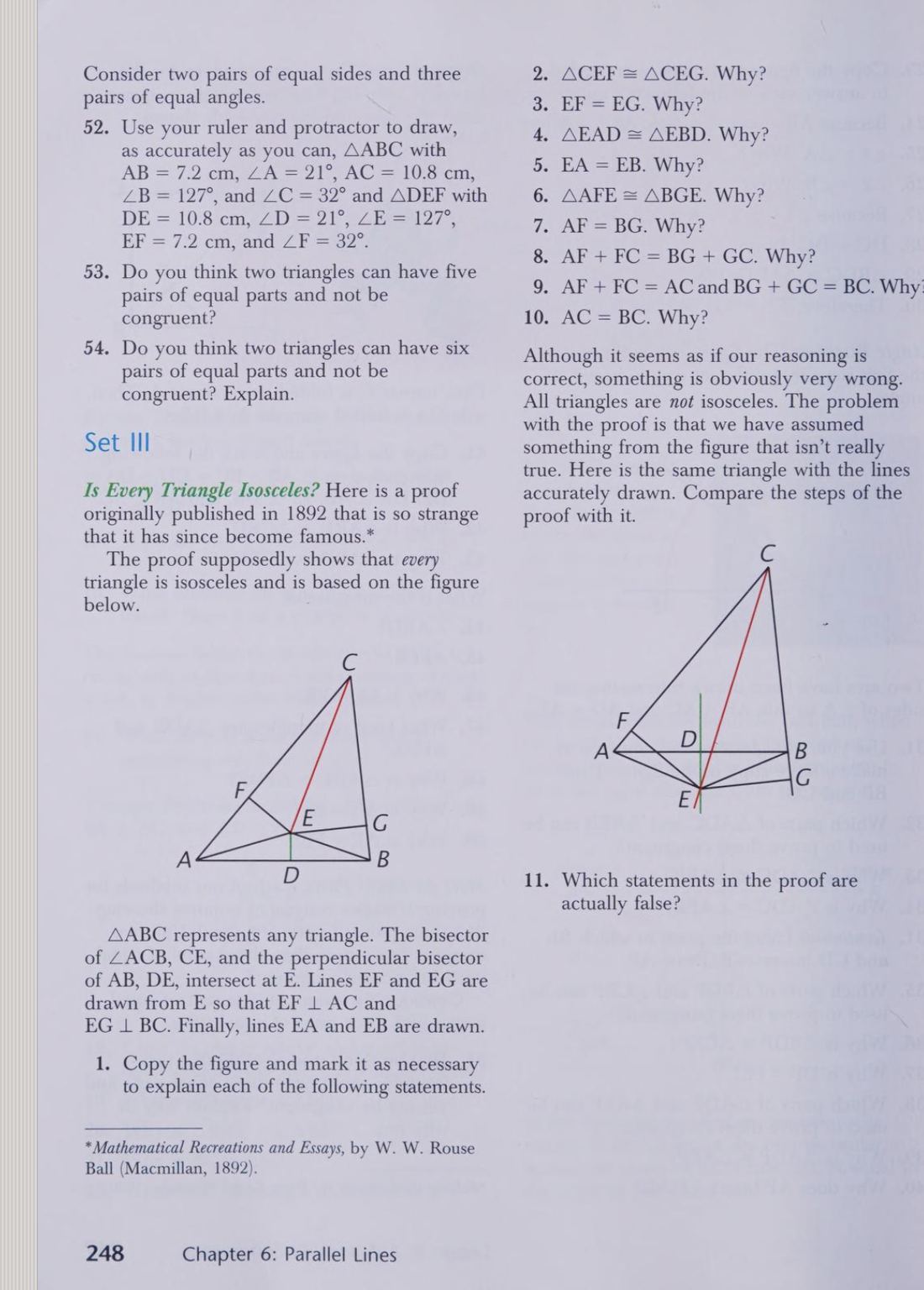
Set III: the every-triangle-is-isosceles fallacy
The angle bisector at C and the perpendicular bisector of AB meet at E; perpendiculars EF and EG drop to the sides; EA and EB are drawn. Ten steps conclude AC = BC. Where is the lie?
- Audit the congruences first: △CEF ≅ △CEG is honest AAS (bisected angle, right angles, shared CE), so EF = EG. △EAD ≅ △EBD is honest SAS, so EA = EB. △AFE ≅ △BGE is honest HL. Every cited theorem is used correctly.
- So AF = BG and, adding the equal pieces, AF + FC = BG + GC, and if those sums are AC and BC, every triangle is isosceles. Absurd, so audit the one unexamined witness: the figure.
- Question 11, against the accurate drawing: E does not sit inside the triangle at all; the bisector and perpendicular bisector meet below AB (on the circumscribed circle, as chapter 11 will reveal). And the perpendicular feet split: F lands on side AC, but G lands outside segment BC, beyond the vertex.
- The false statement is the addition claim: BG + GC is not BC when G lies outside the segment; betweenness fails, so the Betweenness of Points Theorem never applied. One unstated "G is between B and C," assumed from a doctored picture, carried the whole fraud.
- Keep this proof framed: every congruence theorem used rightly, one figure trusted wrongly. Marked figures think for you (page 153); forged figures think against you.
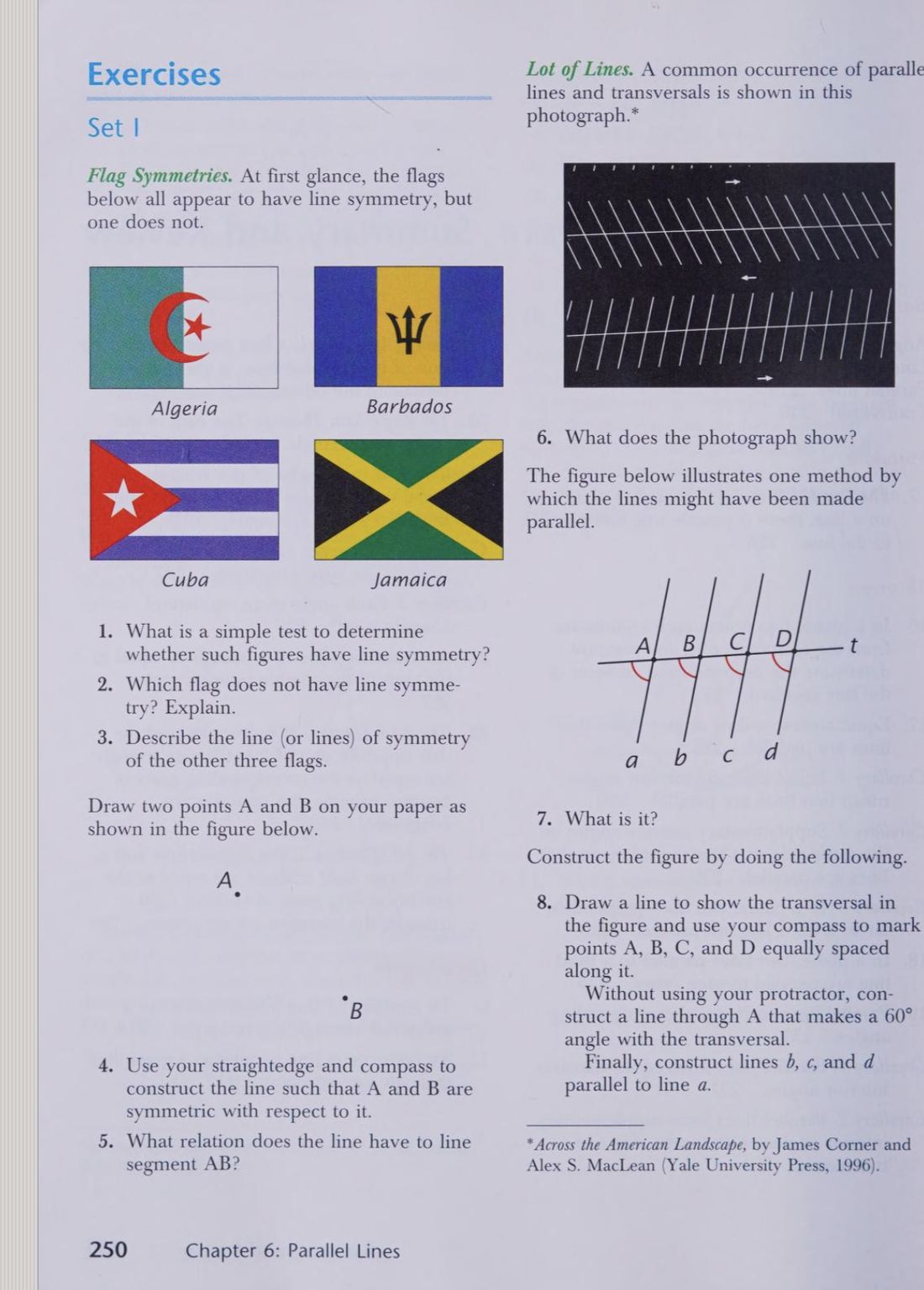
Questions 1 to 5: the flag lineup
Algeria, Barbados, Cuba, Jamaica: which lacks line symmetry, what are the others' lines, and construct the symmetry line for two points A and B.
- Question 1: the test is the fold (or a tracing flipped): a figure has line symmetry iff some fold lands it exactly on itself, page 212's definition in the hand.
- Question 2: Algeria fails. Its crescent opens toward one side, and no fold can send an opening-right crescent onto itself; the star and crescent break every candidate line.
- Question 3: Barbados folds left onto right: one vertical line through the trident's shaft. Cuba folds top onto bottom: one horizontal line through the star. Jamaica's gold saltire allows both the horizontal and the vertical: two lines.
- Questions 4 and 5: for points A and B, the line making them symmetric is by definition the perpendicular bisector of AB: construct it with the two-arc crossing (Construction 1), and name the relation exactly that way.
- Notice the grading rubric hiding in question 3: "describe the line" means locate it (through the shaft, through the star), not just count it. Symmetry claims are claims about a specific line, and naming it is the proof.
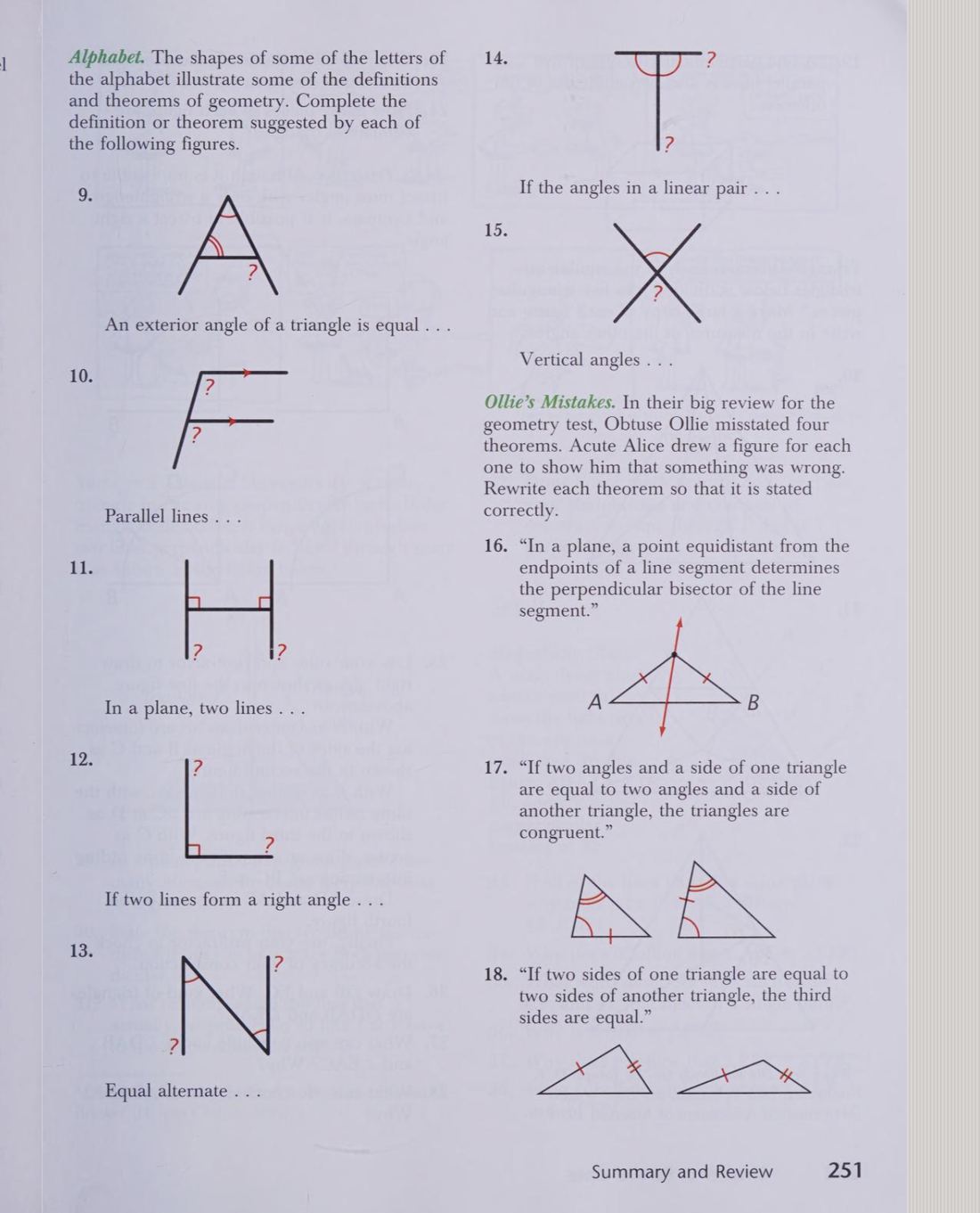
Questions 9 to 15: the theorem alphabet
A, F, H, L, N, T, X: complete the definition or theorem each letter's shape suggests.
- A (question 9): the crossbar cuts the legs, making an exterior angle at the apex... read the marked angles: an exterior angle of a triangle is equal to the sum of the remote interior angles (Theorem 21).
- F (10): two parallel arms cut by the vertical stem: parallel lines form equal corresponding angles (Theorem 19). H (11): two vertical strokes joined by a perpendicular bar: in a plane, two lines perpendicular to a third line are parallel.
- L (12): if two lines form a right angle, they are perpendicular (the definition). N (13): the diagonal crossing the two parallel strokes: equal alternate interior angles mean that lines are parallel.
- T (14): if the angles in a linear pair are equal, their sides are perpendicular (Theorem 8, visiting from chapter 3). X (15): vertical angles are equal.
- Two letters cite definitions, five cite theorems, and three chapters share the credits. If any completion hesitated, its page number is one column away on 249; the alphabet is the summary list wearing serifs.
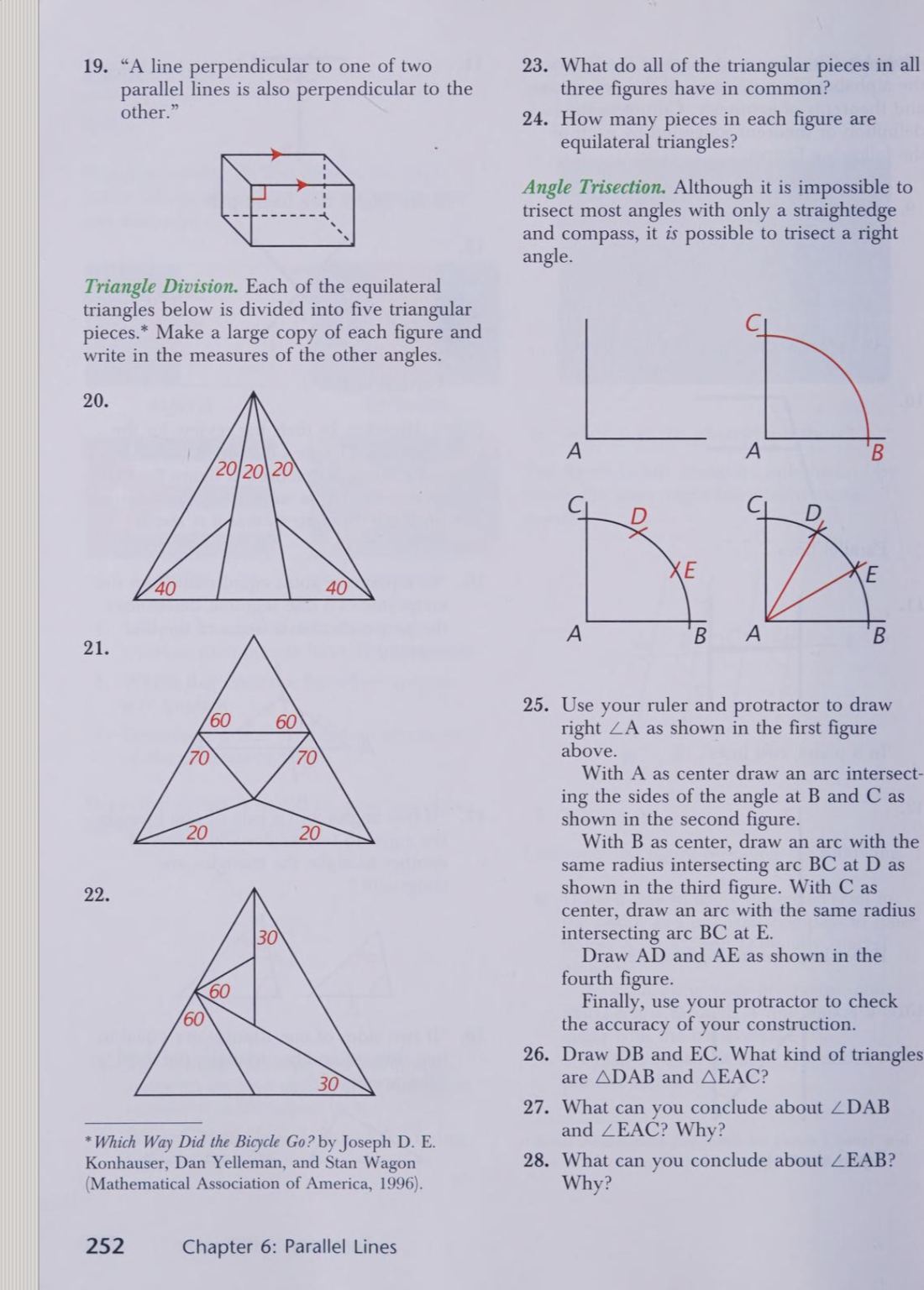
Questions 25 to 28: trisecting the right angle
One arc from A crosses the sides at B and C; equal arcs from B and from C cross it at D and E; draw AD and AE. Why does this trisect the 90°?
- Question 26: AD = AB = BD, all radii of equal arcs, so △DAB is equilateral; likewise △EAC. The page 28 hexagon trick is the engine again.
- Question 27: equilateral means equiangular (page 159), so ∠DAB = 60° and ∠EAC = 60°.
- Question 28: ∠EAB = ∠BAC −... work from the right angle: ∠DAC = 90 − 60 = 30°, and symmetrically ∠EAB = 30°, which leaves the middle ∠DAE = 90 − 30 − 30 = 30°. Three equal 30-degree slices: trisected.
- Why no contradiction with the impossibility theorem: the compass cannot trisect every angle, but it constructs 60° outright, and 90 − 60 = 30 happens to be exactly a third of 90. Special angles have special luck; 60° itself, whose third is the unconstructible 20°, has none. The impossibility was about a method for all angles, and this page never contradicts it.
Questions 33 to 38: the focusing lens
AB ∥ CP ∥ EF, and CP is the perpendicular bisector of BF. All lines lie in one plane. Chase the conclusions to ∠ABP = ∠EFP.
- Question 33: CP ⊥ BF (a perpendicular bisector's job), and AB and EF are parallel to CP, so both are perpendicular to BF too: a line perpendicular to one of parallels is perpendicular to the others (Theorem 19's third corollary, used twice).
- Question 34: ∠ABF and ∠EFB are both right angles, and all right angles are equal.
- Question 35: rays BP, CP, FP meeting at one point are concurrent, the page 9 word still working.
- Questions 36 and 37: D is BF's midpoint, so BD = DF; the right angles at D match; DP = DP: SAS gives △BDP ≅ △FDP, and corresponding parts make ∠PBF = ∠PFB.
- Question 38: subtract the equal base angles from the equal right angles: ∠ABP = ∠EFP. Parallel sun rays striking a symmetric lens bend by equal amounts toward one focus; the hot spot under a magnifying glass is a congruence theorem with a temperature.
Questions 54 and 55: stairs, then the SAT
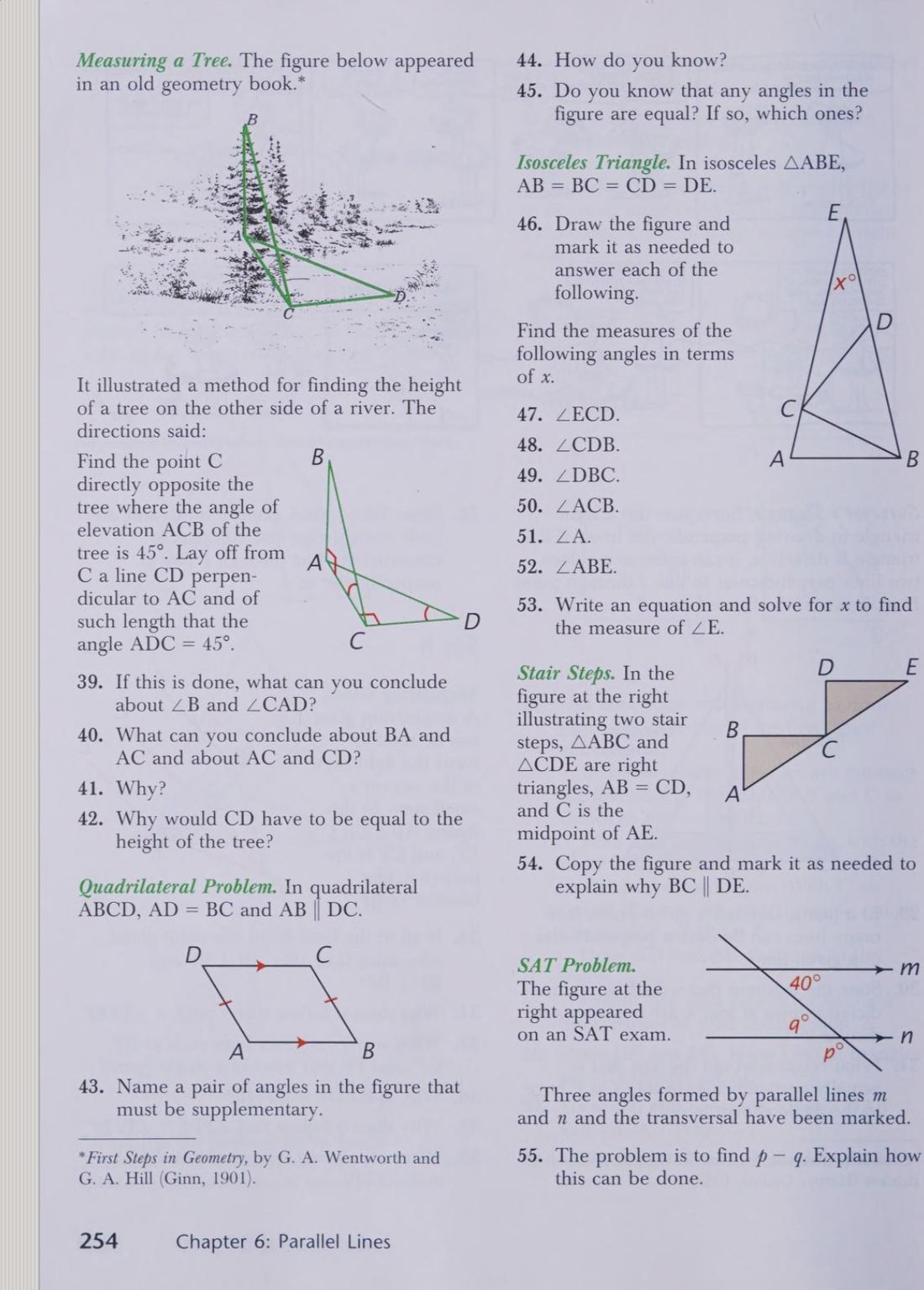
54: right triangles ABC and CDE have AB = CD and C the midpoint of AE; why is BC ∥ DE? 55: parallels m and n cut by a transversal show angles 40°, q, and p; find p − q.
- Question 54: C the midpoint gives AC = CE; with AB = CD and the right angles at A and C, SAS delivers △ABC ≅ △CDE.
- Corresponding parts: ∠BCA = ∠DEC. Those two sit as corresponding angles on transversal AE, so BC ∥ DE by Theorem 17. Two congruent steps force parallel banisters, which is why identical stair treads climb in a straight line.
- Question 55: label the little triangle the transversal makes between the parallels: the 40° at m re-appears down at n as its alternate interior partner inside the triangle.
- Then p, an exterior angle of that triangle, equals the sum of its remotes: p = q + 40. So p − q = 40, no individual values needed.
- Both problems finish in two theorems or fewer from a marked figure. That is what the chapter's machinery is for: not longer proofs, but shorter ones.
Question 19: a division that vanishes
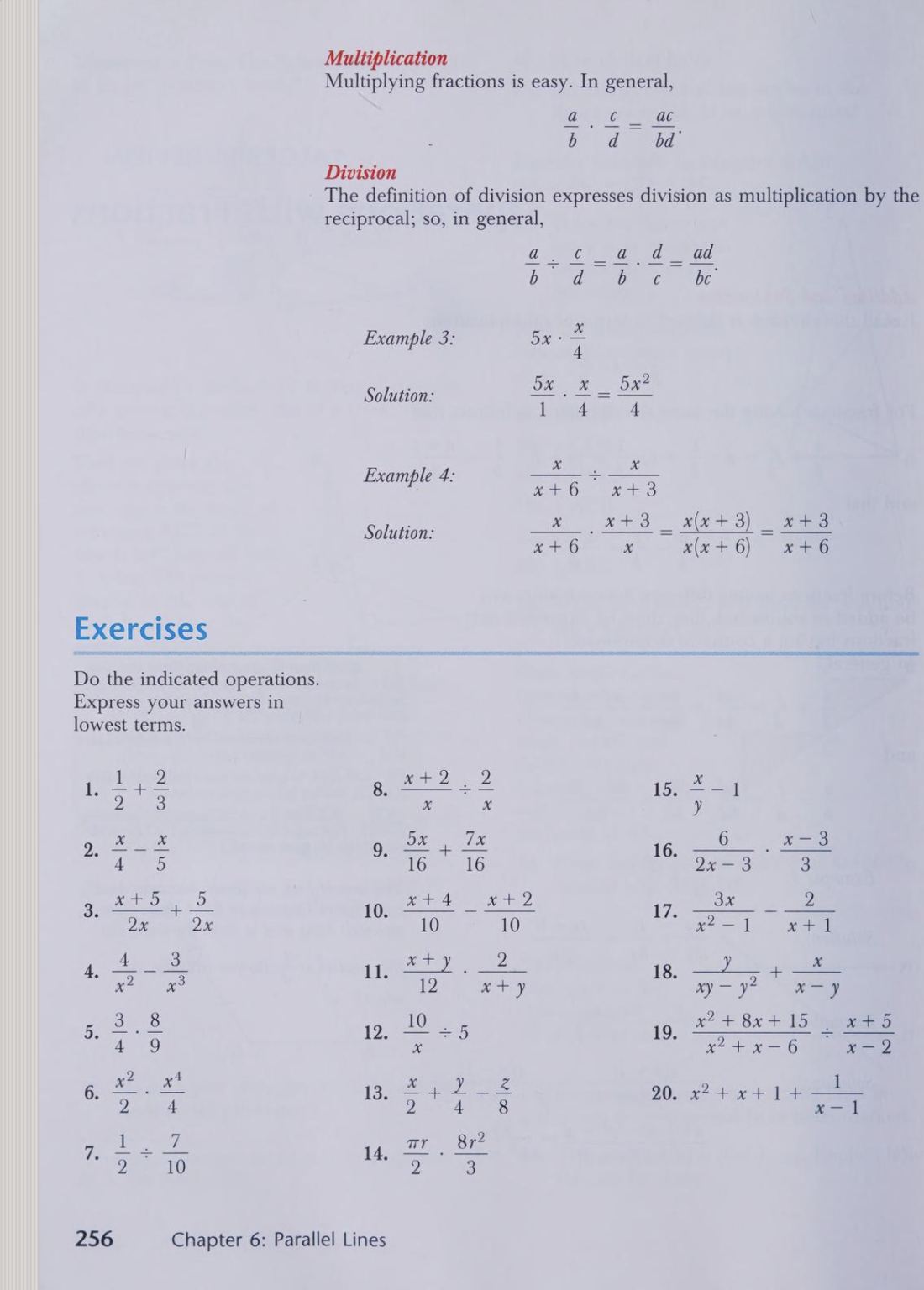
Simplify (x² + 8x + 15)/(x² + x − 6) ÷ (x + 5)/(x − 2).
- Factor first, always: x² + 8x + 15 = (x + 3)(x + 5), and x² + x − 6 = (x + 3)(x − 2).
- Division is multiplication by the reciprocal: multiply by (x − 2)/(x + 5).
- Line up the product: (x + 3)(x + 5)(x − 2) over (x + 3)(x − 2)(x + 5). Every factor upstairs has a twin downstairs.
- Cancel the pairs: the whole expression collapses to 1.
- Check at x = 1 (the page 130 habit): the first fraction is 24/−4 = −6, the divisor is 6/−1 = −6, and −6 ÷ −6 = 1. A page of machinery, a one-digit answer, and chapter 6 signs off the way it worked: everything justified, nothing wasted.