Questions 1 to 6: the kite figure
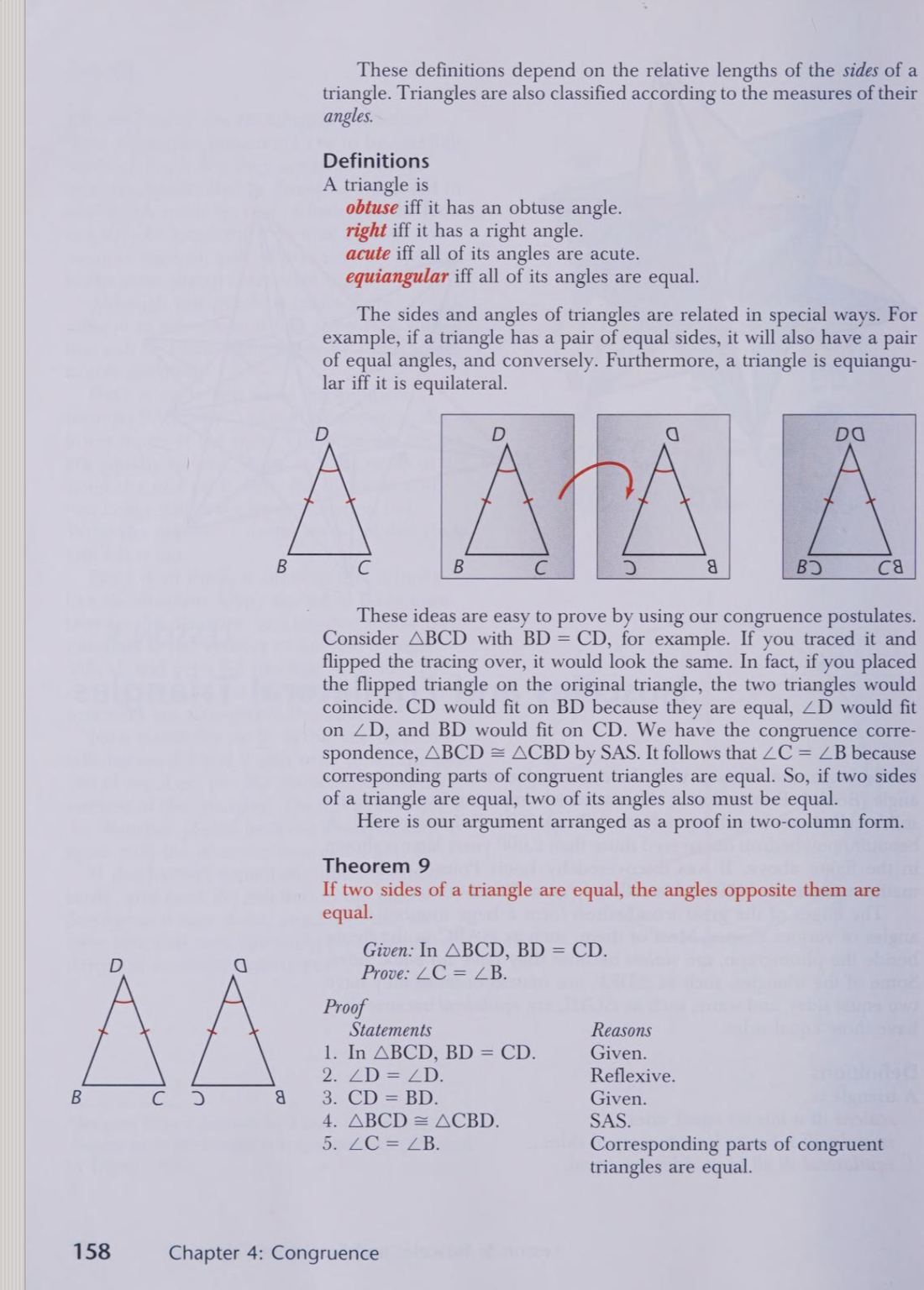
AB = AD, and ∠C = ∠BDC. Mark the figure, then hunt equal parts in △ABD and △BCD. Are the two triangles congruent?
- Question 1: tick AB and AD, arc ∠C and ∠BDC. Marked figures think for you; unmarked ones lie by omission.
- Questions 2 and 3: in △ABD the equal sides AB and AD face ∠ADB and ∠ABD, so Theorem 9 makes ∠ABD = ∠ADB. (Which angle faces AB? The one not touching it: ∠ADB.)
- Questions 4 and 5: in △BCD the equal angles ∠C and ∠BDC face sides BD and BC, so Theorem 10 makes BD = BC. One triangle used the theorem, the other its converse; that is the pairing this lesson exists to teach.
- Question 6: no. Each triangle is isosceles for its own reason, but nothing matches parts of one to parts of the other: no shared side lengths, no matching angles given. Two isosceles triangles need not be congruent any more than two rich men need be brothers.
Questions 29 to 32: the shuffleboard angles
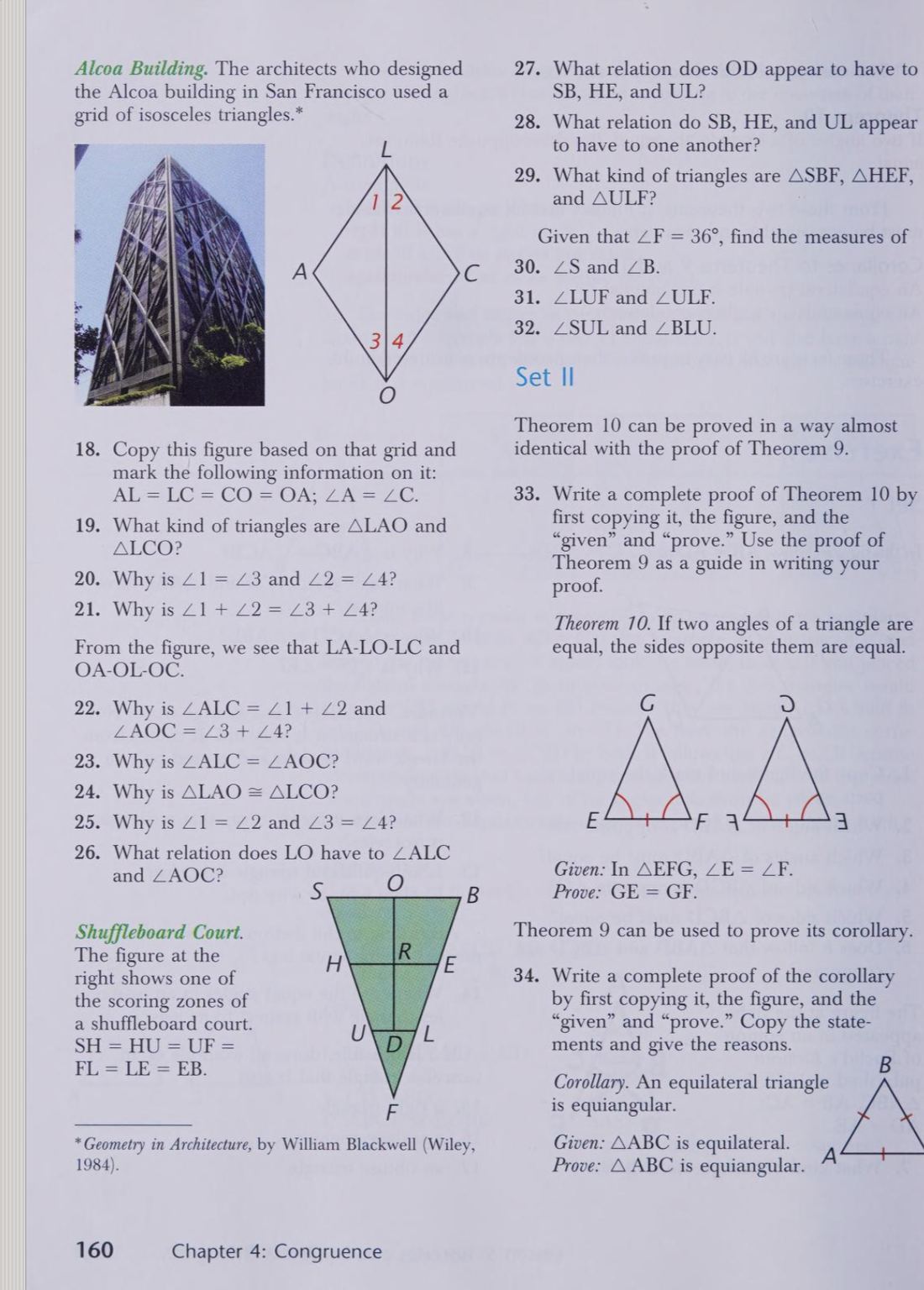
SH = HU = UF = FL = LE = EB and ∠F = 36°. What kinds of triangles are △SBF, △HEF, △ULF, and find ∠S, ∠B, ∠LUF, ∠ULF, ∠SUL, ∠BLU.
- Question 29: each triangle has two equal sides built from the equal segments, so all three are isosceles, nested inside the same 36° point at F.
- Question 30: in △SBF the base angles at S and B face the equal sides, and the three angles total 180 (page 66's theorem, still on loan): ∠S = ∠B = (180 − 36)/2 = 72°.
- Question 31: △ULF is isosceles with the same 36° apex, so ∠LUF = ∠ULF = 72° too. Same shape, smaller size; the word for that arrives in a later chapter (similarity).
- Question 32: ∠SUL sits beside ∠LUF on the straight line SF, a linear pair: 180 − 72 = 108°; likewise ∠BLU = 108°.
- Check the arithmetic the cheap way: 72 + 72 + 108 + 108 = 360, the four angles of quadrilateral SULB, which is what any quadrilateral's angles must total (two triangles' worth). The court is self-auditing.
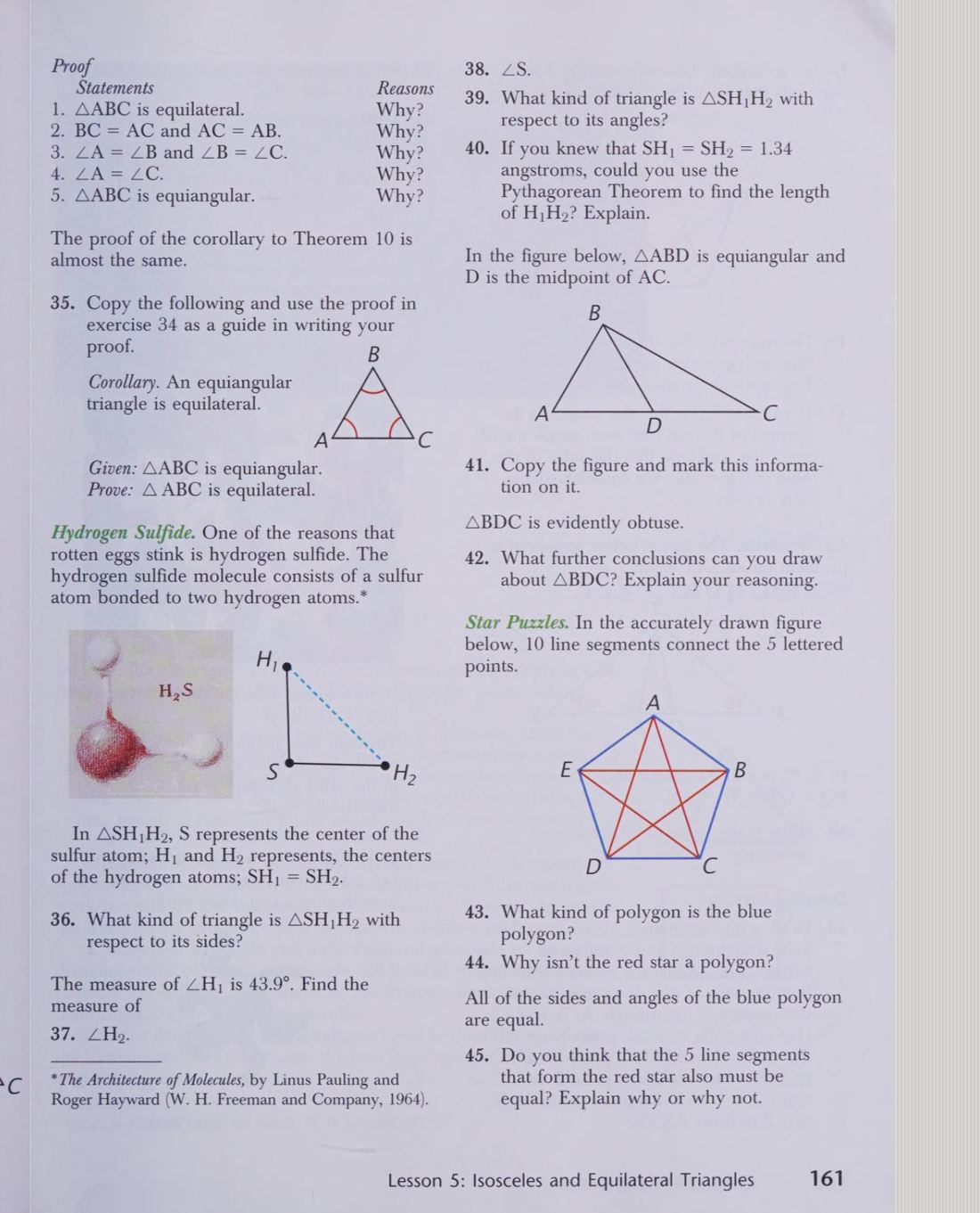
Questions 41 and 42: the leaning equilateral
△ABD is equiangular and D is the midpoint of AC. △BDC is evidently obtuse. What more can be said about it?
- Mark the figure: three arcs in △ABD, tick AD = DC.
- Equiangular forces equilateral (the corollary you just proved), so AB = BD = AD.
- Chain through the midpoint: BD = AD and AD = DC give BD = DC by substitution. So △BDC is isosceles.
- Theorem 9 then makes its base angles equal: ∠DBC = ∠DCB. And the angles have sizes if you want them: ∠BDA = 60 (equiangular), so ∠BDC = 120 (linear pair), leaving 30 each for the base angles.
- So the "evident" obtuse triangle is precisely a 120-30-30 isosceles triangle, every claim resting on a named theorem. From one equiangular triangle and a midpoint, the whole figure surrendered; that economy is what the two new theorems buy.
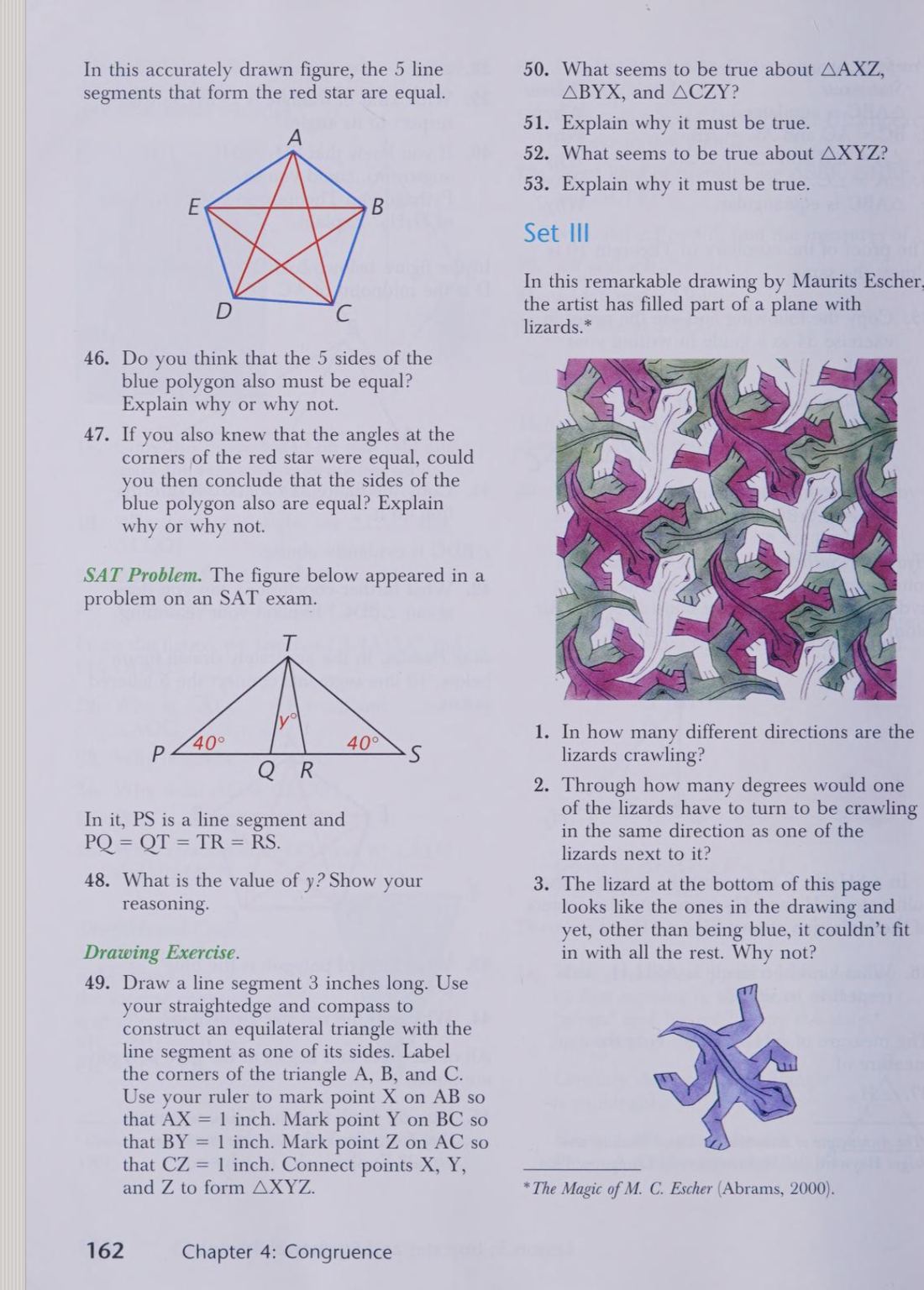
Question 48: the SAT chain of isosceles triangles
PS is a line segment, PQ = QT = TR = RS, ∠P = ∠S = 40°. Find y, the apex angle ∠QTR.
- Left triangle first: PQ = QT makes △PQT isosceles, and the equal sides face equal angles: ∠QTP = ∠P = 40°.
- So ∠PQT = 180 − 40 − 40 = 100°, and its linear-pair neighbor ∠TQR = 80°.
- Mirror the work on the right: △RST gives ∠RTS = 40°, ∠TRS = 100°, ∠TRQ = 80°.
- Middle triangle: ∠TQR + ∠TRQ + y = 180, so y = 180 − 80 − 80 = 20.
- Cross-check along the top: the three angles at T (40 + y + 40) must make ∠PTS, and in △PTS the base angles are 40 and 40, so ∠PTS = 100 = 40 + 20 + 40. It closes. Isosceles plus linear pair plus angle sum, three theorems round-robin: that is the entire SAT geometry playbook in one figure.
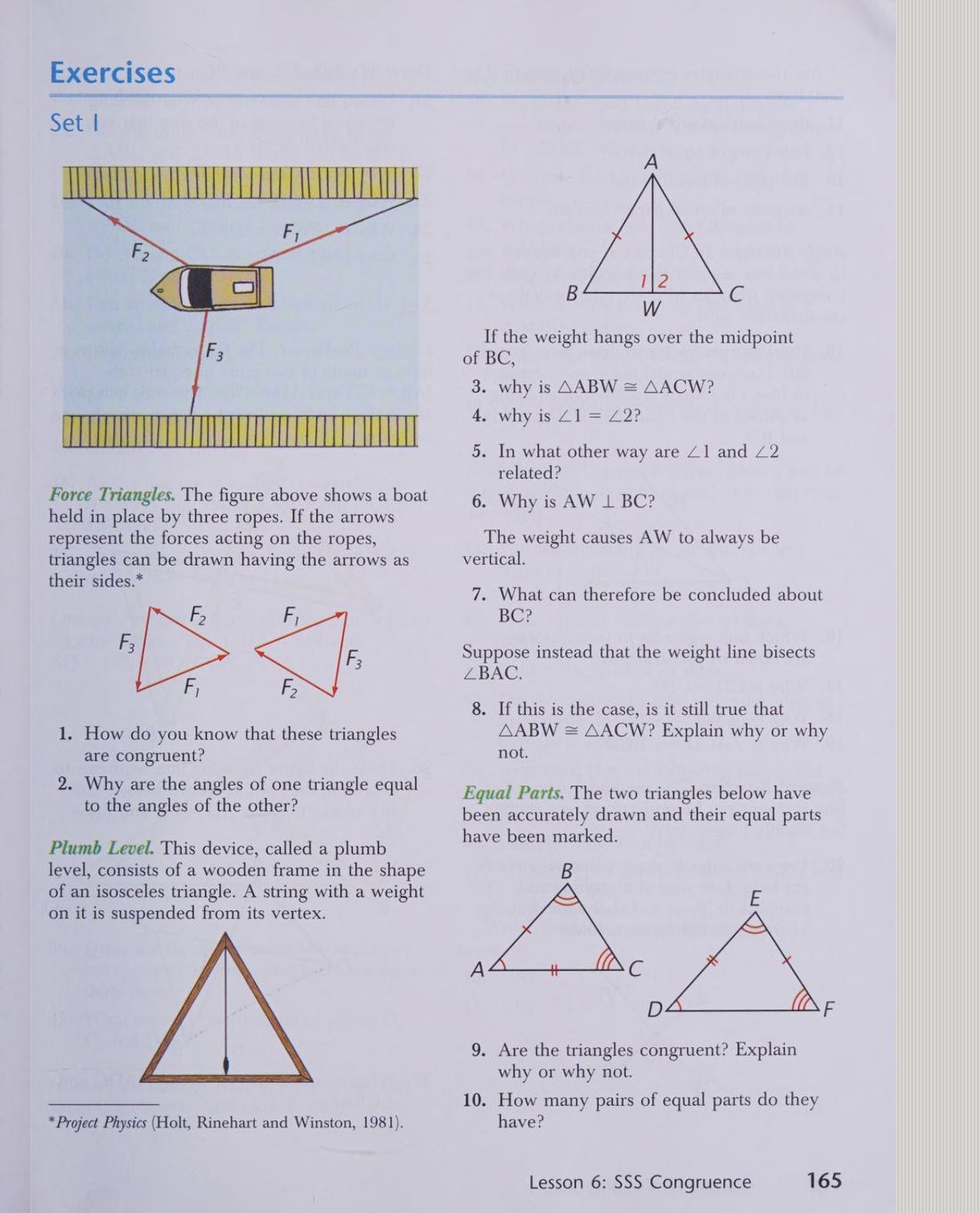
Questions 9 to 14: five equal parts, no congruence
The two accurately drawn triangles have their equal parts marked. Are they congruent? How many pairs of equal parts do they have? Then: do 3, 4, 5, or 6 pairs of equal parts force congruence?
- Question 9: no. Look with page 140 eyes: no tracing of one fits the other; the second triangle is visibly larger. Yet the marks are honest.
- Question 10: count the marks: three pairs of equal angles and two pairs of equal sides: five pairs of equal parts, without congruence.
- How can that be? The equal sides are not in corresponding positions: each equal side sits opposite a different angle in the two triangles. (Triangles like 8, 12, 18 and 12, 18, 27 pull this off: same shape, sides shifted one slot.)
- Questions 11 to 13: three pairs can fail (three angles: same shape, any size), four can fail, and five can fail, as the figure in front of you proves.
- Question 14: six pairs is the definition of congruence itself, so yes, six cannot fail. The moral, in one sentence: congruence postulates are not about how many parts match but about which, and included-ness is the whole game. ASA, SAS, SSS are the arrangements that work; this figure is the tombstone of the ones that don't.
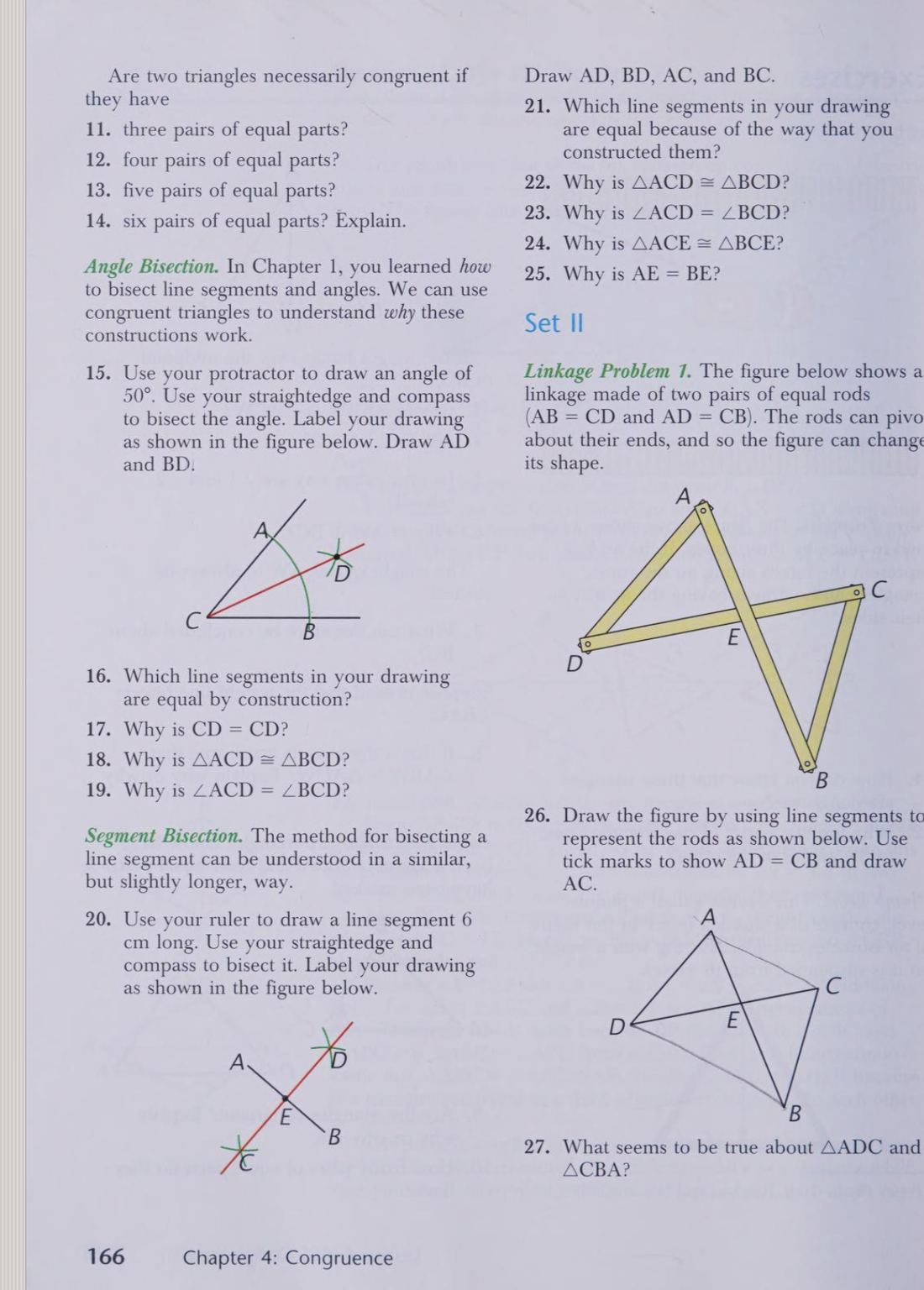
Questions 15 to 19: why angle bisection works
Bisect a 50° angle with compass and straightedge, labeling the arc crossings A and B and the far crossing D. Draw AD and BD. Prove the construction honest.
- Question 16: the construction made CA = CB (one arc from C) and AD = BD (equal arcs from A and B). Equal radii are equal segments; that is all a compass ever says.
- Question 17: CD = CD, reflexive; the ray under test belongs to both triangles.
- Question 18: three pairs of sides equal (CA = CB, AD = BD, CD = CD): △ACD ≅ △BCD by SSS.
- Question 19: corresponding parts make ∠ACD = ∠BCD, and equal halves is what "bisects" means (page 99). The construction is proved, not just trusted.
- Now run questions 20 to 25 the same way for the segment: SSS gives equal angles at C, then SAS gives △ACE ≅ △BCE, then AE = BE. Chapter 1's magic tricks are now theorems, which is the whole story of this course so far told in one construction.
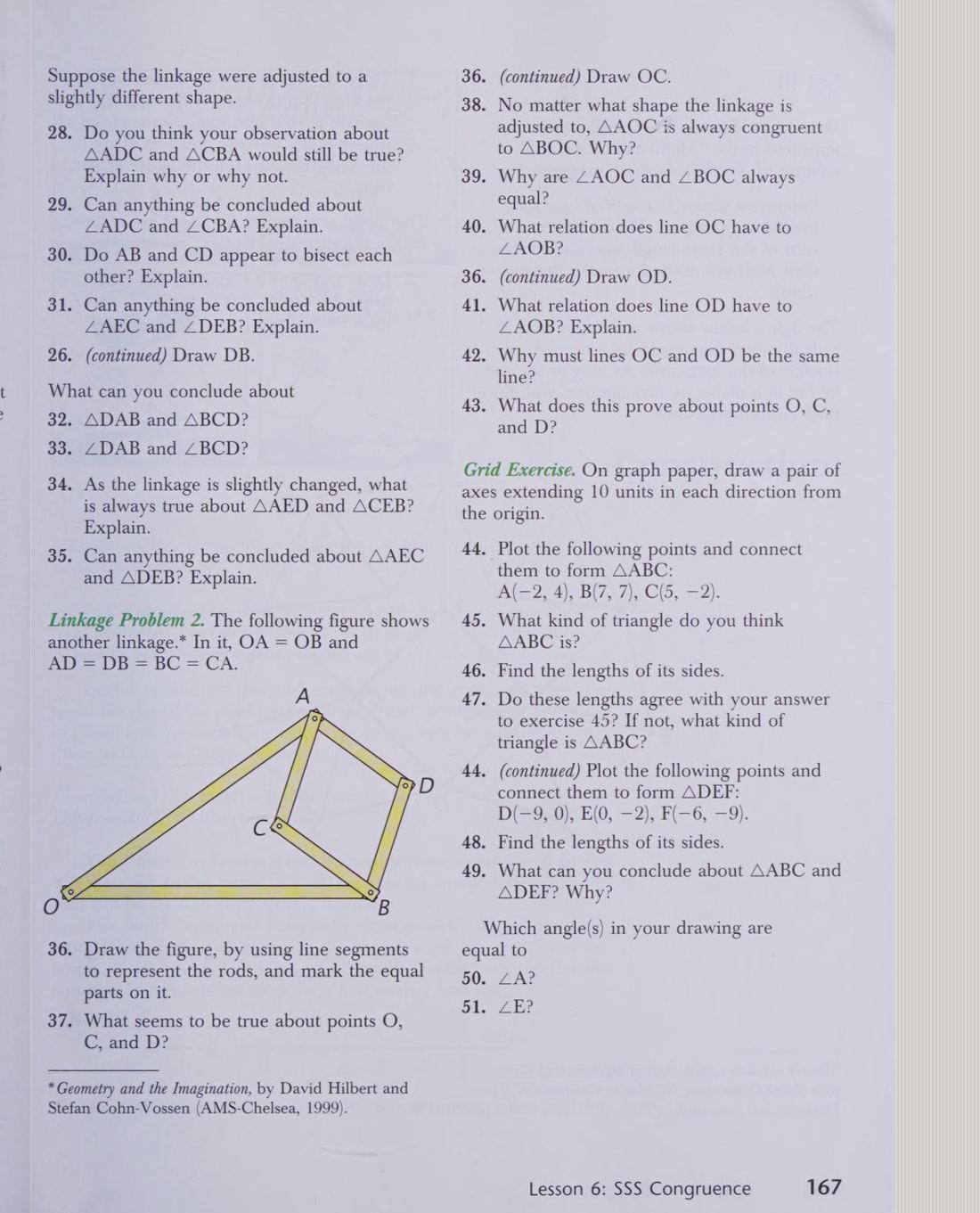
Questions 36 to 43: the bisecting linkage
OA = OB and AD = DB = BC = CA. Whatever shape the linkage takes, prove O, C, D are collinear.
- Question 38: OA = OB (given), CA = CB (given), OC = OC: △AOC ≅ △BOC by SSS, at every setting of the hinges. Question 39: so ∠AOC = ∠BOC always.
- Question 40: equal halves means line OC bisects ∠AOB, by definition of bisecting.
- Question 41: repeat with D: OA = OB, DA = DB, OD = OD: SSS again, so OD also bisects ∠AOB.
- Question 42: the Corollary to the Protractor Postulate (page 100) allows an angle exactly one bisecting ray, so OC and OD are the same line.
- Question 43: one line through O, C, and D: collinear, at every opening. Squeeze the linkage and the three points glide but never leave their common line; a uniqueness corollary from chapter 3 just became a drawing instrument. Hilbert put this linkage in his book on geometric imagination, and now you know why.
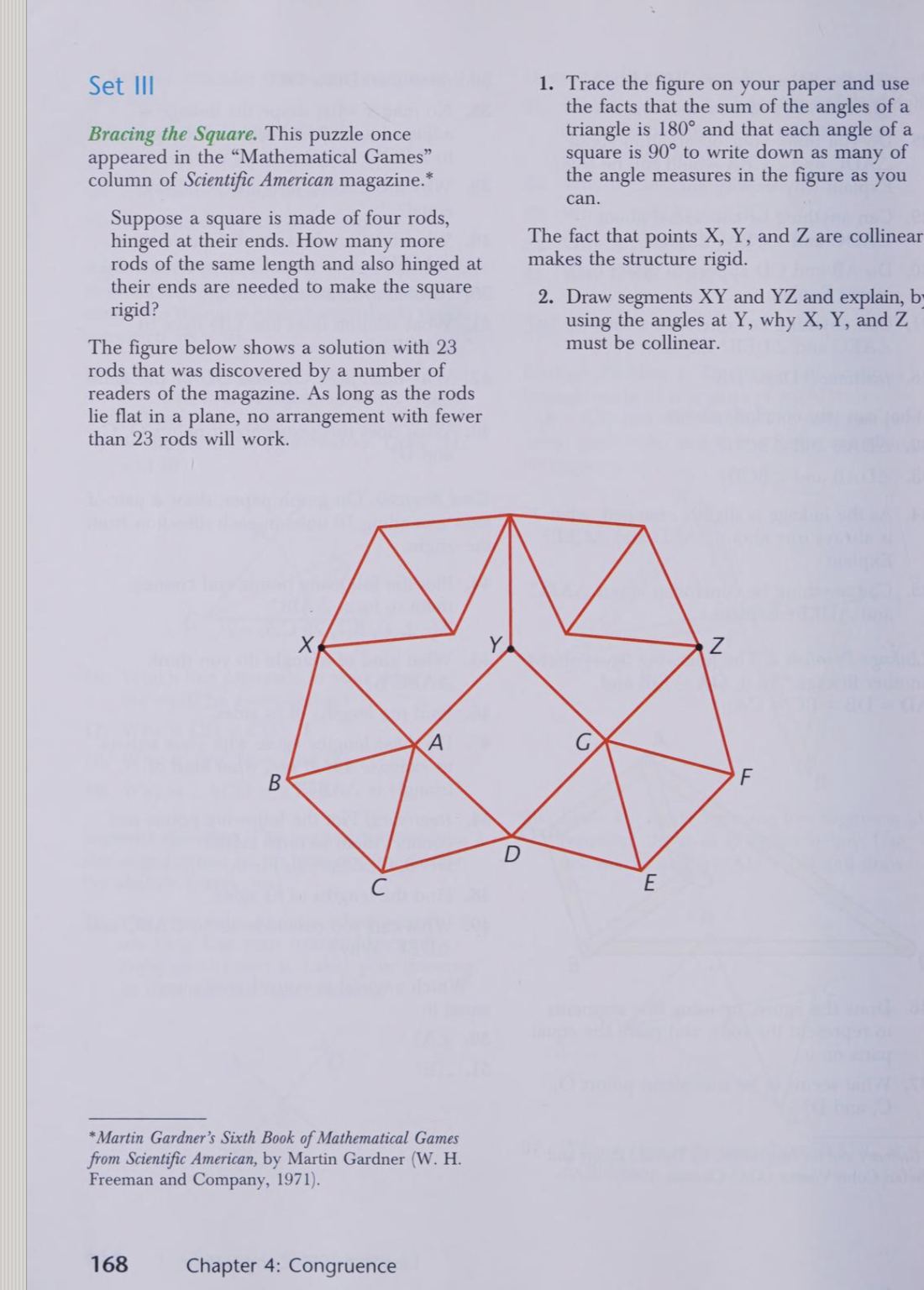
Set III: why the bracing is rigid
Every rod equals the square's side, so every triangle in the figure is equilateral. Fill in the angles, then show X, Y, Z must be collinear using the angles at Y.
- Question 1: every triangle of equal rods is equilateral, so every triangle angle in the figure is 60° (equilateral is equiangular, your page 161 corollary), and the square contributes 90s.
- At any joint, the angles of the triangles meeting there add up; write 60s and 90s around each lettered joint until the figure is inked. This is pure bookkeeping and worth actually doing.
- Question 2: at Y, three angles from the three triangles meeting on the lower side of XZ: 60 + 60 + 60 = 180°.
- Angles filling exactly a straight angle force XY and YZ into one line (the straight-angle definition from page 92 running in reverse). So X, Y, Z are collinear not by looks but by arithmetic.
- And rigidity follows: X and Z are pinned to the braced corners through chains of SSS-rigid triangles, the collinear strut XYZ cannot hinge, and the square's corners lose their last degree of freedom. Twenty-three rods, all doing geometry; the bridge on page 163 was never in danger.