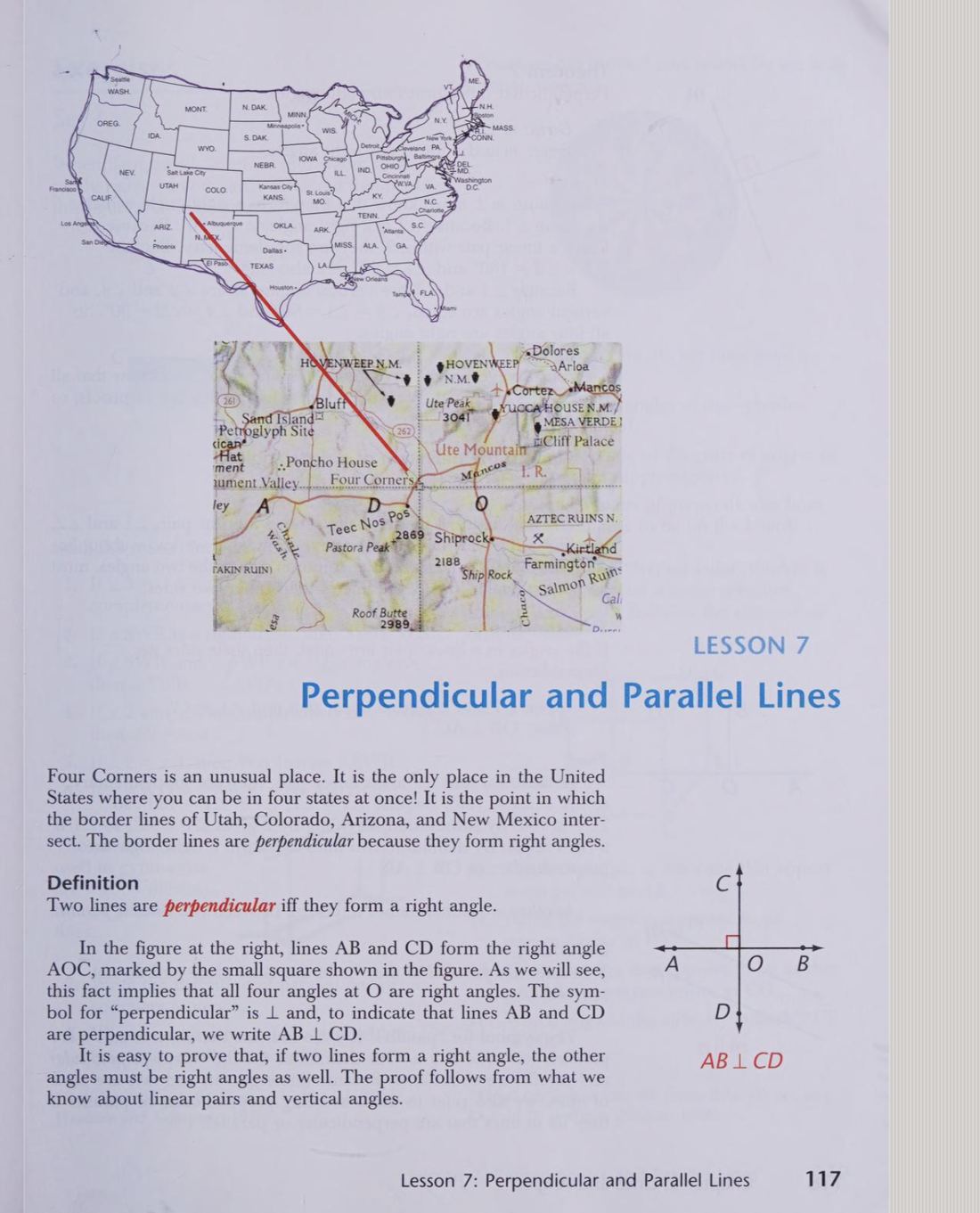
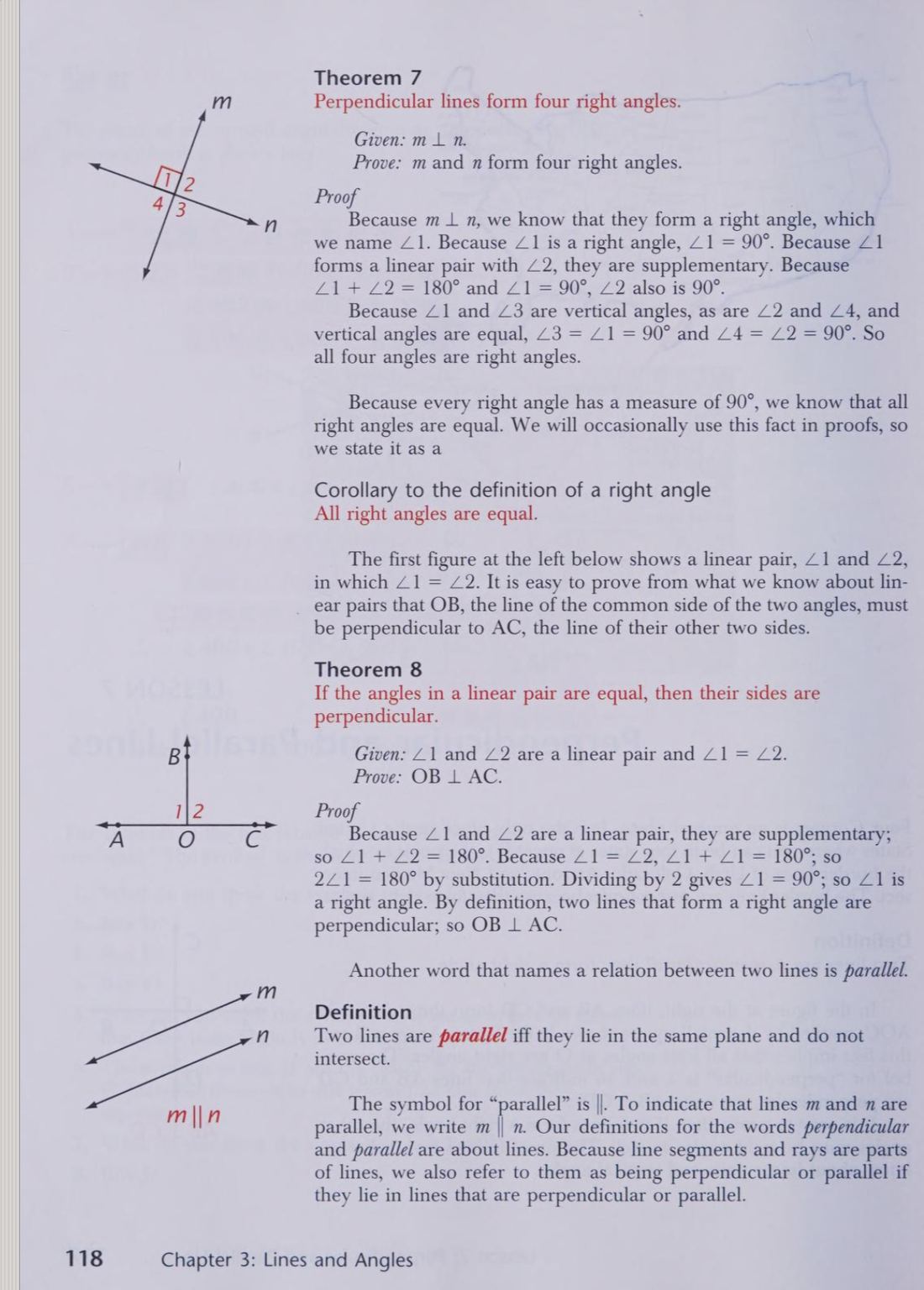
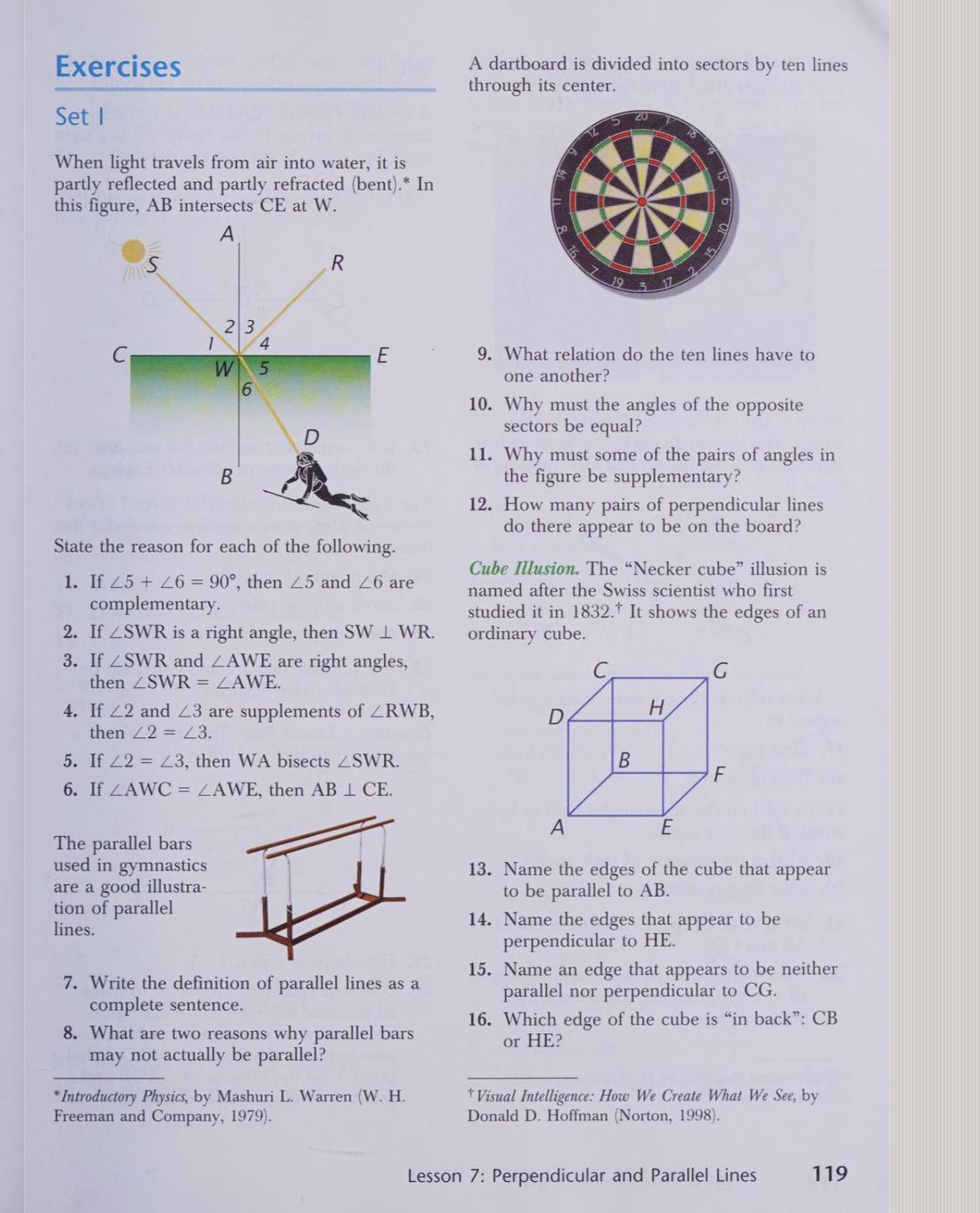
Questions 1 to 6: name every reason
Light meets water at W. Justify each given statement about the numbered angles.
- Question 1: ∠5 + ∠6 = 90° makes them complementary. Reason: the definition of complementary angles, nothing more; when a sum is 90, the word applies.
- Question 2: ∠SWR a right angle makes SW ⊥ WR. Reason: the definition of perpendicular (two lines forming a right angle).
- Question 3: two right angles are equal. Reason: the corollary to the definition of a right angle, all right angles are equal.
- Question 4: two angles supplementary to the same angle (∠RWB) are equal. Reason: Theorem 4. Question 5: a line splitting ∠SWR into equal parts bisects it, the definition of bisecting an angle.
- Question 6: ∠AWC = ∠AWE is an equal linear pair, so AB ⊥ CE. Reason: Theorem 8. Six statements, six different citations, and not one measurement; that inventory is what the review pages will assume you own.
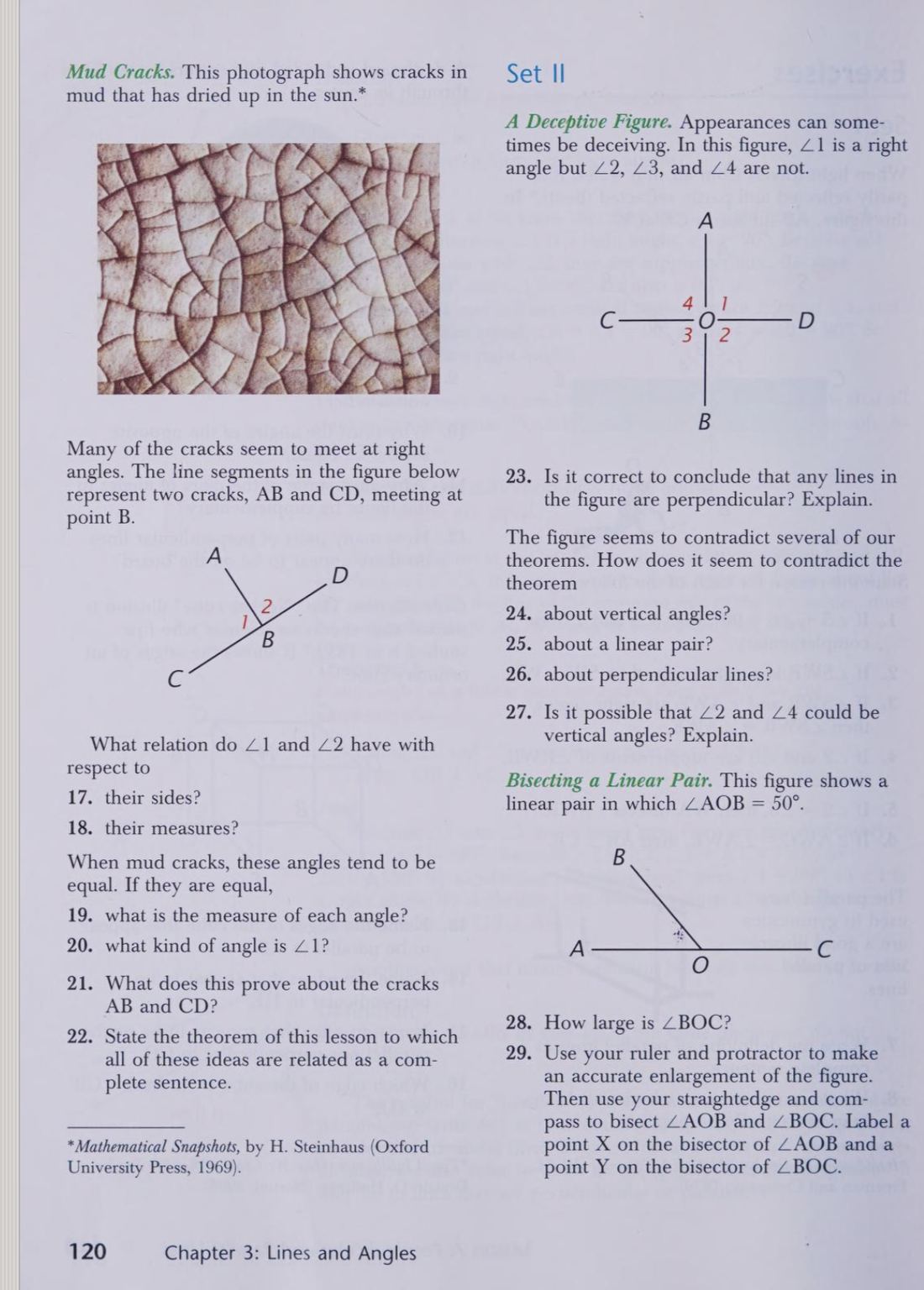
Questions 17 to 22: why mud cracks meet square
Cracks AB and CD meet at B, making ∠1 and ∠2. What are the two angles with respect to sides and measures, and what does their tendency to be equal prove about the cracks?
- Questions 17 and 18: the two angles share the side along crack BD, and their other sides are opposite rays along AB. By sides they are a linear pair; by measures, Theorem 5 makes them supplementary.
- Question 19: mud tends to crack so the pair is equal. Equal and summing to 180 forces each to 90°.
- Question 20: a 90° angle is a right angle, by definition.
- Question 21: one right angle between the cracks makes AB ⊥ CD, the definition of perpendicular.
- Question 22: the theorem holding the whole chain is Theorem 8, if the angles in a linear pair are equal then their sides are perpendicular. Drying mud minimizes stress, stress balances when the pair equalizes, and Theorem 8 converts that physics into the right angles the photograph shows. Soap films argued the same way on page 95.
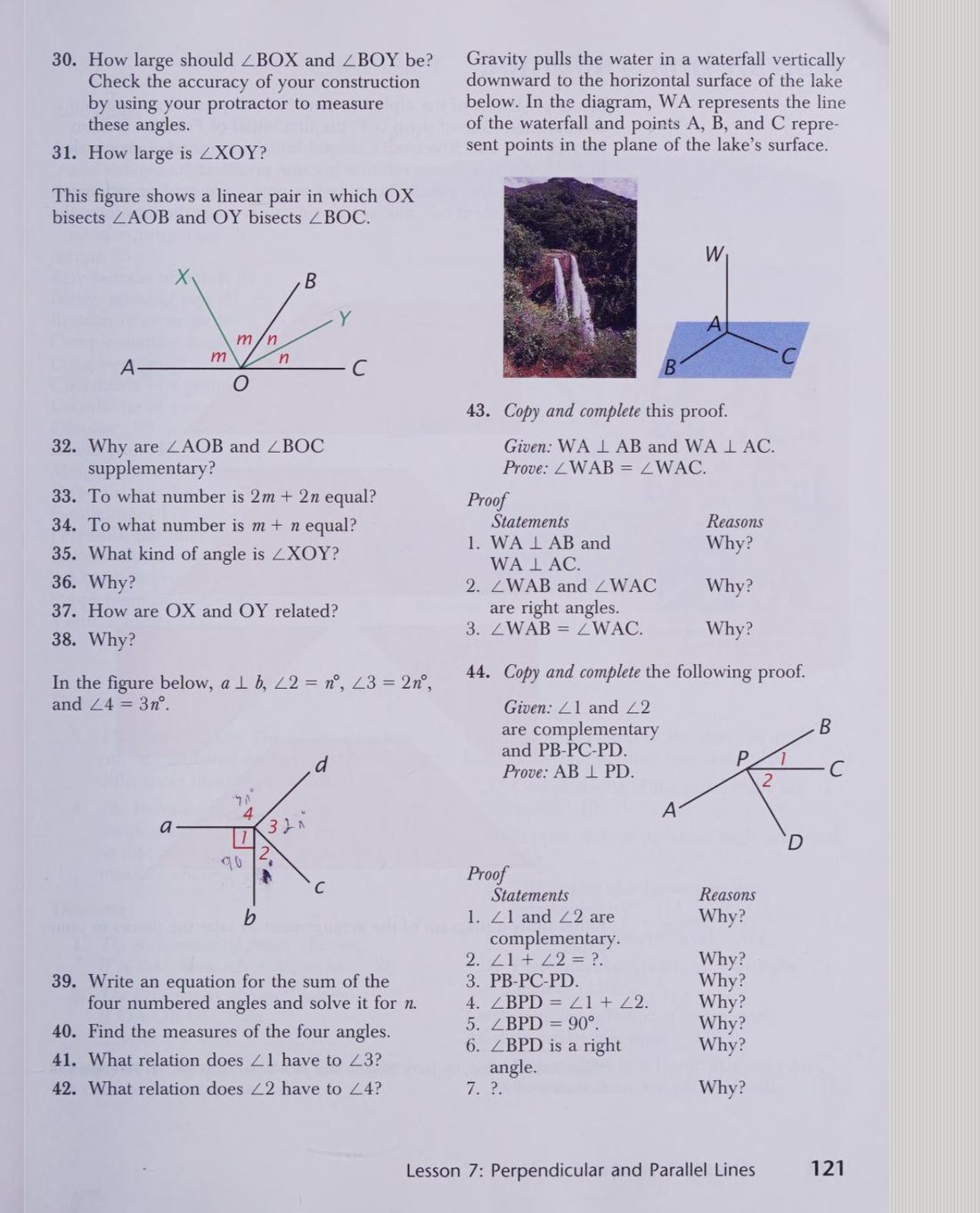
Questions 32 to 38: bisectors of a linear pair
OX bisects ∠AOB and OY bisects ∠BOC, where ∠AOB and ∠BOC are a linear pair; the half-angles are marked m, m, n, n. Show ∠XOY is a right angle.
- Question 32: ∠AOB and ∠BOC are a linear pair, so they are supplementary by Theorem 5.
- Question 33: the whole straight angle is 2m + 2n, and supplementary means 2m + 2n = 180°.
- Question 34: divide both sides by 2: m + n = 90°.
- Questions 35 and 36: ∠XOY is exactly one m plus one n, so ∠XOY = 90°, a right angle. Questions 37 and 38: one right angle between them makes OX ⊥ OY, by the definition of perpendicular.
- Say the result in words and enjoy it: however lopsided the linear pair (10 and 170, 89 and 91), its two bisectors meet at exactly 90°. Check it on your page 120 construction with a protractor, then notice the proof needed no protractor at all.
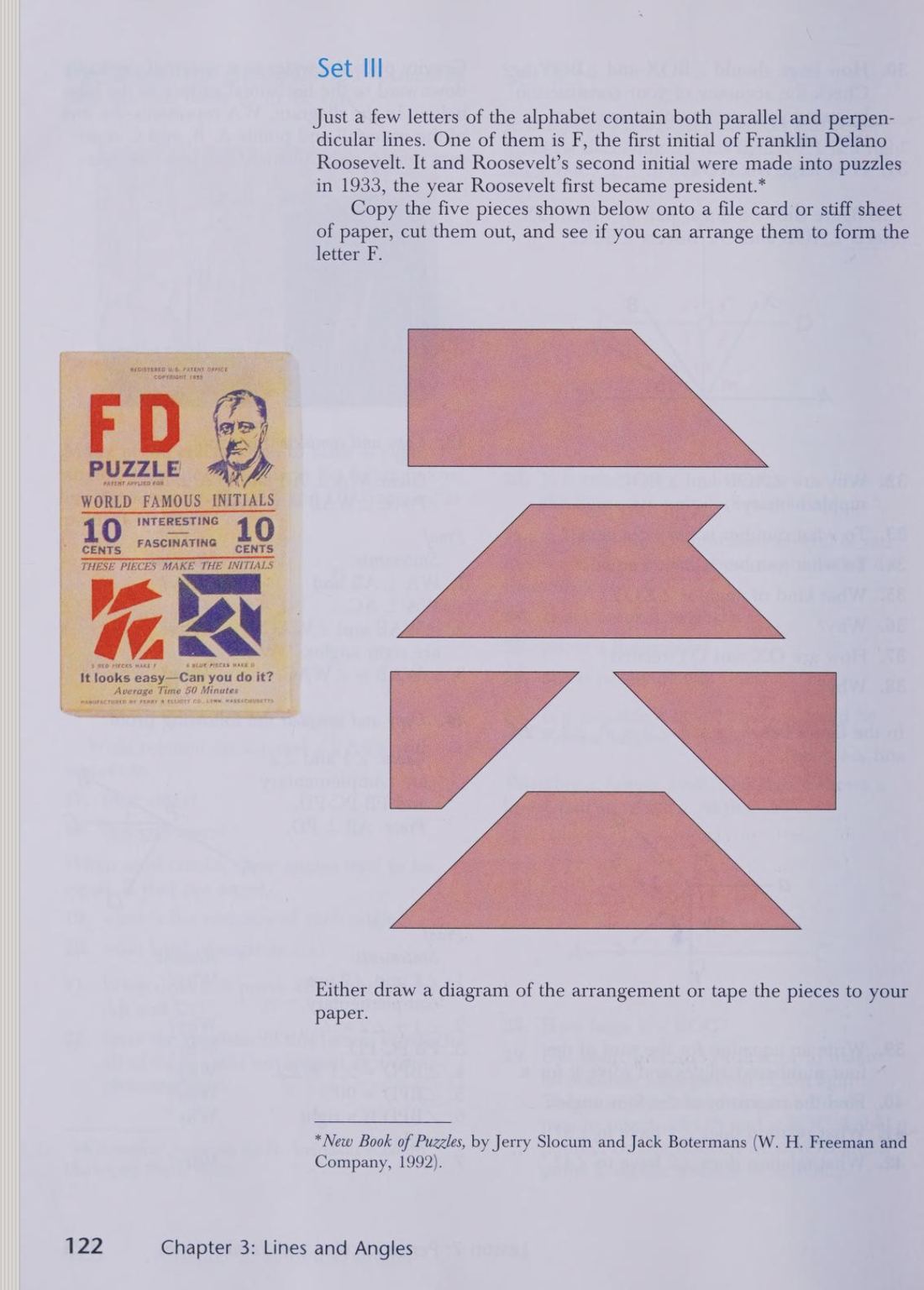
Set III: how to attack the FD puzzle
Arrange the five pieces to form the letter F. A strategy walk, without the final arrangement.
- Inventory the target first: a block letter F is all right angles, roughly ten of them, with every edge parallel or perpendicular to every other. That is the lesson's vocabulary as a shopping list.
- Inventory the pieces: count each piece's square corners and its slanted edges. Slanted edges cannot lie on the F's boundary, so every slanted edge must be buried against another piece's matching slant.
- Pair the slants by length, exactly as Dudeney's pieces paired on page 23. The long slant needs a long partner; that constraint alone fixes most of the layout.
- Place the largest piece to carry the F's tall stem, then let the paired slants dictate the two arms. Expect several dead ends; the 1933 box bragged about the fifty minutes.
- When it closes, check your solution like a proof: every boundary edge parallel or perpendicular to the stem, no slant showing. Then question the vocabulary: how many pairs of parallel edges does your finished F contain?
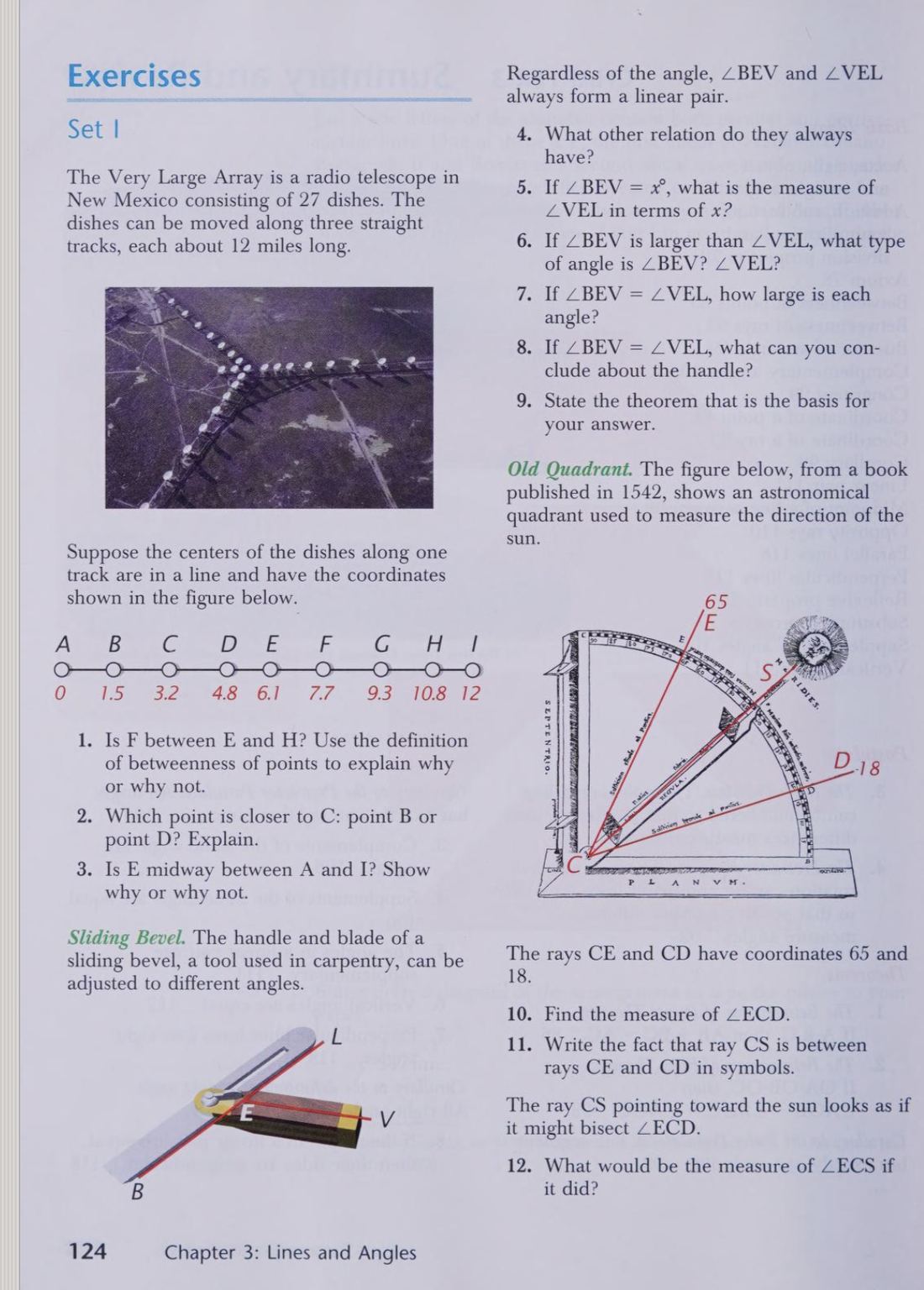
Questions 10 to 14: the old quadrant
Rays CE and CD have coordinates 65 and 18 on the quadrant's scale. Find ∠ECD; write "CS is between CE and CD" in symbols; if CS bisects ∠ECD, find ∠ECS, the coordinate of CS, and check with ∠SCD.
- Question 10: positive difference of coordinates: ∠ECD = 65 − 18 = 47°.
- Question 11: CE-CS-CD, the betweenness-of-rays notation from page 93.
- Question 12: a bisector halves the angle: ∠ECS = 47/2 = 23.5°.
- Question 13: step down from CE's coordinate: 65 − 23.5 = 41.5.
- Question 14: check the other half: ∠SCD = 41.5 − 18 = 23.5°, equal halves as a bisector demands. Instrument, postulate, corollary, all in one woodcut; the mathematics aged better than the astronomy.
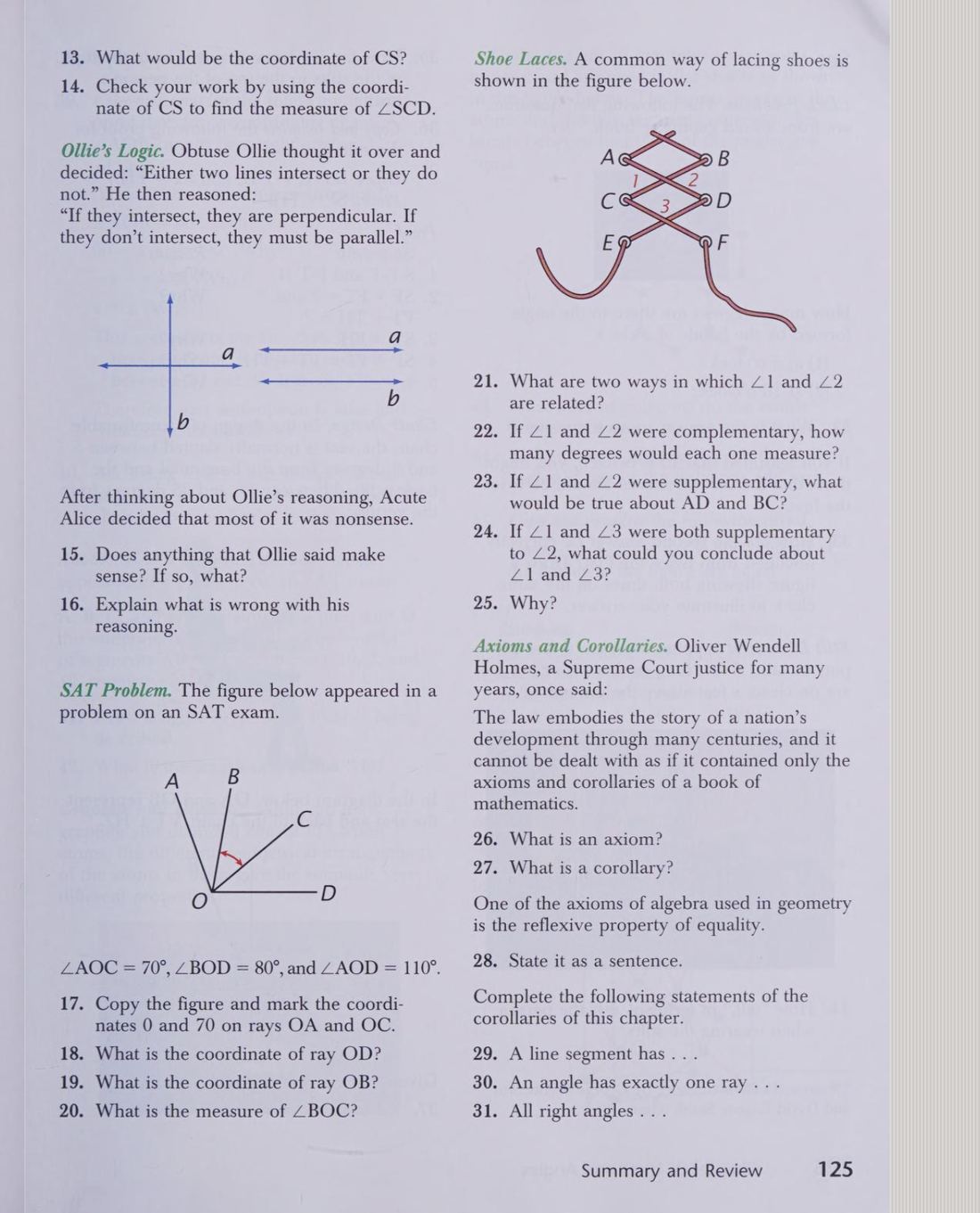
Questions 17 to 20: the SAT ray figure
∠AOC = 70°, ∠BOD = 80°, ∠AOD = 110°. Put coordinates on the rays and find ∠BOC.
- Question 17: install the Protractor Postulate: OA gets 0, and since ∠AOC = 70, OC gets 70.
- Question 18: ∠AOD = 110 puts OD at coordinate 110.
- Question 19: OB must sit ∠BOD = 80 away from OD: 110 − 80 = 30. (The figure shows B between A and C, so 30 is the sensible root.)
- Question 20: ∠BOC = 70 − 30 = 40°.
- Check the whole line of reasoning by adding parts: ∠AOB + ∠BOC + ∠COD = 30 + 40 + 40 = 110 = ∠AOD. Coordinates turned four overlapping angles into subtraction, which is why the SAT liked this figure and why the Protractor Postulate earns its keep under time pressure.
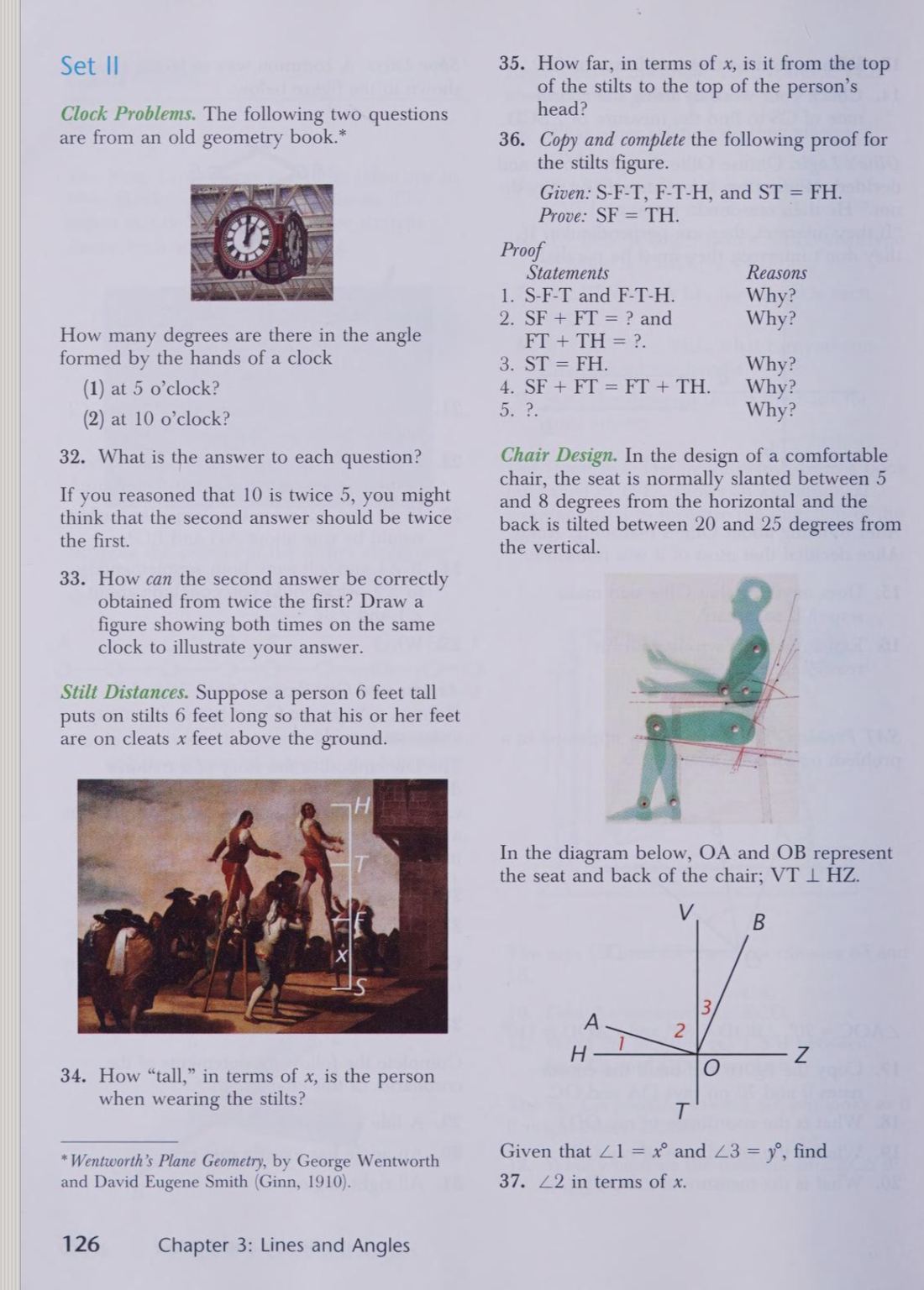
Questions 34 to 36: the stilt walker
A 6-foot person on 6-foot stilts stands on cleats x feet up: S-F-T-H marks stilt bottom, feet, stilt top, head, with ST = FH = 6. How tall is the arrangement, what is TH, and complete the proof that SF = TH.
- Question 34: the head stands the person's height above the feet: x + 6 feet up.
- Question 35: from stilt top (6) to head (x + 6) is x feet; curious and true: the head clears the stilts by exactly the cleat height.
- Question 36, the proof: S-F-T and F-T-H are given; the Betweenness of Points Theorem turns them into SF + FT = ST and FT + TH = FH.
- ST = FH is given (both are 6 feet), so substitution gives SF + FT = FT + TH.
- Subtract the shared FT: SF = TH, cleat height equals head clearance, the same subtraction that measured the extension ladder on page 89 and the acetylene bond on page 102. One argument, three costumes, full marks if you can now write it cold.
Questions 41 and 42: four points on a line
A, B, C, D are on a line; D is the midpoint of BC. AB = 10, AC = 2, BC = 12. Draw the figure and find AD.
- Do not trust the alphabet to give the order; let the numbers place the points. AB = 10 and AC = 2 with BC = 12 means B and C sit on opposite sides of A, since 10 + 2 = 12.
- Install coordinates, Ruler Postulate style: A = 0, C = −2, B = 10. Check: BC = 10 − (−2) = 12.
- D is the midpoint of BC, so its coordinate is halfway from −2 to 10: (−2 + 10)/2 = 4.
- Question 42: AD = 4 − 0 = 4.
- The trap this SAT problem sold: sketching A-B-C-D in alphabetical order makes AD unanswerable. The definition of betweenness, not the lettering, dictates the picture; that was page 85's first lesson, and it is the review's last word on coordinates.
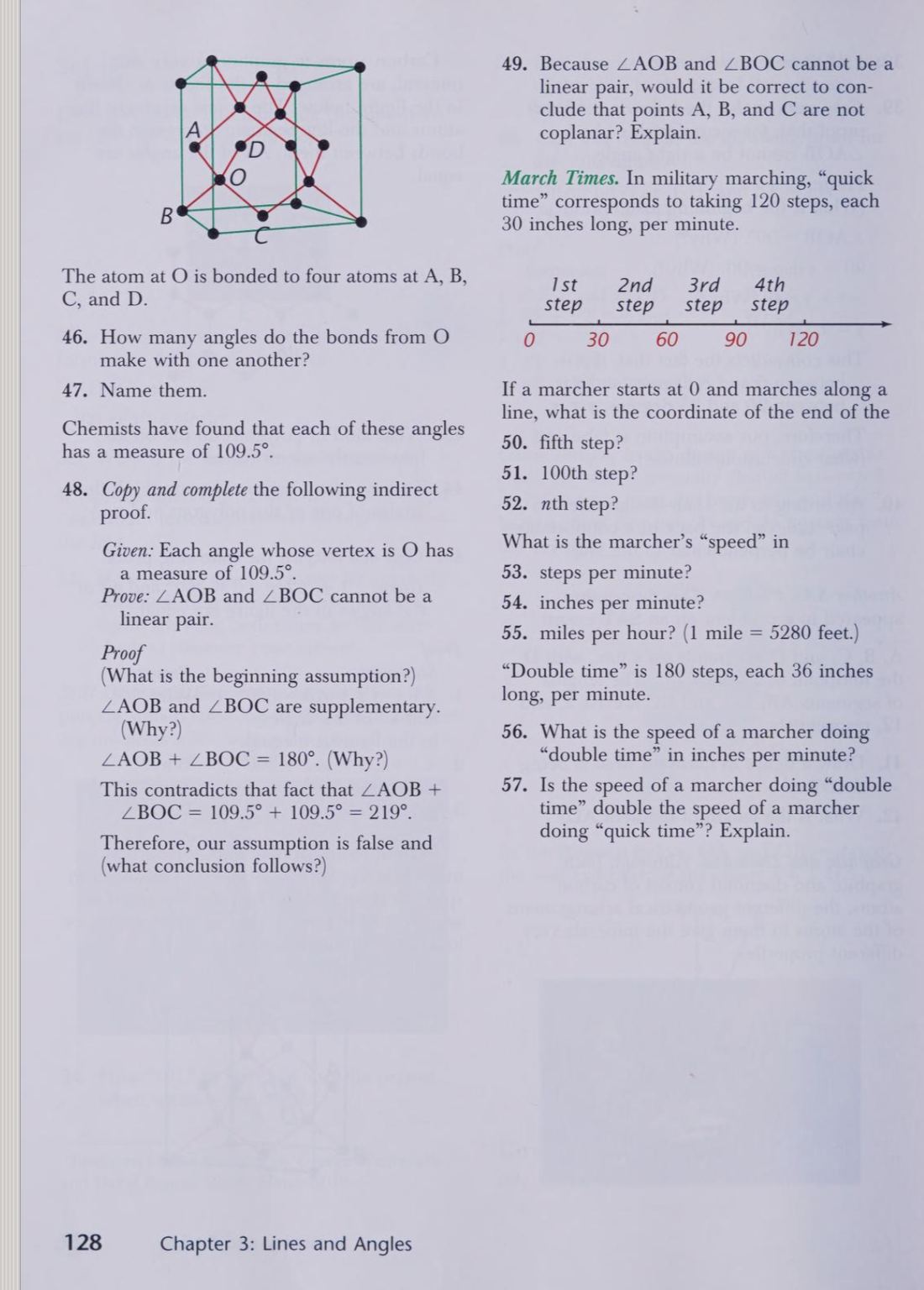
Questions 50 to 57: quick time and double time
Quick time: 120 steps per minute, each 30 inches. Find the nth step's coordinate and the marcher's speed in steps per minute, inches per minute, and miles per hour; then compare double time (180 steps of 36 inches).
- Questions 50 to 52: each step adds 30 inches, so the fifth step ends at 150, the 100th at 3,000, the nth at 30n; the seven-league boots formula from page 87, in inches.
- Questions 53 and 54: 120 steps per minute is given, and 120 × 30 = 3,600 inches per minute.
- Question 55: convert in stages: 3,600 inches is 300 feet, so 300 feet per minute; times 60 is 18,000 feet per hour; divide by 5,280 to get about 3.4 miles per hour.
- Question 56: double time gives 180 × 36 = 6,480 inches per minute.
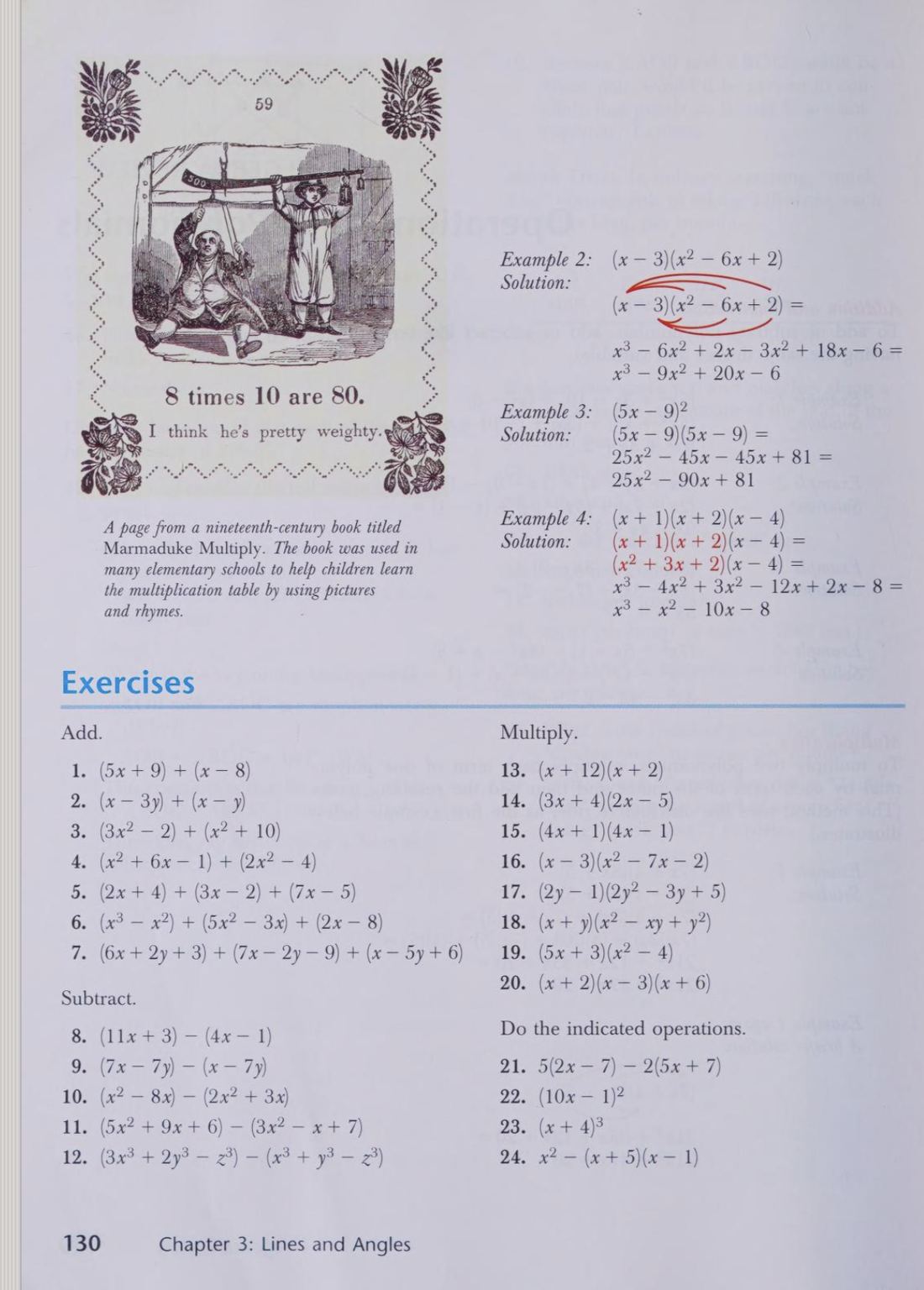
- Question 57: 6,480 ÷ 3,600 = 1.8, so "double time" is only 1.8 times quick time; the name doubles the step count while the step grows just a fifth. Marmaduke Multiply, waiting on page 130, would approve of checking the arithmetic behind a name.
Question 20: a three-factor product
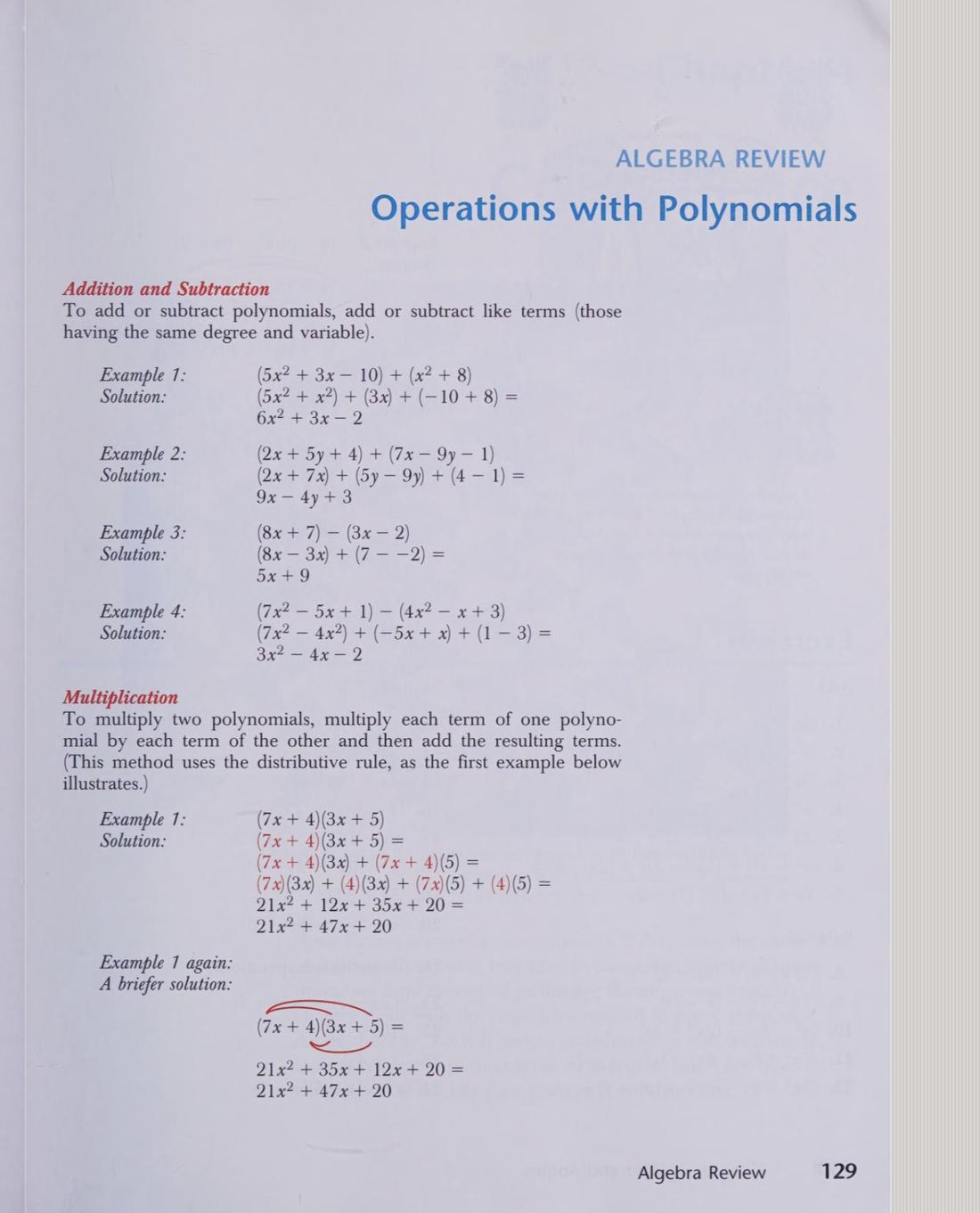
Multiply (x + 2)(x − 3)(x + 6).
- Two at a time, always. Start with the first pair: (x + 2)(x − 3) = x² − 3x + 2x − 6 = x² − x − 6.
- Now multiply the result by (x + 6), every term by every term: (x² − x − 6)(x + 6) = x³ + 6x² − x² − 6x − 6x − 36.
- Collect like terms: x³ + 5x² − 12x − 36.
- Check with a cheap substitution: at x = 1 the factors give (3)(−2)(7) = −42, and the answer gives 1 + 5 − 12 − 36 = −42. A one-number check catches most sign slips, and it is the page 81 "check by substitution" habit applied to yourself.
- The same two-stage discipline handles question 23's cube: square first, then multiply by the third factor. No shortcut survives contact with (x + 4)³ on the first try; the written middle terms do.